
Soviet War Memorial Schönholzer Heide
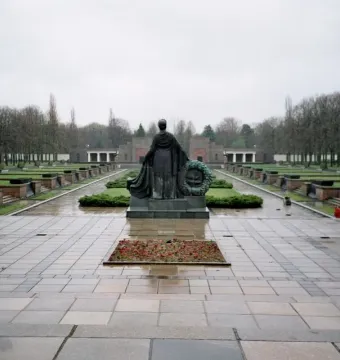
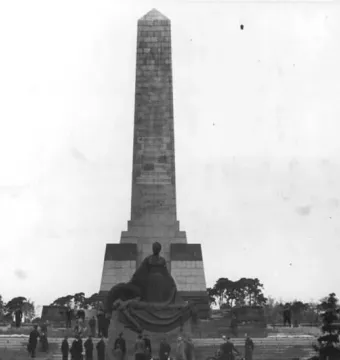
The Soviet War Memorial Schönholzer Heide in Pankow, Berlin was erected between May 1947 and November 1949. It is one of three Soviet memorials built in Berlin after the war and contains the largest Soviet cemetery in the city, as well as the largest Russian cemetery in Europe outside Russia. Designed by Soviet architects K. Solovyov, M. Belaventsev, and V. Korolyov with sculptor Ivan Pershudchev, the memorial includes an obelisk of syenite, a statue of Mother Russia on a black porphyry base, eight burial chambers, and 100 bronze tablets with the names of identified soldiers.
April 1997 © Stiangutten · CC BY-SA 3.0
© Köhler, Gustav · CC BY-SA 3.0 de
August 2010 © OTFW · CC BY-SA 3.0
April 1997 © Stiangutten · CC BY-SA 3.0
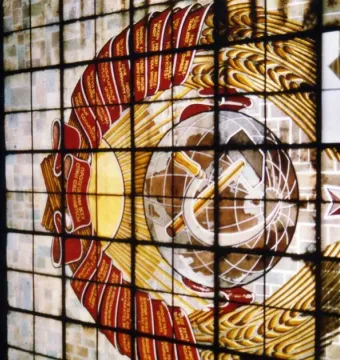
March 2009 © Sludge G · CC BY-SA 2.0
Identification | |
| Title | Soviet War Memorial Schönholzer Heide |
| Original name | Sowjetisches Ehrenmal in der Schönholzer Heide |
| Alternative names | Das Sowjetische Ehrenmal in der Schönholzer Heide; Soviet War Memorial in Pankow; Cemetery-memorial to the soldiers of the Soviet Army in Schönholzer Heide Park |
| Type | Soviet war memorial and military cemetery |
Location and ownership | |
| Location | Schönholzer Heide, Pankow, Berlin, Germany |
| Site | Schönholzer Heide public park, Niederschönhausen, Pankow |
| Area | 27,500 m² |
Historical context | |
| Construction period | May 1947 to November 1949 |
| Previous use of site | A popular recreation or excursion area in the 19th century; during the Second World War it was turned into a forced labor camp / work camp |
| Postwar site use | The northwestern part of the area was used to build the memorial |
Creator | |
| Designed by | A Soviet architectural team of Konstantin A. Solovyov, M. Belaventsev, and V. Korolyov, together with sculptor Ivan G. Pershudchev |
Discovery and provenance | |
| Burials planned | 13,200 of the about 80,000 Soviet soldiers who fell during the Battle of Berlin |
| Burials | 13,200 Soviet soldiers |
| Named dead commemorated | 3,180 buried soldiers are identified; 100 bronze tablets record the names, ranks, and birth dates of about one-fifth of the dead |
| Contains | The largest Soviet cemetery in Berlin and the largest Russian cemetery in Europe outside Russia |
| Related Soviet memorials in Berlin | One of the three main Soviet memorials in Berlin, together with the memorials in Tiergarten and Treptower Park |
| Nearby related memorial | Another Soviet memorial is located in Berlin-Buch in Schlosspark Buch |
Physical characteristics | |
| Inscriptions and plaques | 100 bronze plaques on a wall around the memorial; a Stalin quotation; inscriptions at the entrance gate; a memorial stone behind the obelisk |
| Obelisk base material | Black porphyry blocks |
| Obelisk material | Syenite |
| Statue base plaques | 42 bronze plaques with the names of fallen officers |
| Main statue | A statue of Mother Russia, standing in front of the obelisk and serving as the memorial's main focal point |
| Base material of statue | Black porphyry |
| Burials in chambers | 1,182 soldiers in each chamber |
| Burial chambers | Eight burial chambers |
| Main axis | A central axis ending in a 33.5 m high obelisk |
| Burial beneath obelisk | Two Soviet colonels buried in a crypt under the Honor Hall inside the obelisk |
Materials | |
| Bronze elements | Bronze tablets and plaques |
| Stone materials | Syenite and black porphyry |
Appearance | |
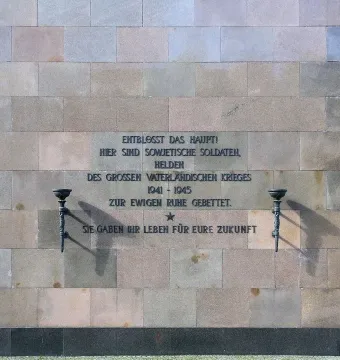
| Entrance inscriptions | To eternal memory of the heroes; Take off your hat! Here lie Soviet soldiers, heroes of the Great War of 1941-1945, laid to eternal rest; A grateful humanity never forgets their courageous deeds |
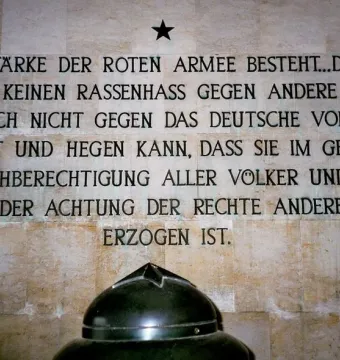
| Portal quotation | A quote attributed to Stalin about the Red Army's lack of racial hatred and respect for the rights of other peoples |
| Tablet inscription | They were never subdued by fascism. Their love for their homeland and their people was stronger than death. |
Iconography and meaning | |
| Interpretive note | The inclusion of Soviet prisoners of war is described as unusual because under Stalin prisoners of war were generally regarded as potential collaborators |
| Dedicated to | Soviet soldiers, Soviet victims of war and Nazi violence, including Soviet prisoners of war and concentration camp victims |
| Commemorated event | The storming of Berlin in April–May 1945 |
History and restoration | |
| Restoration | Restoration began in 2011 and the memorial reopened on 13 August 2013 |
| Restoration cost | About €10.35 million |
| Reason for restoration | General wear and deterioration |
| Legal protection | Protected under Article 18 of the 1990 Treaty on Good Neighbourliness, Partnership and Cooperation between Germany and the Soviet Union; the 1992 German-Russian war graves agreement committed Germany to permanently secure, maintain, and repair the graves |
| Public access | Open to the public since the reopening |
Significance | |
| Claim to fame | The largest memorial complex commemorating Red Army soldiers who fell during the storming of Berlin |
| Postage stamp depiction | Depicted on a 1977 Deutsche Post stamp designed by Joachim Rieß |