
Hermannsdenkmal
Hermannsdenkmal is a monument in North Rhine-Westphalia, Germany, located in the southern Teutoburg Forest southwest of Detmold, in the Lippe district. It stands on the wooded Teutberg hill, within the circular fortification of Grotenburg. The statue itself is 24.82 metres high, and with its 28.62-metre pedestal it reaches a total height of 53.44 metres. The monument commemorates the Cheruscan war leader Arminius, known in German as Hermann, and the Battle of the Teutoburg Forest, in which Germanic tribes under his command decisively defeated three Roman legions under Varus in AD 9. An inscription on the monument reads: “Deutsche Einigkeit, meine Stärke - meine Stärke, Deutschlands Macht.”
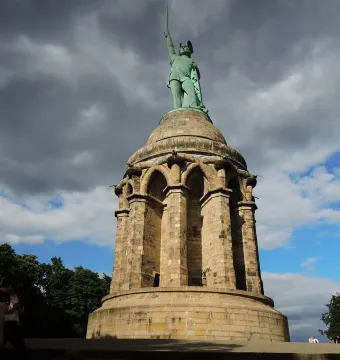
May 2020 © Dr.Xos · CC BY-SA 4.0
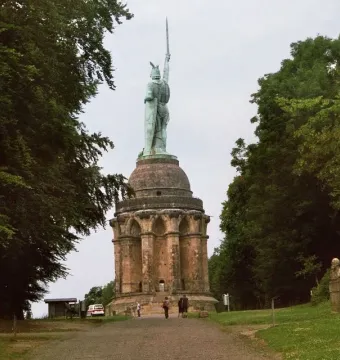
July 2016 © m66roepers · CC BY 2.0
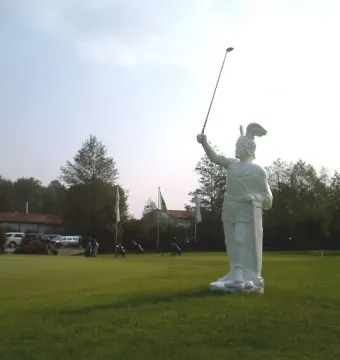
September 2009 © R-E-AL · CC BY-SA 3.0
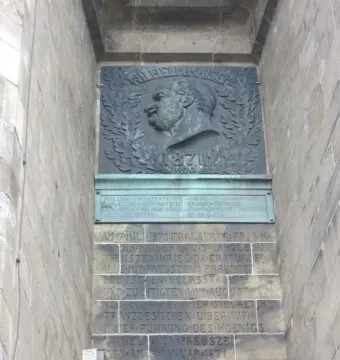
April 2014 © Kaisching · CC BY-SA 4.0
January 2009 © Tola69 · CC BY-SA 3.0
Identification | |
| Title | Hermannsdenkmal |
| Alternative names | Hermann Monument; The Hermann Memorial; Monument to Arminius; Pomnik Arminiusza Hermana w Detmold; Arminius Monument |
| Type | monument; colossal statue; national monument |
Historical context | |
| Historical context | Built in 1838–1875 amid 19th-century German nationalism, political fragmentation after Napoleon's occupation and the Congress of Vienna, and later the Franco-Prussian War and German unification of 1871. |
Creator | |
| Designer | Ernst von Bandel |
| Other artists mentioned | Karl Friedrich Schinkel; Christian Daniel Rauch |
Discovery and provenance | |
| Construction period | 1838–1875 |
| Construction milestones | Construction began in 1838; the pedestal was completed by 1846; work was frozen in 1848 because of the German Revolution; construction resumed in 1863. |
| Early design proposals | Schinkel prepared designs in 1813–1814 and submitted a competing design with Christian Daniel Rauch in 1839, but it was rejected. |
| Completion context | Completed after the Franco-Prussian War and the unification of Germany in 1871. |
| Funding | Supported by funding associations across Germany, with substantial financial support from Prussia and Kaiser Wilhelm for completion. |
Physical characteristics | |
| Height | 53.46 m total height |
| Statue height | 24.82 m |
| Pedestal height | 28.62 m |
| Orientation | Faces west |
Materials | |
| Materials | Not stated in the input parameters |
Location and ownership | |
| Related site | Teutoburg Hill (Teutberg/Teut); Grotenburg Castle; Teutoburg Forest range |
| Location | Grotenburg, Hiddesen, southwest of Detmold, Lippe district, North Rhine-Westphalia, Germany |
| Site | On a 386 m hill in the southern Teutoburg Forest, within the remains of a circular rampart / pre-Roman hillfort |
Iconography and meaning | |
| Subject | Arminius, the Cherusci chieftain later Germanized as Hermann |
| Depicted pose or attribute | The victorious Arminius is shown holding a raised sword |
| Commemorated event | The Battle of the Teutoburg Forest (the Varus disaster), in AD 9 |
| Historical significance of event | Germanic tribes under Arminius decisively defeated three Roman legions under Publius Quinctilius Varus, and the defeat was later seen as limiting Roman expansion into Germania. |
| Inscriptions | "Deutsche Einigkeit, meine Stärke - meine Stärke, Deutschlands Macht."; "Deutschlands Einigkeit meine Stärke - meine Stärke Deutschlands Macht." |
| Inscription translation | "German unity is my strength - my strength (makes) Germany's power."; "German unity, my strength - my strength, Germany's power." |
| Symbolic meaning | A symbol of German unity, national pride, and the idea of Arminius as an early unifier of Germanic tribes. |
| Broader political associations | Linked in the 19th century to opposition to French domination and, by extension, to resistance against external rule seen as analogous to Rome. |
History and restoration | |
| Author's battle-site hypothesis | Ernst von Bandel believed the Battle of the Teutoburg Forest took place roughly in this area. |
| Modern archaeological view | Modern archaeological research places the battle about 100 km to the northwest, near present-day Kalkriese / Osnabrück. |
| Inauguration | Inaugurated in the presence of Emperor Wilhelm I. |
Significance | |
| Designation | One of the sights of North Rhine-Westphalia and one of Germany's national monuments. |
| Comparable monuments | Walhalla in Regensburg; Niederwalddenkmal in Rüdesheim am Rhein; Monument to Germany. |
Other | |
| Historical note | Arminius was later defeated by Germanicus in a Roman retaliatory campaign. |