
Dorna
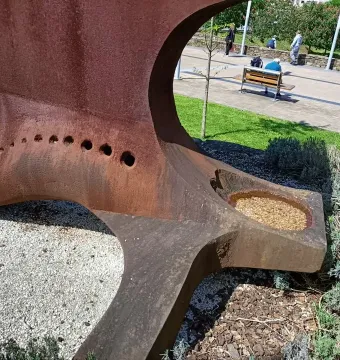
Dorna is a sculpture created by Spanish artist Xaime Quesada and located in Pontevedra, Spain. It is also known as Homage to the Pilgrimage Route to Saint James of Compostela. The work was commissioned as part of a project linked to the redevelopment of Avenida Uruguay and the south bank of the Lérez River, completed in 2001. It was intended to commemorate the passage of the Portuguese pilgrimage route to Santiago de Compostela through this strategic point in the city. The sculpture is currently located on Gorgullón Street, on the Portuguese Way, opposite the Vialia shopping center. After a later redevelopment of the area, the roundabout was removed and some original elements were lost, including the basin and lighting.
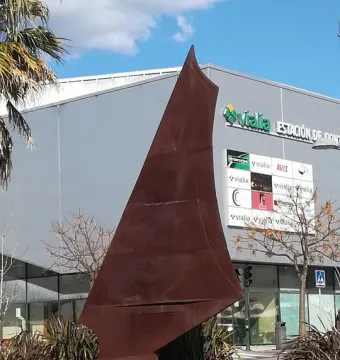
March 2022 © MJSB73MP · CC BY-SA 4.0
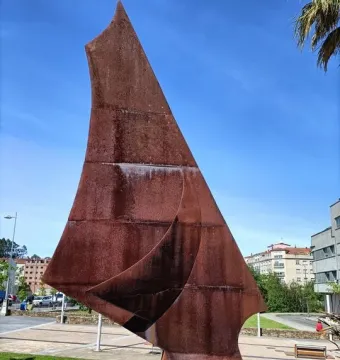
May 2024 © Domi402 · CC0
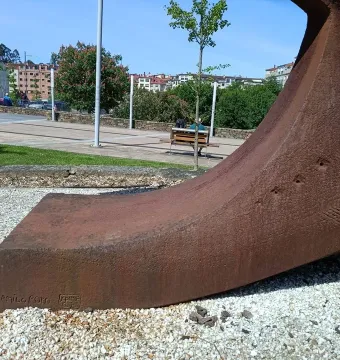
May 2024 © Domi402 · CC BY-SA 4.0
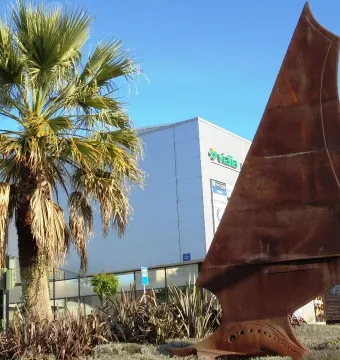
December 2014 © Pvibahu · CC BY-SA 4.0
May 2024 © Domi402 · CC BY-SA 4.0
Identification | |
| Title | Dorna |
| Type | Sculpture |
Creator | |
| Artist | Xaime Quesada |
| Artist nationality | Spanish |
| Artist origin | Ourense |
Historical context | |
| Commission year | 2001 |
| Commission context | Commissioned as a commemorative monument for the passage of the Portuguese Way of the Camino de Santiago through this strategic point of the city |
| Project context | Created as the culmination of the redevelopment of Avenida de Uruguay and the southern bank of the Lérez River, carried out by the Spanish Ministry of Public Works |
| Year completed | 2001 |
| Inauguration date | 20 August 2001 |
| Design setting | Designed for a roundabout with a basin of water around the sculpture and illuminated with a colored-water effect |
| Original site feature | Installed on a large roundabout created on Avenida de Uruguay |
Location and ownership | |
| Nearby landmark | Vialia shopping center |
| Associated route | Portuguese Way of the Camino de Santiago |
| Current location | Gorgullón Street, on the Portuguese Way of the Camino de Santiago, opposite the Vialia shopping center, Pontevedra, Spain |
| Original location | The roundabout on Avenida de Uruguay at the entrance to the Burgo Bridge, Pontevedra, Spain |
History and restoration | |
| Later alteration | In October 2006 the section of Avenida de Uruguay where the sculpture was located was redesigned; the roundabout was removed and the basin and lighting were lost |
Physical characteristics | |
| Form | Shaped like an old Galician dorna, a traditional fishing boat of the Rías Baixas, with its sail unfurled in the wind |
| Orientation | The bow points toward Santiago de Compostela |
Materials | |
| Material | Cast iron |
Appearance | |
| Dynamic effect | The sail is driven by the wind to create a sense of movement |
Iconography and meaning | |
| Subject | Represents Galicia as a land of water, light, and wind |
| Dedication | A tribute to the Camino de Santiago |
| Symbolism | Symbolizes the pilgrim undertaking the journey to Santiago de Compostela |
| Local significance | Emphasizes Pontevedra's maritime character and its relationship with the sea |
| Material symbolism | Cast iron was associated by the artist with the idea that its self-oxidation makes it eternal, like the pilgrimage route |