
Nelson Monument
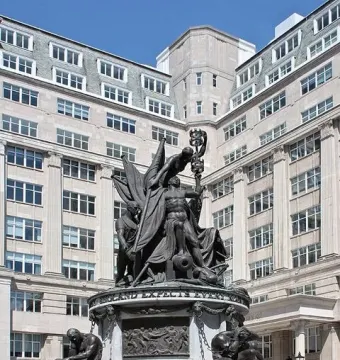
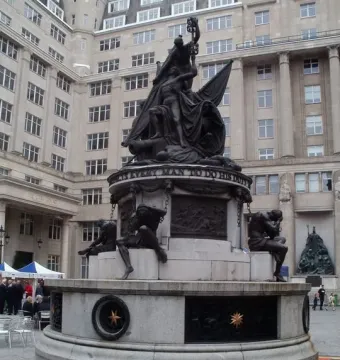
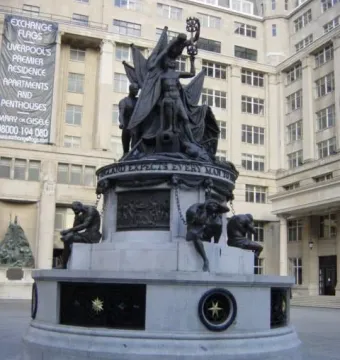
Nelson Monument is a monument to Admiral Horatio Nelson at Exchange Flags in Liverpool, England. Designed by Matthew Cotes Wyatt and sculpted by Richard Westmacott, it was unveiled in 1813 and stands north of the Town Hall. The monument combines a bronze sculpture with a stone base, reaching a total height of 8.8 metres. Its pedestal includes chained prisoner figures, bronze reliefs of Nelson’s naval actions, laurel garlands, and an inscription reading, “England expects that every man will do his duty.” At the top is a group of bronze figures showing Nelson, Britannia, Victory, Death, and a British sailor. It was the first public sculpture erected in Liverpool and is listed on the National Heritage List for England.
July 2011 © Craigthornber · CC BY-SA 3.0
May 2013 © John Bradley · CC BY-SA 3.0
January 2006 © Sue Adair · CC BY-SA 2.0
© Rijksmuseum · CC0
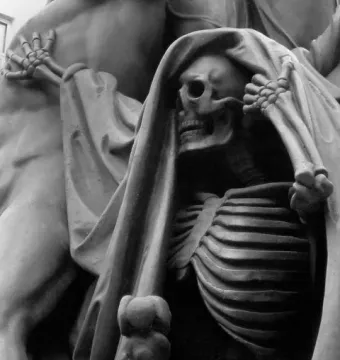
January 2010 © mira66 · CC BY 2.0
Identification | |
| Title | Nelson Monument |
| Type | monument |
Iconography and meaning | |
| Subject | Admiral Horatio Nelson |
| Figure behind Nelson | Britannia holding a laurel wreath and Nelson's decorations |
| Figure to the left of Nelson | A British sailor striding forward |
| Figure to the right of Nelson | Death, reaching out to touch him |
| Nelson's action | Holds an upright sword on which Victory places the last of four crowns |
| Nelson's pose | One foot on a cannon and the other on the corpse of an enemy |
| Nelson's arm | Right arm amputated and partly covered by a flag |
| Central figure | Idealized nude representation of Nelson |
| Upper group composition details | A roughly pyramidal structure of five figures surrounded by drapes and poles of captured flags, with an anchor and a rope on the ground |
| Alternative interpretation of the elements | Some people see the depicted prisoners of war as representing the suffering of slaves |
| Interpretation of sculptural elements | The monument includes elements depicting prisoners of war; these elements are interpreted in different ways |
| Battle scenes depicted | Nelson's victories at Saint Vincent (14 February 1797), Aboukir (1 August 1798), Copenhagen (2 April 1801), and Nelson's death at Trafalgar |
| Bronze bas-reliefs depict | Other naval actions in which Nelson participated |
| Seated statues represent | Nelson's major victories: the battles of Cape St Vincent, the Nile, Copenhagen, and Trafalgar |
Historical context | |
| Historical context of Trafalgar victory | The victory allowed Liverpool merchants to resume international trade |
| Purpose | To commemorate Nelson's victory at the Battle of Trafalgar |
Location and ownership | |
| Current location | Exchange Flags, Liverpool |
| Location | Exchange Flags, Liverpool, England |
| Protection status | Grade II* listed building on the National Heritage List for England |
| Original planned location | A prominent site near the Exchange, Liverpool |
| Position within the area | North of the Town Hall |
Creator | |
| Designer experience | Matthew Cotes Wyatt was relatively inexperienced |
| Designer relationship | Son of James Wyatt |
| Sculptor | Richard Westmacott |
| Designer | Matthew Cotes Wyatt |
Discovery and provenance | |
| Notable contributors to the fund | £750 from Lloyd's underwriters; £500 from the West India Association |
| Public subscription period | Two months |
| Public subscription total | £8,930 |
| Funding | Funded mainly by public subscription, with £1,000 voted by Liverpool City Council and a large donation from William Roscoe |
| Commissioning body | Liverpool City Council |
| Design competition | A competition was organized for the design |
| Design competition winner | Matthew Cotes Wyatt |
| Planned location | A prominent site near the Exchange |
| Contract signed | 1809 |
History and restoration | |
| 2023 installation purpose | To reflect statues in Ukraine that were covered up to protect them from damage during the Russian invasion |
| 2023 modification | Surrounded by 2,500 sandbags as part of the Protect the Beats art installation for Eurovision Song Contest celebrations |
| Bunker-related alteration | A ventilation shaft was constructed under the monument during construction of a bunker under Exchange Flags for Western Approaches Command, allowing airflow into the bunker below |
| Reason for restoration | Restored for the 200th anniversary of Admiral Nelson's victory in the Battle of Trafalgar |
| Restoration period | 27 May to 4 September 2005 |
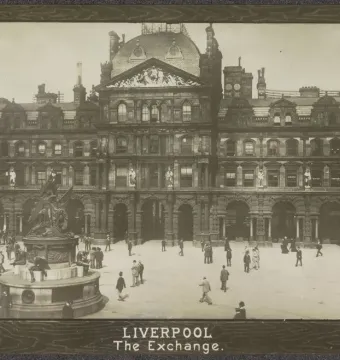
| Reason for relocation | To allow an extension to the Exchange Buildings |
| Relocated | 1866 |
| Unveiling significance | The eighth anniversary of Nelson's death |
| Unveiled | 21 October 1813 |
| Foundation stone laid | 15 July 1812 |
Physical characteristics | |
| Upper group height | 4.3 m |
| Overall height | 8.8 metres |
| Base circumference | 29.1 m |
| Pedestal shape | Drum-shaped |
| Pedestal height | 2.7 m |
| Granite sub-base height | 1.8 m |
| Number of seated statues around the pedestal | Four |
| Number of bronze bas-reliefs | Four |
| Each figure height | 2.1 m |
| Upper group composition | Five figures arranged in an approximately pyramidal structure |
Materials | |
| Upper group material | Bronze |
| Main materials | Bronze and stone |
| Pedestal material | Westmorland stone |
| Replacement base material | Granite |
| Original base material | Westmorland stone |
| Pedestal material | Westmorland marble |
| Base material | Marble pedestal on a granite sub-base |
Appearance | |
| Figures seated around the pedestal | Four statues of manacled prisoners in poses of sadness |
| Composition | Bronze statue on a stone base |
| Additional pedestal decoration | Angels, flags, and cannons |
| Pedestal decoration | Bronze plaques showing battle scenes |
| Inscription | England expects that every man will do his duty |
| Chains | Attached to rings in the lions' mouths and descending to manacle the prisoners |
| Decorative elements around pedestal | Swags of laurel hanging from behind lions' heads |
| Bas-reliefs | Four bronze bas-reliefs set into the drum between the statues |
| Base | Stone base consisting of a drum-shaped pedestal and a granite basement |
Significance | |
| Historical significance | The first piece of public sculpture erected in Liverpool |