
Monument to Mykola Shchors in Kyiv
Monument to Mykola Shchors in Kyiv was a monument to the Red commander and division commander Mykola Shchors. It was unveiled on 30 April 1954, with the opening timed to mark the 300th anniversary of the reunification of Russia and Ukraine. The sculptors were V. Z. Borodai, N. M. Sukhodolov, and M. G. Lysenko, and the architects were A. I. Zavarov and A. I. Vlasov. Although it was indirectly covered by decommunization laws, the monument was protected as a cultural heritage site and listed in Ukraine’s State Register of Immovable Monuments as a national monument of monumental art. It was demolished in December 2023.
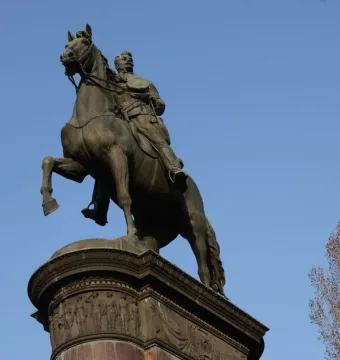
March 2014 © Canercangul · CC BY-SA 4.0
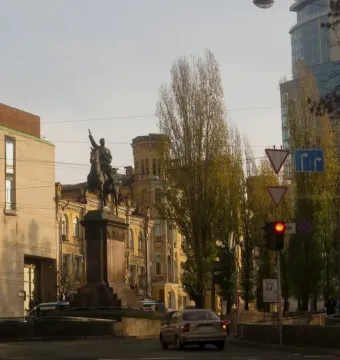
November 2013 © ЯдвигаВереск · CC BY-SA 4.0
July 2016 © Сарапулов · CC BY-SA 4.0
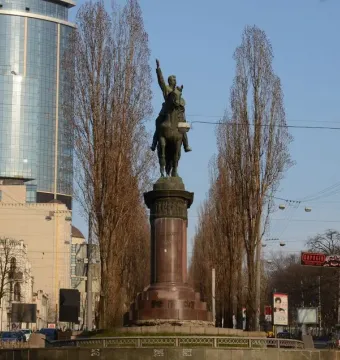
March 2014 © Canercangul · CC BY-SA 4.0
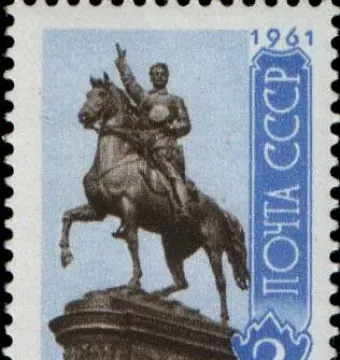
April 2004 © Post of the Soviet Union. · Public domain
Identification | |
| Title | Monument to Mykola Shchors in Kyiv |
| Russian name | Памятник Николаю Щорсу |
| Type | Monument |
| Form | Equestrian statue |
| Subject | Mykola Shchors |
Historical context | |
| Subject's role | Red Army commander and member of the Russian Communist Party |
| Subject's later status | Ignored for more than a decade, then glorified in the Soviet Union from the mid-1930s |
| Subject's death | Killed in battle near Biloshytsi village near Korosten in Zhytomyr Oblast on 30 August 1919, reportedly after receiving a bullet in the back of the head |
| Monument origin | Idea to erect a monument to Shchors in Kyiv arose in 1936 |
| Initiator | Joseph Stalin |
| Purpose of unveiling | Coincided with the 300th anniversary of the Pereiaslav Council / Pereiaslav Agreement of 1654 |
Creator | |
| Architects | Oleksandr Vlasov and Oleksii Zavarov |
| Sculptors | Vasyl Borodai, Mykola Sukhodolov, and Mykhailo Lysenko |
Discovery and provenance | |
| Original site | At the intersection of Taras Shevchenko Boulevard and Symon Petliura Street (formerly Komintern Street), Kyiv, Ukraine |
| Previous monument on the site | A monument to Count A. Bobrinsky / Oleksii Bobrynskyi, organizer of the construction of the railway in Kyiv, stood on the site from 1872 to 1926 |
| Planning history | A postwar equestrian sculpture was approved; an earlier pedestrian design was changed in 1949 |
| Planned location | Lev Tolstoy Square, later Taras Shevchenko Boulevard |
| Work began | 1940 |
| Opening date | 30 April 1954 |
| Demolition date | 9 December 2023 |
| Relocated to | Ukraine State Aviation Museum |
Physical characteristics | |
| Height | 13.8 m |
| Pedestal height | 6.5 m |
| Weight | Reported 7 tons |
Materials | |
| Figure material | Bronze |
| Pedestal material | Granite |
Appearance | |
| Pedestal decoration | Cornice and frieze with bas-reliefs depicting episodes of the Ukrainian–Soviet War |
| Artistic intent | The silhouette and severe facial features were meant to convey the officer’s iron will |
| Original design concept | Shchors was first proposed with a raised hand holding a cap, but this was changed because it was considered too vulgar; the cap was moved to the other hand |
| Base inscription / defacement | The pedestal was defaced with white paint |
| Composition | Shchors is shown rising in the stirrups with one arm raised upward, appearing to call soldiers to attack |
Location and ownership | |
| Current location | Kyiv, Ukraine |
| Heritage status | Protected as an object of cultural heritage and listed in the State Register of Immovable Monuments of Ukraine as a monument of national significance of monumental art |
| Protection details | Protected under Cabinet of Ministers resolution of 3 September 2009 No. 928, protection number 260055-N |
History and restoration | |
| Temporary covering | For a long time the monument was covered on all sides with fabric shields in national colors; on 23 August 2016 one side was covered with a Ukrainian flag, and from 24 to 29 August 2016 it was fully covered with a frame stretched with dense canvas in national colors |
| Demolition context | Demolished at the beginning of December 2023 |
| Missing part | By 20 March 2017, the front right leg of the horse was missing; the circumstances are unknown |
| Graffiti | On 4 March 2010, vandals wrote the name of Yevhen Konovalets in white paint on the pedestal |
| Decommunization plans | After the Revolution of Dignity, authorities planned to dismantle the monument under decommunization law, but it was also protected from demolition as cultural heritage |
| Protection during 2022 invasion | During the 2022 Russian invasion, Kyiv monuments were sandbagged and protected except this one |
| Explosion damage | Blown up on the night of 10 April 2008, breaking off a 50 × 50 cm fragment of granite |
| Vandalism | Often vandalized, including multiple desecrations by Ukrainian nationalists |
| Historical role | Effectively an unofficial symbol of Kyiv from 1954 to 1982 |
Significance | |
| Unique feature | The only equestrian monument in Kyiv built during the Soviet period |
| Criticism | Critics noted the fragmented plastic form, unambiguous silhouette, and unsuccessful pedestal, saying the romantic theme was not fully revealed when walking around the monument |
Other | |
| Model claim | Leonid Kravchuk was repeatedly claimed to have posed as a model while a student, and he later said he was indifferent to the monument’s fate and that it is Shchors, not Kravchuk |
| Alternative model account | In 1998, Mykola Sukhodolov said it was possible that Mykhailo Lysenko invited Leonid Kravchuk to pose for the sketch during trial studies, and another possible model was sculptor A. Bozhko |
| Photo captions | The monument is depicted in photos from 1961, 2010, 2016, and 2022, including graffiti in the 2022 photo |