
Statue of Tadeusz Kościuszko
The Statue of Tadeusz Kościuszko is a bronze memorial in Lafayette Square, Washington, D.C., honoring the Polish military figure and engineer. Dedicated in 1910, it is the third of four statues in the square created to honor foreign-born heroes of the American Revolutionary War. The sculpture was designed by Antoni Popiel after a competition, with President Theodore Roosevelt favoring his selection. Kościuszko served as an engineer in the Continental Army and later led the Kościuszko Uprising in his homeland. The statue’s base figures were completed by 1909, and the dedication drew about 15,000 Polish Americans. It is part of the American Revolution Statuary and a contributing property to the Lafayette Square Historic District.
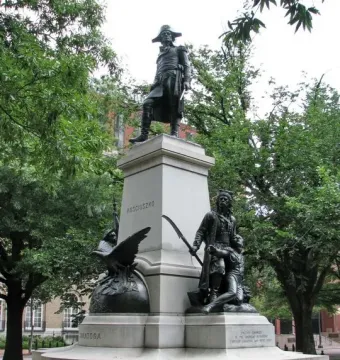
June 2008 © Cliff · CC BY 2.0
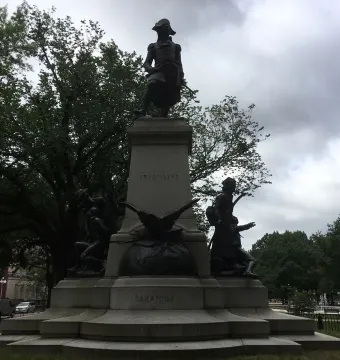
© NPS Photo · Public domain
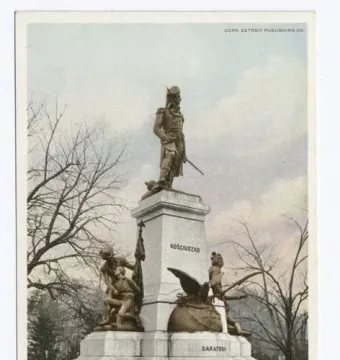
© Scan by NYPL · Public domain
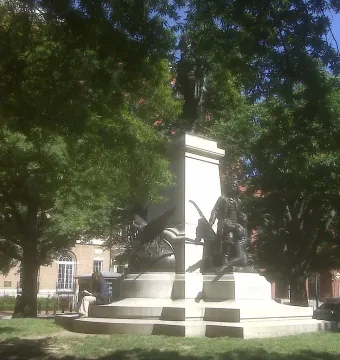
May 2009 © Kas Hayes · CC BY-SA 4.0
June 2012 © Daderot · CC0
Identification | |
| Title | Statue of Tadeusz Kościuszko |
| Type | Bronze statue |
| Monument name | Tadeusz Kościuszko Monument |
| Subject | Tadeusz Kościuszko (Andrzej Tadeusz Bonawentura Kościuszko, 1746–1817) |
| Depicted person | Tadeusz Kościuszko |
| Depicted person description | Polish-American freedom fighter, military engineer, and general |
| Other title | Brigadier General Thaddeus Kościuszko |
Historical context | |
| Unveiling order | The Kościuszko statue was dedicated at 2:30 pm, before the Pulaski statue at 4:00 pm; both were unveiled and dedicated on the same day |
| Banquet | A banquet was held later that night at the Raleigh Hotel, with Taft in attendance |
| Music at dedication | The United States Marine Band played the U.S. national anthem, and the Polish Singers Alliance greeted attendees with music |
| Other speakers at dedication | John F. Smulski, Jacob M. Dickinson, and Myron Stenczynski |
| Invocation | Given by Bishop Paul Peter Rhode |
| Dedication speaker | President William Howard Taft |
| Attendees at dedication | Approximately 15,000 Polish Americans |
| Ceremonial act | The statue was unveiled and ceremonially gifted to the American people |
| Dedication date | May 11, 1910 |
| Part of | 14 American Revolution Statuary in Washington, D.C. |
| Selected after | Chosen after a competition among sculptors |
| Dedication context | One of the statues in Lafayette Square honoring foreign-born heroes of the American Revolutionary War |
| Honors | Foreign-born hero of the American Revolutionary War |
| Project approval date | April 18, 1904 |
| Approval authority | Act of the U.S. Congress |
| Competition | A design competition was held, with 20 participants submitting models |
| Commissioning history | Requested by the Polish National Alliance as an equestrian statue of Casimir Pulaski, but President Theodore Roosevelt insisted the Lafayette Square statue be Kościuszko instead |
Creator | |
| Sculptor | Antoni Popiel |
| Artist's origin | Lviv |
| Chosen by | President Theodore Roosevelt |
Discovery and provenance | |
| Casting date of statue | 1908 |
| Initiators | Polish citizens in the United States |
| Approval date | April 18, 1904 |
| Year erected | 1910 |
| Casting dates of base sculptures | 1908–1909 |
| Cost included | The statue, base, and preparation of the site |
| Completion date | 1908 |
| Foundry | Jules Berchem & American Art Foundry |
| Contractors | M. J. Falvey & Kyle Granite Company |
| Fundraising amount | 76,000 dollars |
| Cost | $76,835 |
| Approval and funding | The U.S. Congress approved funding for the statue at a cost of $76,835 |
Physical characteristics | |
| Pedestal decoration | Bronze figures on all sides |
| Pedestal design | Several-tiered pedestal |
| Material | Bronze statue on a Vermont granite pedestal |
| Clothing | Continental Army officer uniform with a hat, long coat with epaulets, sash, and boots |
| Additional object | Sword in the left hand |
| Hand holding object | Right hand |
| Object held | Map of his fortification designs of Saratoga |
| Orientation | Faces north |
| Base dimensions | Square pedestal with sides 4 feet (1.2 m) at the top and 20 feet (6.1 m) at the bottom; pedestal height 15 feet (4.6 m) |
| Height of statue | Approximately 10 feet (3 m) |
| Pose | Standing, facing left, with the right foot advanced |
Appearance | |
| West side motif | Two statues depicting Kościuszko's soldiers in Polish military uniforms |
| Inscriptions | KOŚCIUSZKO; SARATOGA; GENERAL TADEUSZ KOŚCIUSZKO 1746-1817 SON OF POLAND; 'AND LIBERTY CRIED KOŚCIUSZKO FELL' Erected by the Polish National Alliance of America and presented by the United States on behalf of Polish-American citizens, May 11, 1910; 'RACŁAWICE'; MILITARY ENGINEER OF THE AMERICAN REVOLUTION WHO FORTIFIED SARATOGA AND WEST POINT |
| West side detail | One figure lies on the ground and points into the distance with his right hand, while a Polish soldier dressed as a peasant supports him |
| Pedestal inscription | 'And liberty cried—Kościuszko fell!' |
| East side detail | One figure holds a flag in his left hand; a drum lies near his right foot; with his right hand he unties a rope around the waist of a bound American soldier symbolizing the U.S. Army |
| East side motif | Two statues depicting Kościuszko's soldiers in American military uniforms |
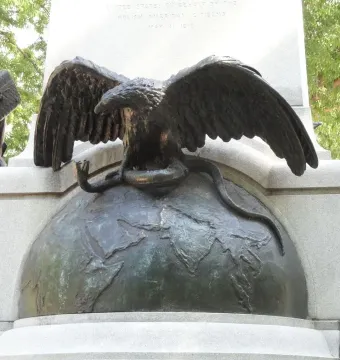
| South side motif | An eagle fighting a snake while perched on a globe |
| Front/base motif | An American eagle resting on the globe, holding a sword, a shield, and the U.S. flag |
Iconography and meaning | |
| Subject significance | He fought for freedom in both the United States and Poland |
| Historical role | Military engineer of the American Revolution |
| Historical contribution | Fortified Saratoga and West Point |
| Quotation source | The phrase 'And liberty cried—Kościuszko fell!' is from Thomas Campbell's The Pleasures of Hope |
| Quotation context | Thomas Campbell was influenced by the French Revolution, the partition of Poland, and the slavery of Black people |
Location and ownership | |
| National Register reference number | 78000256 |
| Lafayette Square Historic District DCIHS date | June 19, 1973 |
| Lafayette Square Historic District NRHP date | August 29, 1970 |
| L'Enfant Plan DCIHS date | January 19, 1971 |
| L'Enfant Plan listing date | April 24, 1997 |
| District of Columbia Inventory listing date | March 3, 1979 |
| Ownership and maintenance | Owned and maintained by the National Park Service |
| National Register listing date | July 14, 1978 |
| National Register listing | Collectively listed on the National Register of Historic Places as part of the 14 American Revolution Statuary in Washington, D.C. |
| Historic designation | National Historic Landmark |
| Contributing property | Contributing property to the L'Enfant Plan and the Lafayette Square Historic District |
| Associated city | Washington, D.C. |
| Nearby landmark | Lafayette Square |
| Location | Northeast corner of Lafayette Square, in front of the White House, Washington, D.C., United States |
History and restoration | |
| Damage history | The Washington, D.C., statue was damaged during the unrest following George Floyd's death in 2020 |
| Previous vandalism | In the 1990s, Kościuszko's sword and hat were stolen and later replaced |
| Vandalism | Defaced with spray paint during the George Floyd protests in Washington, D.C., in 2020 |
| Inspection and maintenance date | 1988 |
| Cleaning date | 1987 |
Other | |
| Replica | A replica of the Washington, D.C., statue was unveiled in Warsaw in 2010, in front of the Lubomirski Palace |
| Replica location | Warsaw, Poland, in front of the Lubomirski Palace |
| Replica date | 2010 |
| Related memorials | Kościuszko is memorialized in the United States with many other statues and memorials, including an equestrian statue in Milwaukee, a monument on the battlefield at Saratoga, and a statue at West Point |
| Comparative memorialization | According to a Monument Lab study, Kościuszko and Pulaski are memorialized more than most American-born Revolutionary War heroes; only George Washington and Gilbert du Motier, Marquis de Lafayette, have more statues than Kościuszko |
| Posthumous promise | Participants pledged that a similar Kościuszko monument would be installed in Warsaw after Poland regained independence |