
Gänseliesel Fountain in Göttingen
Gänseliesel-Brunnen Göttingen is a popular symbol of the city of Göttingen. The fountain, created in 1901, features a girl in folk costume carrying two geese, standing beneath an openwork canopy of intertwined branches above a basin. The bronze figure is the work of sculptor Paul Nisse, while the fountain was designed by architect Heinrich Stöckhardt. The present statue is a copy of the original, which was moved to the city museum in 1990. The sculpture also became part of Göttingen student tradition, with graduates now continuing the custom of presenting flowers to the figure after completing their doctoral defense.
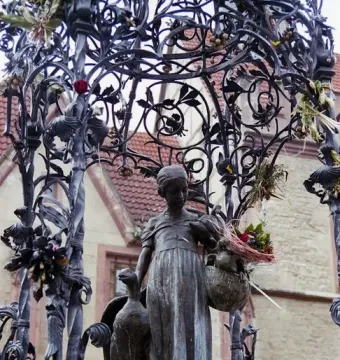
April 2010 © Christoph Alexander Martsch · CC BY-SA 2.0
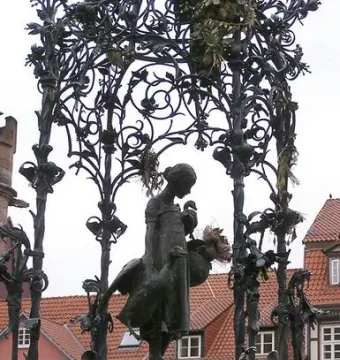
September 2008 © Anton Gausepohl · CC BY-SA 4.0
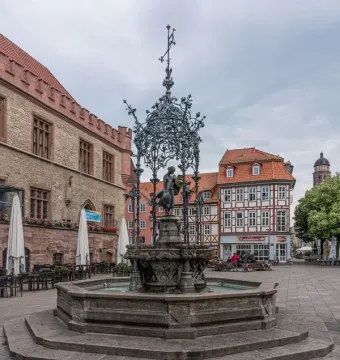
June 2022 © A.Savin · FAL
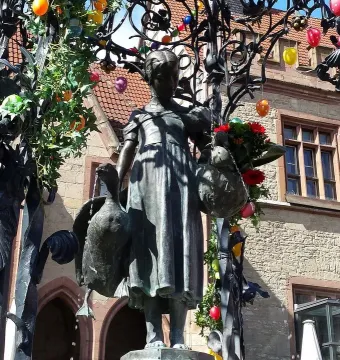
© Goerigk-1 · CC BY-SA 3.0
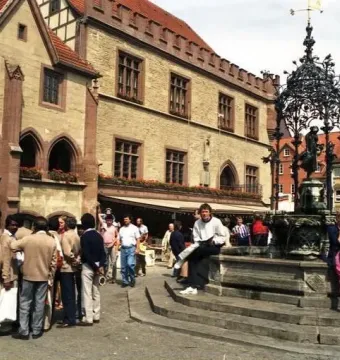
© Unknown authorUnknown author · CC BY-SA 3.0 de
Identification | |
| Title | Gänseliesel-Brunnen Göttingen |
| German name | Göttinger Gänseliesel |
| Literal translation | Goose Girl Lizzy of Göttingen |
| Type | Market fountain / sculptural fountain |
| Subject | A goose girl carrying two geese |
| Figure depiction | A girl in folk costume |
| Alternative name | Gęsiareczka z Getyngi |
Historical context | |
| Competition for redesign | Announced by the Göttingen city council in 1898 |
| Winning design | "Im Geist der Alten" / "Im Geiste der Alten" / "Tugendbrunnen" by Claus Mehs and Hermann Jehs (also given as C. Meiß and H. Yeis) |
| Competition entries | 40 artists and architects submitted 46 designs |
| Predecessor fountain | A large round fountain already existed on the market square by 1568; it was partly pulled down in the early 19th century due to deterioration |
| Year erected | 1901 |
| Year created | 1901 |
Creator | |
| Sculptor | Paul Nisse |
| Architect / designer | Heinrich Stöckhardt |
| Jury chairman | Ferdinand Hartzer |
Discovery and provenance | |
| Original figure status | The current figure is a copy of the original |
| Original figure location | Städtisches Museum Göttingen; displayed there since 1990 |
| Second original | A second bronze original was secretly made from the same mold in 1900/01; it was privately owned and later sold to Leipzig for a villa garden |
Physical characteristics | |
| Canopy material | Mainly wrought iron with bronze details |
| Structure | The figure stands on a pedestal beneath an openwork canopy of intertwined branches |
| Basin diameter | Originally 29 feet (about 8.40 m); later reduced by about 0.5 m |
| Basin shape | Round |
| Water feature | Water flows from beneath the pedestal into the basin |
| Fountain superstructure material | Warm reddish Wünschelburg sandstone |
| Base and coping material | Multicolored greenish Beucha granite |
| Figure material | Bronze |
| Total height | 7.10 m from the market square surface to the top |
| Size | Rather small |
Appearance | |
| Artistic style | Historicist with medieval forms; the competition phase also had a Neo-Gothic background |
Iconography and meaning | |
| Meaning | A popular symbol and landmark of Göttingen |
| Depicted figure | A goose girl (Gänseliesel) |
Location and ownership | |
| Current location | Market square in front of the Old Town Hall, Göttingen, Lower Saxony, Germany |
| Associated university | University of Göttingen (Georgia Augusta) |
| Original fountain site | Market square in Göttingen |
History and restoration | |
| Temporary lifting of ban | The kissing ban was lifted for one day in 2001 to mark the fountain's 100th anniversary by the city council |
| Canopy restorations | The iron baldachin was restored and partly renewed in 2000, 2004, 2020, and 2023 |
| 2004 damage and restoration | In winter 2004 the fountain was severely damaged, including by arson; it had to be disassembled and underwent major restoration |
| Later alteration | During a later redesign of the square, the stepped base was shortened, reducing the overall height of the fountain ensemble |
| 1943 repair | The 1941 damage was repaired in 1943 |
| 1968 alteration | During a redesign of the market square in 1968, the basin was shifted south and fundamentally renewed by the Göttingen stonemasonry firm Chr. Wolf; the inner basin shell was replaced by a copy |
| 1941 damage | The original figure was severely damaged in 1941 when it was torn out of its anchoring |
| 1930s alteration | The distinctive 24 coping stones on the stepped base were removed in the 1930s |
| Official inauguration | No official inauguration or ceremonial opening took place |
| Installation date | 8 July 1901 |
Significance | |
| Student tradition | Since soon after installation, students climbed the pedestal and kissed the statue after matriculation; the custom was officially banned in 1926 after a kiss trial, but later persisted mainly among doctoral graduates who present flowers and kiss the figure after receiving their doctorate |
| Penalty for ban violation | One student was fined 10 Reichsmarks / 10 marks for violating the ban |
| Reputation | Known in Göttingen as the 'most kissed girl in the world' |
| Current custom | Doctoral graduates now commonly kiss the statue and present a bouquet of flowers |
| Annual festival | Since 1995, Göttingen has held the annual Gänselieselfest in September, including the election of a young woman as the Gänseliesel for one year |
| Representational role | The chosen Gänseliesel represents the city and the statue for one year |
| Publicity and marketing | The sculpture's image has been used for motorway signs, the city logo, postcards, as a mascot, and as a marzipan figure |
| Social-critical response | The city guide 'Göttingen ohne Gänseliesel' was published as a socially critical counter-reaction in 1988 and 1989 |
| Similar sculptures | Similar Gänseliesel figures exist in Monheim am Rhein, Hanover, Berlin-Wilmersdorf, Kreischa, and Barlinek |