
Monument to the Negev Brigade
The Monument to the Negev Brigade, known locally as the Andarta, is a memorial by Dani Karavan for the Palmach Negev Brigade members who fell in the 1948 Arab Israeli War. Built between 1963 and 1968, it stands on a hill overlooking Beersheba from the east and is regarded as a symbol of the Negev and the city. The monument is made of raw concrete and consists of eighteen separate elements spread over 10,000 square meters. Its perforated tower and pipeline tunnel are symbolic references to wartime watchtowers and the water channel defended by the soldiers, while the concrete surfaces are engraved with names, badges, diary passages, battle records, Bible verses, and songs.
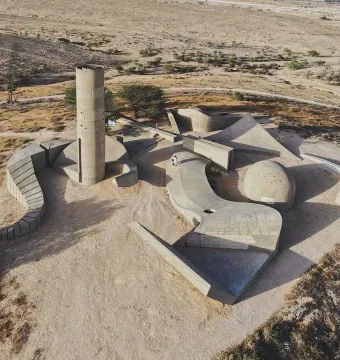
June 2021 © Nir Tober · CC BY-SA 4.0
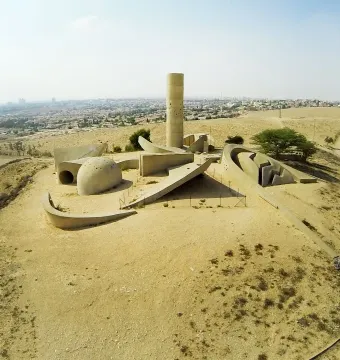
September 2013 © Guymeg · CC BY-SA 3.0
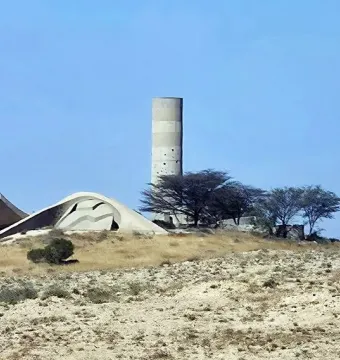
May 2026 © ישראל פרקר · CC BY 2.5
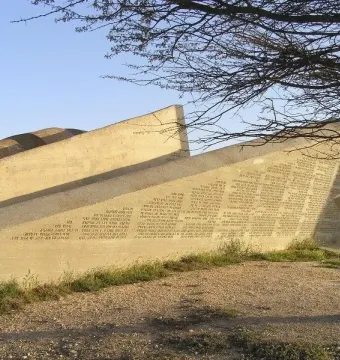
© Eman · Public domain
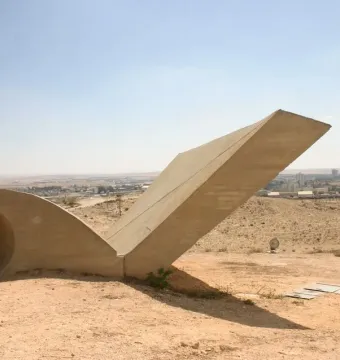
August 2009 © Libi Fishman · CC BY-SA 3.0
Identification | |
| Title | Monument to the Negev Brigade |
| Transliteration | Andartat hativat ha-Negev |
| Local name | Andarta |
| Type | Memorial monument |
| Original-language name | Andartat Hativat HaNegev |
Creator | |
| Artist | Dani Karavan |
| Artist nationality | Israeli |
Historical context | |
| Commemorated group | Soldiers and officers of the Negev Brigade of the Palmach |
| Historical event commemorated | The 1948 Arab–Israeli War, especially the War of Independence / Negev campaign and the capture of Beersheba and the Negev |
| Historical context | Built during a period when Israel was erecting many physical memorials to those who fought and died in its wars |
| Date created | 1963–1968 |
Discovery and provenance | |
| Purpose | Memorial to the fallen members of the Negev Brigade |
Location and ownership | |
| Location | On a hill in the northeast of Beersheba, Israel, overlooking the city and the Negev Desert |
| Visibility | Visible from far away |
| Role | Landmark of Beersheba and the Negev Desert |
| Site area | 30 dunams |
| National park | Monument to the Negev Brigade National Park |
| Park area | 295 dunams |
| Not part of | The national park |
| Associated event | Operation Yoav |
Physical characteristics | |
| Area covered | 10,000 square meters |
| Number of parts | 18 |
Materials | |
| Material detail | 17 of the 18 parts are concrete elements; the 18th part is the memorial garden/national garden |
| Material | Concrete |
Appearance | |
| Symbolism of parts | Each part symbolizes an aspect of the Negev Brigade’s history, the Palmach, the War of Independence, or the surrounding desert environment |
| Tower symbolism | A perforated tower symbolizes a shelled watchtower |
| Tunnel symbolism | A pipeline tunnel symbolizes a water channel in the desert defended by soldiers |
| Inscribed names | Names of 324 soldiers killed in the war are engraved in the concrete |
| Other inscriptions | Palmach emblem, soldiers’ diary passages, battle notes or registry, biblical verses from 2 Kings 2:12, and songs |
| Landscape / view | Panoramic view of modern Beersheba, the Beersheba Valley, and the southern Hebron mountains |
Style | |
| Style | Minimalist art; Brutalism; land art |
Significance | |
| Recognized as | Cultural heritage site by the Council for the Preservation of Israeli Heritage Sites |
| Symbolic significance | Recognized symbol of the Negev and Beersheba; visible landmark of the city |
| Artistic significance | One of the most famous and outstanding examples worldwide of the use of concrete in minimalist art |
| Art-historical significance | One of the first examples of land art and a precursor to the land art movement |
Other | |
| Nearby context | Located next to a major memorial dedicated to the War of Independence |
| Geological setting | The hills of the park are geologically similar to the hills of central and northern Israel |
| Main rock types | Limestone and dolomite, including hard and soft limestone and chalk with flint layers |
| Vegetation zone | Vegetation of the Arabian Desert |
| Restored / planted species | An iris species characteristic of the loess soils of the northern Negev was planted on the memorial hills as part of a conservation project |
| Historical flora note | An iris formerly grew in the northern Negev and is now under serious threat of extinction |
| Nearby flowering areas | Near the park, slightly north of its borders, there are areas where anemones and desert tulips (Tulipa agenensis) bloom |