
Equestrian Statue of Frederick V
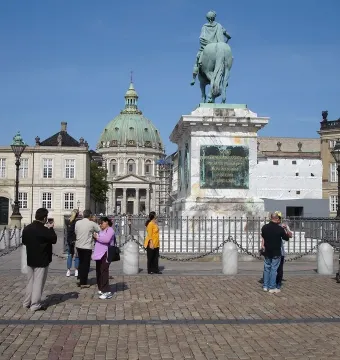
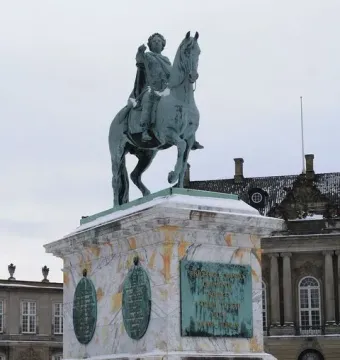
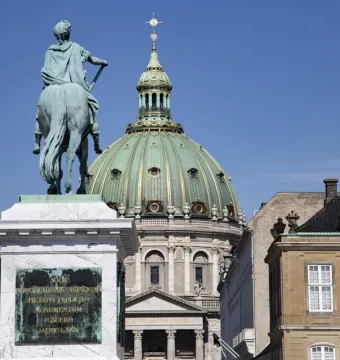
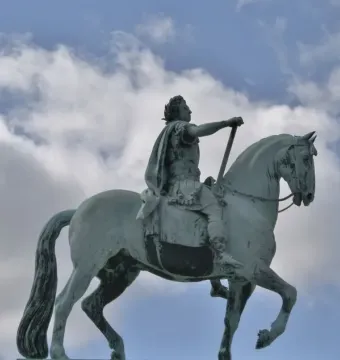
The Equestrian statue of Frederick V is located at the center of Amalienborg Square in Copenhagen, framed by the four symmetrical wings of Amalienborg Palace. It depicts the king in classical dress, crowned with laurels, with one hand extended and holding a baton. Commissioned by the Danish East India Company, the monument was designed in the neoclassical style by Jacques Saly in 1768 and cast in bronze in 1771. Its composed dignity and calm are characteristic of Danish depictions of monarchs. It is regarded as one of the notable equestrian monuments of its time.
August 2006 © Jim G · CC BY 2.0
© pandrcutts · CC BY-SA 2.0
December 2009 © Government of Thailand · CC BY 2.0
June 2021 © News Oresund · CC BY 2.0
May 2012 © Filipefirix · CC BY-SA 3.0
Identification | |
| Title | Equestrian statue of Frederick V of Denmark |
| Type | Equestrian statue |
| Subject | King Frederick V of Denmark |
Historical context | |
| Commissioned in | 1752 |
| Commissioned by | Adam Gottlob Moltke, head of the Asiatic Company |
| Commission purpose | A gift for the king |
| Funding | Offered by the Asiatic Company |
| Historical significance | Considered one of the most outstanding equestrian monuments of its time |
| Stylistic significance | The king's dignified and tranquil depiction is described as typical of Danish representations of monarchs |
Creator | |
| Style | Neoclassical |
| Design date | 1768 |
| Artist nationality | French |
| Artist | Jacques Saly |
Discovery and provenance | |
| Casting occurred | Two years after the king's death |
| Casting audience | 300 invited guests |
| Casting duration | 3 minutes and a few seconds |
| Amount of bronze poured | 40,000 pounds |
| Bronze composition | 10 parts zinc, 4 parts tin, 0.5 parts lead, and 100 parts copper |
| Time spent on final finishing | Another two years |
| Method of removing statue from foundry | A wall of the Giethuset had to be broken through |
| Transportation to the square | On 15 August 1768 at 4:30 a.m., 60 sailors pulled the statue on a sled from Kongens Nytorv to Amalienborg Square |
| Ceremonial gun salutes during transport | 27 cannon shots when the rider figure passed Kongens Nytorv and the same number upon arrival in Frederiksstaden in the afternoon |
| Installation method | Raised onto the marble pedestal with capstans and pulleys |
| Post-installation finishing | Covered to secure it, finish it, and chisel the bronze surface |
| Foundry preparations | Gor and five assistants demolished the roof of the Giethuset, the former cannon foundry at the site of today's Royal Theatre, to build a larger furnace |
| Casting date | 2 March 1768 |
| Bronze casting preparations | Took four more years after the plaster model was presented |
| Bronze caster's arrival in Denmark | 1764 |
| First sketch shown to the king | 4 December 1754 |
| Contract date | Spring 1752 |
| Selection of sculptor | Chosen by the Danish government after Count Johan Hartvig Ernst Bernstorff asked Joachim Wasserschlebe in Paris to find a suitable French sculptor; Edmé Bouchardon declined and recommended Jacques Saly |
| Arrival in Denmark | 8 October 1753 |
| Sculptor's entourage on arrival | His parents, his two sisters, and at least one assistant |
| Work began | 1753 |
| Bronze caster | Pierre Gor (Pierre Gors), a Frenchman |
| Preliminary study | Detailed study of the king's horses in the royal stables |
| King approval of sketch | August 1755 |
| Small model shown to the king | November 1758 |
| Small model size | About one meter high |
| Small model casts location | The Academy collection and the State Collection, now the Danish National Gallery |
| Large model made | 1761 to 1763 |
| Large model material | Plaster |
| Large model presented | 3 February 1764 |
| Large model presented to | The Academy and the king |
History and restoration | |
| Mosaic cladding removed | The mosaic cladding by Johan Daniel Herholdt from 1886 was removed during the 1998 work |
| Restoration work | The sculpture was restored and the pedestal renewed |
| Restoration funding | Financial support from the A.P. Møller og Hustru Chastine Mc-Kinney Møllers Fond til almene Formaal foundation |
| Restoration and pedestal renewal | 1998 |
| Financing | The Asiatic Company paid off the bill over twenty years |
| Total completion time | 14 years |
| Total cost | 500,000 Rigsdaler |
| Saly left Denmark | 2 July 1774 |
| Final payment to Saly | 8,000 Reichstalers instead of the expected gratuity of 50,000 Reichstalers |
| Additional decorative elements completed later | Bronze reliefs and inscription plaques on the pedestal, and the surrounding fence, were made in 1773/74 after Struensee was overthrown in 1772 |
| Saly's positions lost | He lost his honorary posts and was dismissed as director of the Royal Danish Academy of Fine Arts |
| Regent affecting the project | Johann Friedrich Struensee, acting as sole regent for Christian VII from 1770, imposed drastic economies |
| Official completion date | 1768 |
| Unveiling date | 1 August 1771 |
Physical characteristics | |
| Total height including base | Almost ... (exact height not given) |
| Weight | About 22 tons |
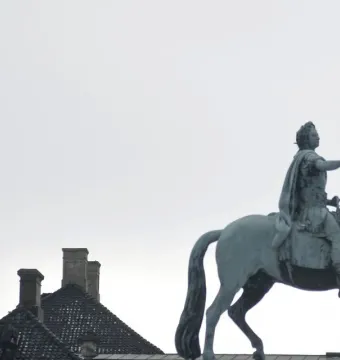
| Pose | The king is shown seated on a horse, in classical attire, crowned with a laurel wreath, with one hand extended and holding a staff or baton |
Materials | |
| Material | Bronze |
Appearance | |
| Interpretation | The depiction of the king shows apparent dignity and tranquility |
| Inspiration | Saly said he was inspired by the equestrian statue of Marcus Aurelius in Rome, Juan de Bolonia's equestrian Henry IV on the Pont Neuf in Paris, and perhaps most strongly by Edmé Bouchardon's Louis XV in the Place Louis XV (now Place de la Concorde) |
| Initial portrait model | Frederick V is shown as a Roman emperor crowned with laurels; the model has been lost |
Location and ownership | |
| Current location | Center of Amalienborg Square, Copenhagen, framed by the four symmetrical wings of Amalienborg Palace |
| Intended location | Center of the courtyard of Amalienborg Palace |
| Current surroundings | Four contemporary street lamps still surround the statue |
Other | |
| Small bronze casts | Saly made some small bronze casts |
| Maquette reception | The king applauded it |
| Surviving copies of the maquette | Copies still exist in museums in Copenhagen |