
Apotheosis of St. Louis
Apotheosis of St. Louis is a bronze statue of King Louis IX of France, the namesake of St. Louis, Missouri. It stands before the Saint Louis Art Museum in Forest Park and was created by the American sculptor Charles Henry Niehaus. Before the completion of the Gateway Arch, the statue served as the city’s main symbol. In 2020, after the protests following George Floyd’s death, its presence was challenged by activists, leading to tense exchanges with Catholic counter-protesters and eventually physical confrontation.
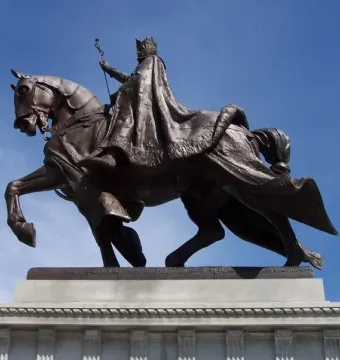
© Colin Faulkingham · Public domain
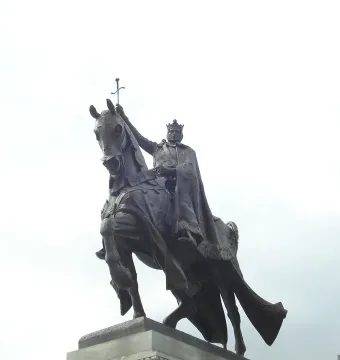
June 2014 © Starfire1118 · CC BY-SA 3.0
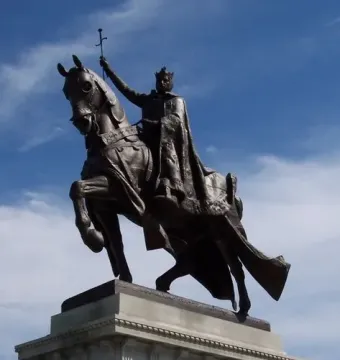
© Charles Niehaus · Public domain
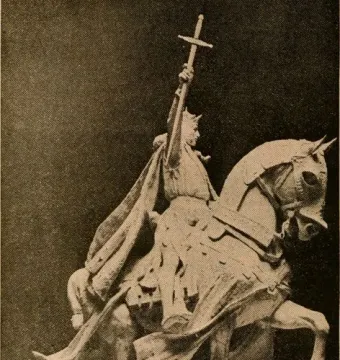
1904 © Internet Archive Book Images · No restrictions
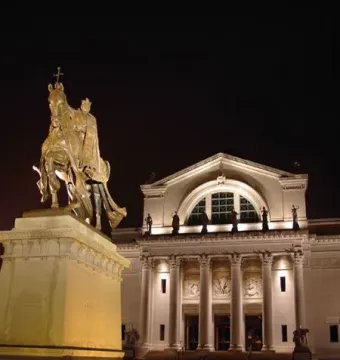
© Matito · CC BY-SA 2.0
Identification | |
| Title | Apotheosis of St. Louis |
| Type | bronze statue |
| Subject | King Louis IX of France |
| Namesake | St. Louis, Missouri |
| Original title | L'Apothéose de Saint-Louis |
Creator | |
| Sculptor | Charles Henry Niehaus |
| Sculptor nationality | American |
Discovery and provenance | |
| Proposed bronze price | US$90,000 |
| Legal dispute | Niehaus sued the company for infringement of his intellectual property rights |
| Accepted bronze price | US$37,500 |
| Legal settlement | Niehaus received US$3,000 and the pedestal was inscribed "designed by C. H. Niehaus" |
| Bronze version commissioned from | W. R. Hodges |
| Donation context | presented to Forest Park after the 1904 World's Fair (Universal Exposition of 1904) |
| Donated by | the Louisiana Purchase Exposition Company |
| Based on | a plaster statue by Charles Henry Niehaus that stood on the concourse/lobby of the Plaza of St. Louis near the main entrance to the 1904 World's Fair, now the Missouri History Museum |
Physical characteristics | |
| Location | in front of the Saint Louis Art Museum in Forest Park, St. Louis, Missouri |
| Current location | Forest Park, St. Louis, Missouri |
| Erection date | 1906 |
| Unveiling date | October 4, 1906 |
Materials | |
| Material | bronze |
Appearance | |
| Pedestal inscriptions | west: "Presented to the City of St. Louis by the Louisiana Purchase Exposition in commemoration of the Universal Exposition of 1904 held on this site."; north and south: "Saint Louis" |
History and restoration | |
| 2020 controversy | during protests following the death of George Floyd, activists called for the statue to be removed |
| Defense of statue | Archbishop Robert James Carlson defended the statue's presence, citing Louis IX's pious actions including charity toward the poor |
| 2020 protest outcome | mostly peaceful until clashes broke out toward the end, instigated by anti-Catholic protestors |
| 2020 protest duration | nearly three hours |
| Counter-protests | Catholic counter-protesters prayed the rosary in front of the statue and at times confronted the activists physically |
| 2020 protest leader | Umar Lee |
| 2020 criticism | activists criticized Saint Louis's participation in the Crusades and the antisemitic laws he is said to have enacted, including the burning of Jewish texts and the expulsion of French Jews |
| Historical role | principal symbol of St. Louis from its erection in 1906 until the Gateway Arch was built in the mid-1960s |
| Vandalism history | Saint Louis' sword has been broken or stolen several times over the years |
| Sword replacements | replaced in 1970, 1972, 1977, and 1981 |
| Restoration cost | US$23,000 |
| Restoration | restored in 1999 by Russell-Marti Conservation Services |
| Gateway Arch relation | the Gateway Arch replaced it as the city's main symbol in the mid-1960s |
| Association with city iconography | featured heavily in St. Louis iconography until the completion of the Gateway Arch in the 1960s |
Iconography and meaning | |
| City origin association | King Louis IX is the origin of the name of St. Louis, Missouri |
| Military insignia use | the profile image appears on the arms and distinctive unit insignia of the 138th Infantry Regiment of the U.S. Army and Missouri National Guard |
| Sports logo use | used as part of the St. Louis Browns logo in the 1930s and 1940s |
| Revived logo use | revived by St. Louis Soccer United for use in its logo in 2008 |
| Transmutation | converted into Joan of Arc for the St. Louis Athletica logo |
| Transmutation note | this transmutation was legitimized by the reconciliation of Arc with Arch |
| Iconographic context | part of the iconography of St. Louis |
Significance | |
| Historical interpretation | historian Thomas Madden of Saint Louis University argued that the statue is a symbol of modern progress rather than religious art and supported keeping it |