
Unique Forms of Continuity in Space
Unique Forms of Continuity in Space is a celebrated Futurist sculpture by Italian avant-garde artist Umberto Boccioni. The original, made in plaster in 1913, measures 111.2 cm high, 88.5 cm long, and 40 cm wide, and is held at the Museum of Contemporary Art of the University of São Paulo. Boccioni used the work to explore movement, speed, force, and light, and the figure appears to struggle against an invisible force as it advances. The original plaster survived the destruction of many of the artist’s works after a posthumous exhibition in Italy. Several later bronze castings exist in museums in New York, London, Los Angeles, Milan, and Cosenza, Calabria.
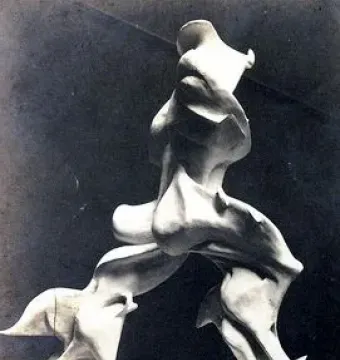
1913 © Estado de São Paulo newspaper · Public domain
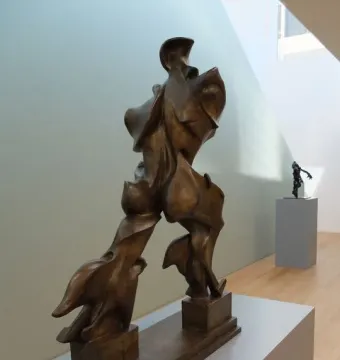
December 2015 © Pcany · CC BY-SA 4.0
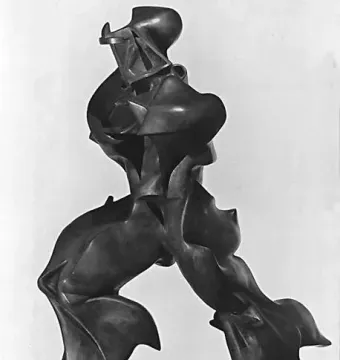
© Salli · Public domain
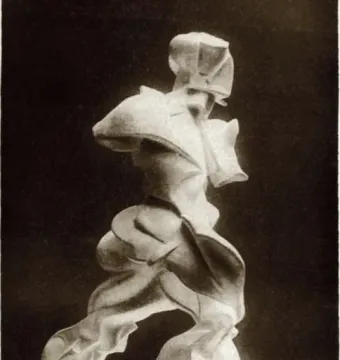
© Umberto Boccioni, anonymous photographer · Public domain
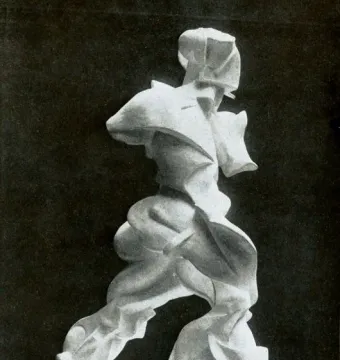
© Umberto Boccioni, anonymous photographer · Public domain
Identification | |
| Title | Unique Forms of Continuity in Space |
| Spanish title | Formas únicas de continuidad en el espacio |
| Russian title | «Уникальные формы непрерывности в пространстве» |
| Alternative title | L'Homme en mouvement (in Italian) |
| Type | Sculpture |
| Italian title | Forme uniche della continuità nello spazio |
Historical context | |
| Series position | Fourth design in a series of striding figures |
| Series theme | Four possible states of a walking figure penetrating surrounding space |
| Related manifesto | Technical Manifesto of Futurist Sculpture |
| Creation period | Begun in late 1912 |
| Creation date | 1913 |
| Movement | Futurism |
Creator | |
| Artist | Umberto Boccioni |
| Artist nationality/style | Italian Futurist |
| Artist's initial profession | Painter |
| Artist began sculpting | 1912 |
| Artist's death date | 1916 |
| Artist's death context | Died during the First World War |
Discovery and provenance | |
| Preservation status | The plaster original is one of the few original works by the artist to survive destruction after a posthumous exhibition in Italy |
| Number of bronze casts | Five posthumous bronze castings are mentioned in the fragment |
| Bronze casting status | No bronze cast was made during Boccioni's lifetime; the bronze versions were cast posthumously |
| Destruction context | The destruction of the other works remains obscure and the circumstances are unclear |
| Inventory number | 1963.3.81 |
| Original owner acquisition | Acquired by Ciccillo Matarazzo in 1952, together with the original plaster of Development of a Bottle in Space |
| Original execution | Cast from a clay/earth model |
| Donation | Donated by Ciccillo Matarazzo to the Museum of Contemporary Art of the University of São Paulo (MAC-USP) in 1963 |
| Original material | Plaster |
Physical characteristics | |
| Height | 111.2 cm; 111 cm; 111.4 cm |
| Length | 88.5 cm |
| Width | 40 cm |
Materials | |
| Material | Plaster for the original version; bronze for later casts |
Appearance | |
| Interpretive form | A three-dimensional portrait in which the moving body introduces a fourth dimension: time |
| Depicted subject | A highly abstracted walking human-like figure, with no recognizable human features |
| Visual impression | The figure appears to snake forward, struggling against an invisible force; it exceeds human bodily limits and can resemble a flag waving in the wind, a robot, or an amphibian |
| Surface treatment | Boccioni intended to assign luminous qualities to the sculpted surface |
Iconography and meaning | |
| Influences | Étienne-Jules Marey's chronophotography, Cubism, and Futurist photography by Anton Giulio and Arturo Bragaglia |
| Facial form | No face is present; cross-shaped blades replace the facial structure |
| Cubist comparison | The cross-shaped blades allude to Pablo Picasso's Portrait of Daniel-Henry Kahnweiler (1910) |
| Head form interpretation | The head is protected by a hilt- or visor-like form |
| Source of inspiration | Created under the impression of a running footballer |
| Related work | Development of a Bottle in Space (1913) |
| Related work significance | Its internal space is exposed outward, and its spiral dynamism suggests the immateriality of the bottle's substance |
| Main idea expressed | Synthetic continuity of movement |
| Shoulder form interpretation | The left shoulder transforms into a kind of natural shield |
| Artistic aim | To translate Futurist principles of simultaneity and universal dynamism into three-dimensional form |
| Figure interpretation | The advancing figure is presented like a gladiator |
| Front view interpretation | Its frontal view can be likened to the bow of a ship |
| Interpretation as monument | Boccioni described it as a victory monument of the 20th century |
| Relation to Nike of Samothrace | Set up as a challenge to the Nike of Samothrace |
| Historical stance | Rejects traditional sculpture, classical heritage, and the past |
| Spatial treatment | The object cuts and slices surrounding space with directed curves; sculpture and space mutually penetrate one another |
| Concept explanation | Starting from the central core of the object to discover new laws and forms invisible to the eye, linking the object with external and internal plastic infinity |
| Concept | Physical transcendentalism |
| Main theme | Movement, speed, and fluidity |
Location and ownership | |
| Coin depiction | Depicted on one side of the Italian 20-cent euro coin |
| Other cast locations mentioned | Museums in New York, London, Los Angeles, Milan, and Cosenza, Calabria are mentioned as locations of casts |
| Earlier bronze casts | One bronze cast is in the Museum of Modern Art, New York (1931); one is in the Metropolitan Museum of Art, New York (1942); one was cast in 1960 for MAC-USP |
| Later bronze cast for Cosenza | A 1972 cast made from the Metropolitan Museum's 1942 version is in the National Gallery of Cosenza, Calabria |
| Later bronze cast for Los Angeles | A 1972 cast made from the Metropolitan Museum's 1942 version is in the Museum of Contemporary Art, Los Angeles |
| Later bronze cast for Milan | A 1972 cast made from the Metropolitan Museum's 1942 version is in Museo del Novecento, Milan |
| Later bronze cast for Tate | Cast for the Tate Gallery and in London since 1972, exchanged for a sculpture by Henry Moore |
| Authorized later versions | The 1972 versions were the only ones authorized by the Marinetti family; they were ratified by Ala Marinetti |
| Known bronze cast locations | Museum of Modern Art, New York; Metropolitan Museum of Art, New York; Tate Modern, London; Museum of Contemporary Art, Los Angeles; Museo del Novecento, Milan; Kröller-Müller Museum, Otterlo, Netherlands; National Gallery of Cosenza; Kunsthalle Mannheim |
| Original location | Museum of Contemporary Art of the University of São Paulo (MAC-USP), São Paulo, Brazil |
Significance | |
| Art historical significance | Considered one of the masterpieces of Futurism |
| Cultural designation | Declared of historical and cultural interest by a ministerial decree |
Other | |
| Related series size | 14 sculptural compositions were made after the manifesto, though the chronology is disputed |
| Survival of related works | Most of the 14 works did not survive and are known only from photographs |
| Series materials | Some works in the series were made in brittle alabaster; Boccioni mainly worked with fragile alabaster and deliberately rejected bronze casting |
| Boccioni's wish | He wanted to be present in Calabria with a sculpture |
| Marinetti letter | 23 November 1933 letter from Filippo Tommaso Marinetti to Visconti, the mayor (podestà) of Milan, proposing a casting intended for Calabria |
| Later realization of project | After about eighty years, the project was realized with the donation of a bronze from the Bilotti collection to the National Gallery of Cosenza |