
Tomb of Pope Clement XIV
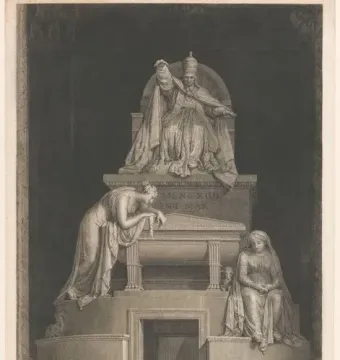
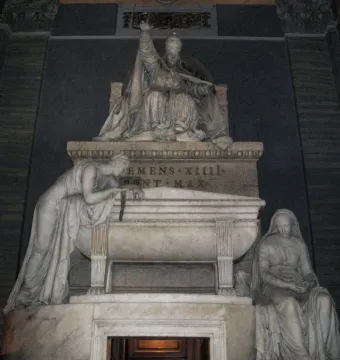
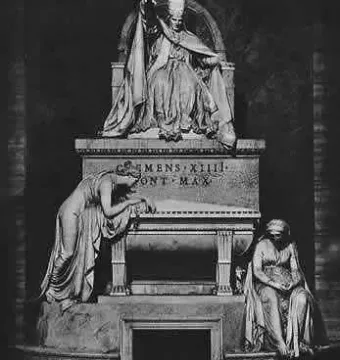
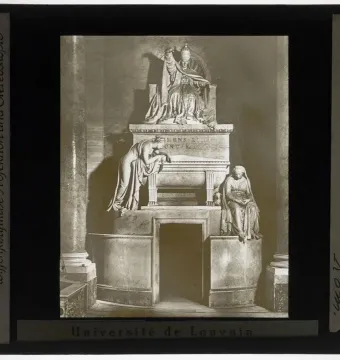
The Tomb of Pope Clement XIV is a neoclassical stone monument and sculptural tableau in Santi Apostoli, Rome, created by the Venetian sculptor Antonio Canova. It was commissioned by the merchant Carlo Giorgi and completed in 1787, thirteen years after the pope’s death. Canova used carrara marble and lumachella in the tomb’s construction. The monument stands in the church where Pope Clement XIV had served as Cardinal-Priest before being elected pontiff. The figure of Pope Clemens XIV atop the tomb is said to reference St. John the Baptist.
© Rijksmuseum · CC0
October 2009 © Yair Haklai · CC BY-SA 3.0
© ignote · Public domain
© Canova, Antonio (Italian Neo-classical sculptor, 1757-1822) (artist) · Public domain
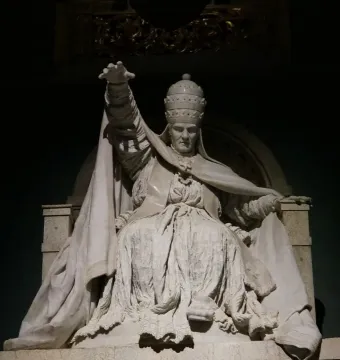
September 2018 © Kurtukov · CC BY-SA 4.0
Identification | |
| Title | Tomb of Pope Clement XIV |
| Original title | Monumento funerario di Clemente XIV |
| Original French title | Le Tombeau de Clément XIV |
| Type | Neoclassical funerary monument and sculptural tableaux |
| Subject | Pope Clement XIV (1705–1774) |
Historical context | |
| Pope commemorated | Pope Clement XIV |
| Pope's background | Clement XIV was a member of the Conventual Franciscans |
| Papal context | During his pontificate he showed a modest adherence to Enlightenment ideas and suppressed the Society of Jesus in 1773 with the papal document Dominus ac Redemptor |
Creator | |
| Sculptor | Antonio Canova |
| Sculptor nationality | Venetian |
Discovery and provenance | |
| Commissioned by | Carlo Giorgi, a merchant |
| Commissioning context | Carlo Giorgi was directed by Giovanni Volpato and Gravin Hamilton and commissioned the monument in gratitude for benefits received from Pope Clement XIV |
| Date of creation | 1783–1787 |
| Completion date | 1787 |
| Time from Pope's death to completion | 13 years |
Materials | |
| Materials | Carrara marble and lumachella |
Physical characteristics | |
| Scale | Grand mausoleum |
| Style | Neoclassical |
| Composition | Figures are arranged asymmetrically but in a balanced way |
| Geometric form | Uses geometric forms |
Appearance | |
| Pope's pose | Pope Clement XIV stands at the top of the monument with his right arm raised in a warning gesture |
| Pope's interpretation | The gesture presents the pope as governor of the Catholic world and is said to reference St. John the Baptist |
| Temperance | Leaning over the sarcophagus with a calm, resigned expression |
| Mildness (Mansuetudine) | Head bowed, curled up on herself, with arms intertwined on her lap, reflecting on the fate of humanity |
Location and ownership | |
| Current location | Left nave of the Basilica dei Santi Apostoli, Rome |
| Associated church | The Basilica of the Holy Apostles, where Clement XIV had been cardinal-priest before becoming pope |
| Site jurisdiction | The basilica and adjoining convent are under the jurisdiction of the Conventual Franciscans, whose general curia is there |
| Plaster replica location | Gipsoteca canoviana, Possagno |
History and restoration | |
| Artistic significance | Canova's first brilliant attempt at a crucial funerary type that would occupy him thereafter |
| Historical significance | This composition codified a new form of funerary monument |