
Pasquino
Pasquino is a battered Hellenistic-style statue, perhaps dating to the third century BC, that was unearthed in Rome’s Parione district in the fifteenth century. Since the early modern period, Romans have used the name to refer to it, and it became famous as the first of Rome’s talking statues because anonymous criticisms were traditionally attached to its base. The satirical form known as a pasquinade takes its name from this custom. The statue stands in Piazza Pasquino, near the northwest corner of the Palazzo Braschi and close to the site where it was found. Its subject is identified as Menelaus supporting the body of Patroclus.
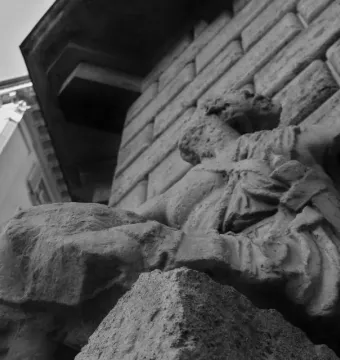
August 2020 © CamillaM107 · CC BY-SA 4.0
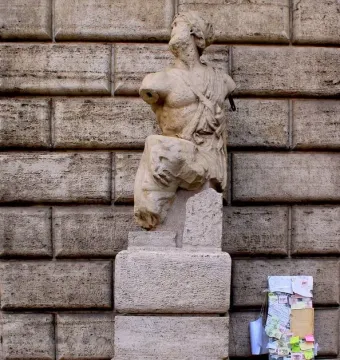
September 2019 © Reflex2.0 · CC BY-SA 4.0
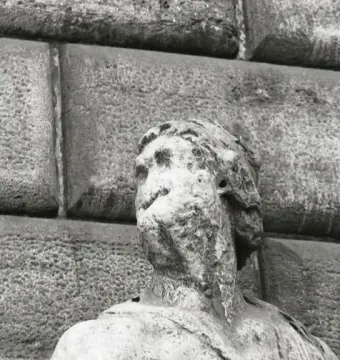
© Paolo Monti · CC BY-SA 4.0
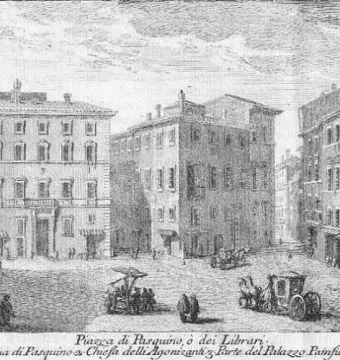
1752 © Giuseppe Vasi · Public domain
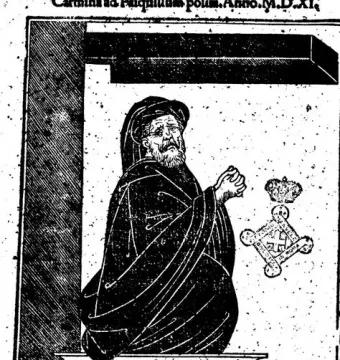
1511 © Unknown authorUnknown author · Public domain
Identification | |
| Title | Pasquino |
| Type | Ancient fragmentary marble sculpture; later one of Rome's talking statues |
| English name | Pasquin |
| Latin names | Pasquinus; Pasquillus |
Historical context | |
| Date | Probably 3rd century BC |
| Style | Hellenistic |
| Original group | Probably a copy of a Hellenistic sculptural group by Antigonos |
| Subject | Menelaus supporting the body of Patroclus |
| Alternative identifications | Hercules strangling Geryon; Ajax supporting the body of Achilles; Hercules fighting the Centaurs; a Greek warrior killing an enemy; two warriors, one supporting the other |
| Original location | Possibly the ancient Roman Stadium of Domitian beneath present-day Piazza Navona |
Creator | |
| Attributed to | Antigonos (for the original group) |
Discovery and provenance | |
| Discovery location | Near Palazzo Orsini in the Parione district of Rome, at the site where it now stands |
| Find circumstances | Found during paving works in muddy ground; reportedly had lain there for many years and may have served as a footbridge |
| Condition at discovery | Arms, legs, nose, and much of the second figure were missing; heavily damaged and fragmentary |
| Installed by | Cardinal Oliviero Carafa |
| Date of installation | 1501 |
| Installation location | On a pedestal at the corner of Palazzo Orsini, later replaced by Palazzo Braschi |
| Inscription | Oliverii Carafae beneficio sum anno salutis MDI |
| Discovery date | 1501 |
Physical characteristics | |
| Preserved form | Broken torso without arms and legs; a second torso is almost completely eroded |
| Material | Marble |
| Condition | Heavily damaged, fragmentary, and mutilated in the limbs and face |
Appearance | |
| Description | A male figure, probably armored, with the face turned upward and one hand visible on the second figure |
Location and ownership | |
| Current location | Piazza Pasquino, Rome, on the northwest corner of Palazzo Braschi near Piazza Navona |
| Current display | Still in the same public setting since 1501 |
| Naming relationship | Piazza Pasquino is named after the statue |
Iconography and meaning | |
| Other talking statues | Marforio, Babuino, Abbate Luigi, Facchino, and Madama Lucrezia |
| Social significance | Especially active during the periods of papal nepotism, the pontificate of Leo X, and conclaves |
| Historical role | The first and most famous of Rome's talking statues; the only one still in use |
| Associated literary form | Satirical poem or pamphlet derived from the statue's name |
| Derived terms | Pasquinade; pasquinate; pasquil; pasquillo |
| Forms used | Latin at first, later mostly Italian or Roman dialect; written in verse and prose; posted on leaflets, tablets, or a notice board |
| Function of notices | A vehicle for popular discontent, political opposition, and religious criticism |
| Associated tradition | Anonymous satirical notices, verses, pamphlets, and epigrams have been attached to the statue or its pedestal, often at night and especially on Saint Mark's Day, to criticize public figures, the papacy, and social and political abuses |
History and restoration | |
| Published collections | Pasquinades were collected and printed; a surviving series exists from 1509 to 1525, including Carmina apposita Pasquino |
| Notable users | Pietro Aretino; Celio Secondo Curione |
| Related publication | Pasquillorum tomi duo (1544) |
Significance | |
| Admired by | Gian Lorenzo Bernini, who considered it the most beautiful sculpture in Rome |
| Literary reference | Mentioned by Joachim du Bellay in Les Regrets, including sonnet 108 |