
Brunswick Lion
Brunswick Lion is a Romanesque bronze sculpture of Duke Henry the Lion, created in 1166 for the Burgplatz in Braunschweig. It shows a roaring lion standing on its front paws and was cast, probably in a local workshop, from copper ores from Rammelsberg near Goslar. The work is regarded as the oldest surviving medieval monumental artwork and a major example of bronze casting. It has been repeatedly restored over the centuries. In 1989 the original was moved to the medieval collection of the Herzog Anton Ulrich Museum, while a faithful copy made in 1937 remained on the historic square.
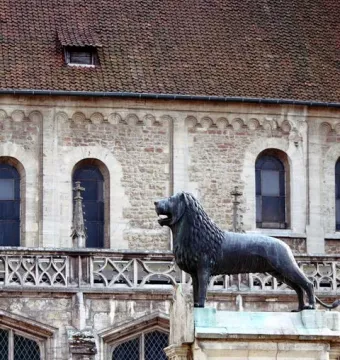
September 2011 © Viteunic · CC BY-SA 3.0
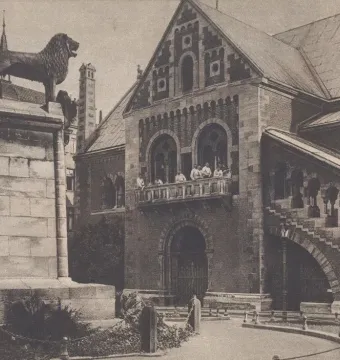
© Unknown authorUnknown author · Public domain
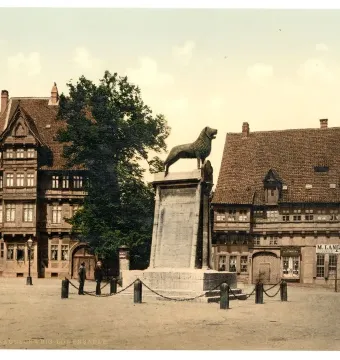
© Photochrom Print Collection · Public domain
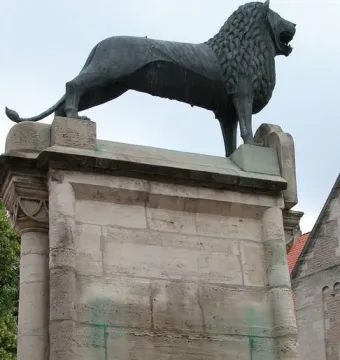
June 2009 © Brunswyk · Public domain
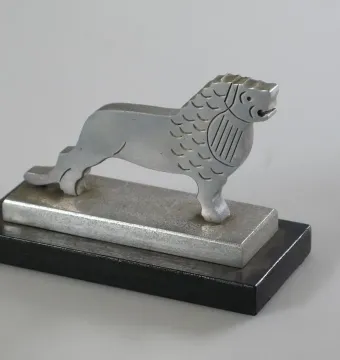
1955 © Unknown authorUnknown author · CC BY-SA 3.0
Identification | |
| Title | Brunswick Lion |
| German name | Braunschweiger Löwe |
| Alternative names | Burglöwe; Löwenstein |
| Type | Medieval bronze free-standing monumental sculpture of a lion |
Historical context | |
| Date | Probably between 1164 and 1176; traditionally given as 1166, but this is disputed |
| Historical context | Created during the period when Henry the Lion took up residence in Braunschweig |
Creator | |
| Patron | Henry the Lion, Duke of Saxony and Bavaria |
| Artist | Unknown, probably made in a local Brunswick workshop; possibly by an experienced goldsmith or bell founder |
| Place of casting | Brunswick |
Materials | |
| Material | Bronze; originally gilded; eyes originally enameled |
| Source material | Probably made from copper ore mined in Rammelsberg near Goslar |
Technique | |
| Technique | Bronze casting; fine chasing |
Physical characteristics | |
| Height | 1.78 m |
| Length | 2.79 m |
| Weight | 880 kg |
| Wall thickness | Up to 12 mm |
Appearance | |
| Subject | A roaring lion standing on its front paws, representing Duke Henry the Lion |
| Style | Romanesque art; stylized but naturalistic and full of life |
Discovery and provenance | |
| Original location | Burgplatz in Brunswick, in front of Dankwarderode Castle and the collegiate church / cathedral |
| Original setting | Placed on a high stone pedestal, originally on two low columns |
| Replacement at original site | A replica was placed on Burgplatz after the original was moved |
Location and ownership | |
| Current location of original | Dankwarderode Castle, Brunswick; temporarily moved to the Herzog Anton Ulrich Museum in 2025, viewable there from March 2026 |
| Current replica location | Burgplatz, Brunswick |
History and restoration | |
| Inscriptions | A later sandstone plaque existed; the original plaque is now in the Städtisches Museum Braunschweig and was replaced by a copy in 1858; an older inscription plaque is reported in a 1722 chronicle but is lost and its date is unclear |
| 1980 relocation | The original was moved indoors in 1980 because increasing air pollution had damaged it; the 1937 copy was placed on Burgplatz on 9 July 1980 and remains there |
| World War II protection | In 1943 the original was secretly exchanged for a copy and moved to a mine tunnel at Rammelsberg near Goslar for safekeeping; returned to Brunswick on 23 October 1945 and reinstalled in 1946 |
| 1858 restoration | Restored in the workshop of Brunswick bronze caster Georg Ferdinand Howaldt; the pedestal was dismantled and rebuilt |
| 1616 alteration | The lion received a new pedestal; the original two low columns were replaced by a pyramidal base and a sandstone inscription plaque was added |
| Restorations and renewals | 1412; 1616; 1721; 1762; 1791-1792; 1818; 1858; 1980-1983 |
Significance | |
| Meaning | A personal emblem of Henry the Lion and a symbol of his power, ducal authority, jurisdiction, and dynastic ambitions; probably also an expression of his claim to power against Emperor Frederick Barbarossa |
| Art historical significance | Considered the oldest surviving large-scale sculptural work of the Middle Ages north of the Alps, the first secular free-standing large sculpture of the Middle Ages north of the Alps, and the first large hollow casting of a figure since antiquity |
| City significance | The best-known symbol and landmark of Braunschweig |
| Models and influence | Probably modeled on the Capitoline Wolf, the Lion of Saint Mark in Venice, and the equestrian statue of Marcus Aurelius in Rome; Henry the Lion likely knew these works through his Italian campaigns with Emperor Frederick Barbarossa |
| Iconographic use | Used as a motif in medieval and later iconography, including city seals, the Ebstorf World Map, Hermann Bote's Sachsenchronik, ducal coins, the 1942 five-mark banknote, and a 1990s Deutsche Bundespost stamp |
Other | |
| Copies and replicas | The sculpture had numerous copies and replicas worldwide, mainly in Germany |