
Dawn
Dawn is a marble statue by Michelangelo, made between 1524 and 1527. It forms part of the decoration of the Sagrestia Nuova, the New Sacristy of the Basilica of San Lorenzo in Florence. The work is one of the four allegories of the Times of Day and is placed on the right side of the sarcophagus of Lorenzo II de' Medici, Duke of Urbino. The sculpture has been interpreted in several ways: as an emblem of bitterness or melancholy pain, as a symbol of divine light fleeing darkness, or as a representation of air, earth, or the sanguine temperament. Giorgio Vasari associated it with grief and mourning for the duke’s death.
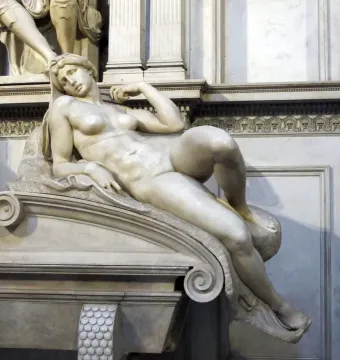
June 2014 © Francesco Bini · CC BY-SA 4.0
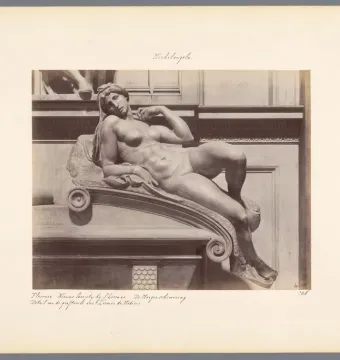
© Rijksmuseum · CC0
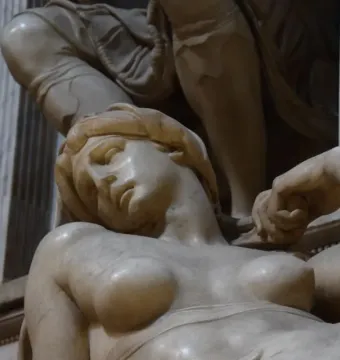
June 2019 © George M. Groutas · CC BY 2.0
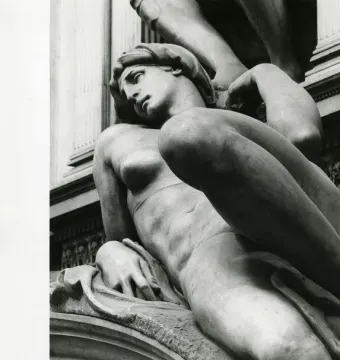
© Paolo Monti · CC BY-SA 4.0
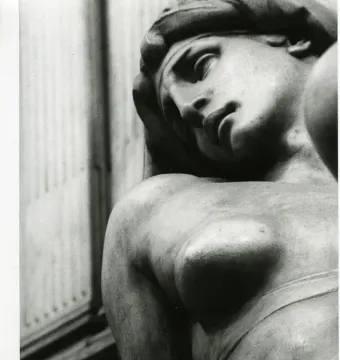
© Paolo Monti · CC BY-SA 4.0
Identification | |
| Title | Dawn |
| Alternative names | Aurora; La Aurora; La Madrugada; Le Matin; L'Aube; Dawn |
| Type | marble sculpture |
| Original title | L'Aurora |
Historical context | |
| Date of creation | c. 1524–1527 |
| Production phase | Second phase of the works on the New Sacristy |
| Historical context | After the election of Clement VII to the papal throne and the resumption of work on the Sacristy in 1524 |
Creator | |
| Artist | Michelangelo Buonarroti |
| Artist period | High Renaissance |
| Artist roles | Sculptor and painter |
Discovery and provenance | |
| Location on tomb | Right side above the sarcophagus |
| Completion status | Probably completed by 1527, though Erpel dated completion to 1531 together with Night |
| Evidence for completion | It appears in a 1527 engraving of Sigismondo Fanti's Triumph of Fortune |
| Model condition | Missing the head, left arm, and right leg below the knee |
| Model date | c. 1524 |
| Model | A terracotta model survives at the Victoria and Albert Museum, London |
| Associated commemorated person | Lorenzo II de' Medici, Duke of Urbino |
| Associated tomb | Tomb monument of Lorenzo II de' Medici, Duke of Urbino |
| Part of | Decoration of the New Sacristy (Sagrestia Nuova) of the Basilica of San Lorenzo in Florence |
| Associated patron | Pope Clement VII, who actively supported the project |
| Intended setting | Memorial chapel for Giuliano de' Medici and Lorenzo, his nephew, who died young |
| Original conception | Pope Leo X |
| Commissioned by | Pope Clement VII |
History and restoration | |
| Work period | 1526–1531 |
| Unfinished status | Michelangelo left for Rome in 1534 without installing the sculpture or completing the tomb |
Physical characteristics | |
| Fit to base | Does not fit perfectly and was adapted to the sloping plan with a little fill material |
| Condition | Unfinished, especially at the feet |
| Maximum oblique length | 206 cm |
| Dimensions | 155 × 180 cm |
Materials | |
| Material | Marble |
| Model material | Terracotta |
Technique | |
| Modeling | The surviving model differs significantly from the final sculpture, especially in pose and drapery; its back is fully finished, unlike the marble sculpture's roughly worked back |
Appearance | |
| Eyes | Empty, with no pupil or iris |
| Completion details | The marble sculpture leans more toward the viewer than the original design, which lay more horizontally |
| Chest detail | A ribbon is tied beneath her breasts |
| Gesture | Appears to be waking from sleep, rising from the bier and turning the torso toward the viewer |
| Head and face | Veiled, with half-closed eyes, a slightly open mouth, and the head turned toward the viewer and inclined toward the right shoulder |
| Pose | Half-reclining and nude on a sarcophagus, leaning on her right arm, with the left arm bent toward the veil, one leg extended along the sarcophagus and the other bent forward for support |
| Depicted figure | A female personification of dawn, shown as a not-yet-awakened woman |
Iconography and meaning | |
| Possible models | Possibly modeled on the mountain and river divinities on the Arch of Septimius Severus in Rome; another proposed model is the Sleeping Ariadne |
| Interpretive note | Borghini noted in 1584 that L'Aurore, Twilight, and Day have no attributes and therefore cannot be identified |
| Interpretive note | Tolnay agreed that the veil is a symbol of mourning, but considered such interpretations not necessary or definitive |
| Specific interpretations | Liebman: Aurora painfully awakens from heavy dreams and her young body bends as if from inner pain; Lazarev: the statue is elevated by the contrast between a blooming maidenly body and a mortally tormented soul within it |
| Iconological interpretations | Interpreted variously as an emblem of bitterness; pain mediated by the melancholic temperament; divine light driving away darkness; the sanguine temperament; the element air; or the element earth |
| Formal resemblance | Has a formal resemblance to ancient river deities |
| Interpretive status | Lacks attributes and cannot be securely identified as an antique-style allegory of the times of day |
| Dialectical meaning | This contrast is presented as a dialectical correspondence to the Madonna, who is both virgin and mother |
| General interpretation | Represents awakening from heavy dreams and suffering; also described as the opposite of Night, with maidenly femininity contrasted against Night's mature femininity |
| Eye symbolism | Blindness symbolizing Sleep and Oblivion, and powerlessness before Fate |
| Ribbon meaning | Symbol of slavery |
| Veil meaning | Symbol of mourning |
| Vasari interpretation | Expression of grief and mourning for the death of Duke Lorenzo, based on the figure's body position, posture, attitude, and gaze |
| Subject | One of the four allegories of the Parts of the Day |
Location and ownership | |
| Current location | Medici Chapel, Florence |