
B of the Bang
B of the Bang was a sculpture designed by Thomas Heatherwick and located near the City of Manchester Stadium in Manchester, United Kingdom. Its form recalled an exploding firework, and it was commissioned for the 2002 Commonwealth Games. Once one of the tallest structures in Manchester, it was also the tallest sculpture in the United Kingdom until Aspire was completed in 2008. The sculpture took its name from a phrase used by sprinter Linford Christie. Built after a commission in 2003, it was not inaugurated until later than planned. Structural problems led to legal action, and in 2009 Manchester City Council decided that dismantling and storage was the only practical solution. The sculpture was later taken apart, despite hopes of possible reconstruction.
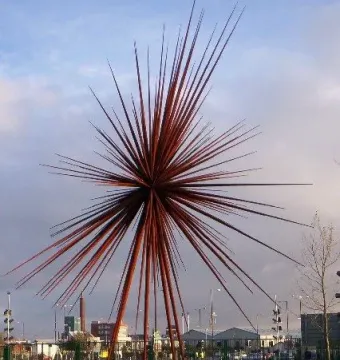
November 2005 © S. Parish · CC BY-SA 2.0
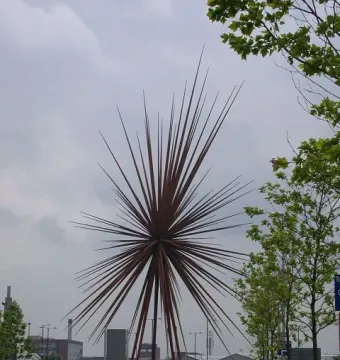
June 2006 © Keith Edkins · CC BY-SA 2.0
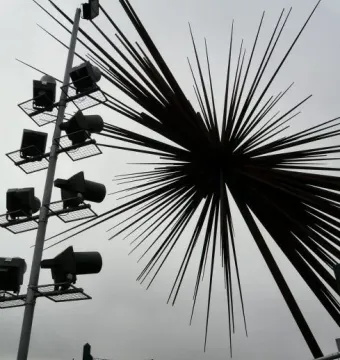
February 2009 © Gerald England · CC BY-SA 2.0
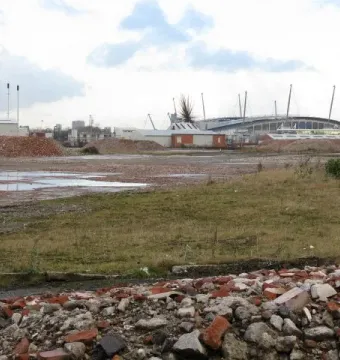
January 2009 © Whatlep · CC BY-SA 2.0
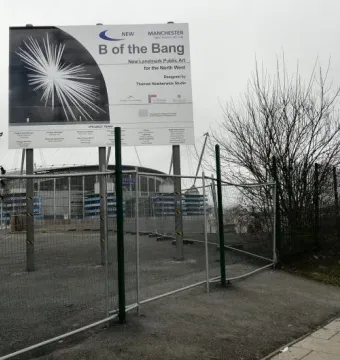
February 2009 © Gerald England · CC BY-SA 2.0
Identification | |
| Title | B of the Bang |
| Type | Sculpture |
Creator | |
| Designer | Thomas Heatherwick |
Location and ownership | |
| Location | Near the City of Manchester Stadium, Sportcity, Beswick, Manchester, England, at the corner of Alan Turing Way and Ashton New Road |
Historical context | |
| Original expected completion date | July 2003 |
| Nickname origin | Named by locals after the 1970s children's game |
| Nickname | KerPlunk |
| Name origin | Named after Linford Christie's phrase about starting races at the 'B of the bang' rather than the bang of the starting pistol |
| Design concept | Designed to resemble an exploding firework |
| Project approval date | Early 2003 |
| Construction team | Thomas Heatherwick Studio, Packman Lucas, Flint and Neill, and Westbury Structures |
| Construction location | Sheffield |
| Selection process | Selected in a 2002 competition by a jury of local residents and art experts |
| Commission year | 2003 |
| Commissioned for | the 2002 Commonwealth Games |
| Commissioned by | New East Manchester Limited |
Physical characteristics | |
| Spike height above ground | 3 metres |
| Foundation size | 20 metres by 20 metres (400 square metres) |
| Foundation | Reinforced concrete slab |
| Weight | 165 tonnes |
| Foundation depth | 20 metres |
| Support structure detail | The legs connected to the spikes above the ground |
| Support structure | Five hollow steel feet/legs |
| Structure | A central core with 180 hollow, tapered steel spikes radiating outward |
| Inclination | Tilted at 30 degrees from the vertical |
| Height | Approximately 56 metres (184 feet) |
Materials | |
| Material | Corten steel (weathering steel) |
| Material property | Develops a tightly adhering oxide layer when exposed to the elements, reducing water permeability and further corrosion |
| Foundation material | Reinforced concrete |
Technique | |
| Wind design | The spikes were designed to sway slightly in wind to withstand gusts of over 100 mph (160 km/h) |
Other | |
| Original design and construction location | Manchester |
| Coordinates | Provided in the source text, but not shown in the fragment |
| Time capsule | A time capsule containing poems and drawings by children was placed inside one of the spikes during construction and was intended to be opened around 2300; its location has been unknown since dismantling |
Significance | |
| Height comparison | Taller and leaned at a greater angle than the Leaning Tower of Pisa |
| Height comparison | More than twice the height of the Angel of the North |
| Height status | One of the tallest structures in Manchester and the tallest sculpture in the United Kingdom until Aspire was completed in 2008 |
Discovery and provenance | |
| Initial cost estimate | About half the final cost, because installation costs were omitted from the estimate |
| Funding | £700,000 from the European Regional Development Fund; £500,000 from the North West Regional Development Agency; £120,000 from Manchester City Council; additional funding from other organizations |
| Construction cost | £1.42 million |
History and restoration | |
| Unveiling date | 12 January 2005 |
| Unveiled by | Linford Christie |
| Pre-unveiling damage | Six days before unveiling, the tip of one spike detached and fell to the ground |
| Structural problems | The sculpture developed structural integrity problems, with three visible problem areas |
| Settlement | Out-of-court settlement of £1.7 million |
| Dismantling announcement | In February 2009, Manchester City Council announced that the sculpture would be dismantled and placed in storage |
| Dismantled | Yes, in 2009 |
| Removal consequences | During removal, the core and legs were cut apart despite promises of storage and possible reassembly |
| Current storage status | The 180 spikes remain in storage |
| Core disposal | The core was sold for scrap in July 2012 |
| Legal action | Manchester City Council began legal action one year later |