
Trésor de Neuvy-en-Sullias
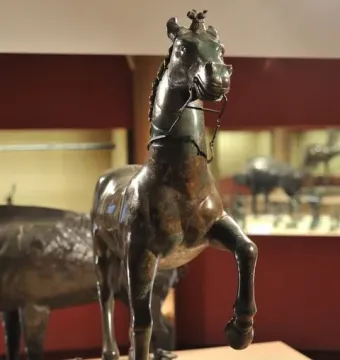
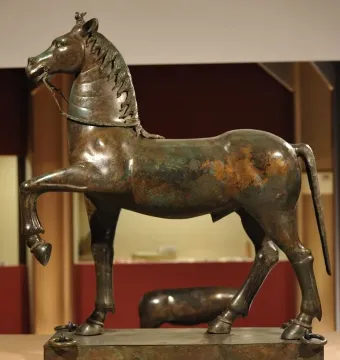
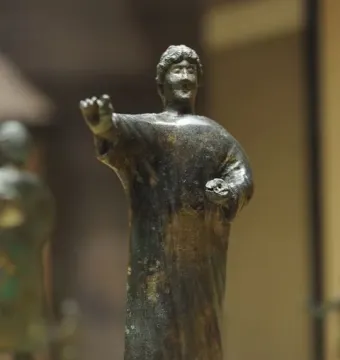
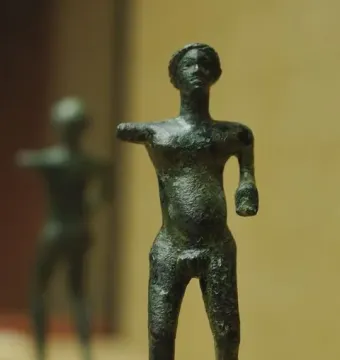
Trésor de Neuvy-en-Sullias is a Gallic and Gallo-Roman hoard of bronze objects that includes sculptures of animals and two groups of statuettes. It was discovered in 1861 in a sand mine in Neuvy-en-Sullias and is now mostly held in the Musée historique et archéologique de l'Orléanais in Orléans. The hoard is generally dated to between the 1st century BC and the 1st century AD, although the boars appear to pre-date the Romans’ arrival in Gaul. It was buried around the 2nd or 3rd century AD, and Mantellier dated the horse statue to about 150–200 AD based on its style and inscription.
July 2010 © Croquant · CC BY-SA 3.0
July 2010 © Croquant · CC BY-SA 3.0
July 2010 © Croquant · CC BY-SA 3.0
July 2010 © Croquant · CC BY-SA 3.0
July 2010 © Croquant · CC BY-SA 3.0
Identification | |
| Title | Trésor de Neuvy-en-Sullias |
| Type | hoard of bronze sculptural and cult objects |
| Alternative name | Neuvy-en-Sullias Hoard |
Historical context | |
| Cultural period | Gaulish and Gallo-Roman period |
| Date of objects | Estimated between the 1st century BC and the 1st century AD; the boars predate the Roman arrival in Gaul |
| Burial date | Probably around the 2nd or 3rd century AD |
Creator | |
| Horse statue date according to Philippe Mantellier | Second half of the 2nd century AD |
| Basis for horse statue dating | Its particular workmanship and the form of the inscription letters |
Discovery and provenance | |
| Extent of discovery | The exact extent remains unclear because of the circumstances of the find, lack of site supervision, and disputes over dividing the objects |
| Acquisition | Acquired by the city of Orléans in 1864 |
| Reported additional contents | Silver coins and harness fittings, now disappeared; some missing pieces were later recovered |
| Discoverers | Workers in a sand quarry |
| Findspot context | A cache made of bricks, stones, and tiles, without masonry |
| Discovery circumstances | Chance discovery |
| Discovery place | A sand quarry in Neuvy-en-Sullias, Loiret, France |
| Discovery date | 27 May 1861 |
Physical characteristics | |
| Composition | About thirty bronze objects grouped into three lots |
| Included objects | Animal sculptures; stylized statuettes; statuettes of Latin divinities; statues and statuettes of animals, human figures, and deities |
Materials | |
| Main material | Bronze |
| Boar material | Bronze sheets hammered over a wooden core, with decorative details in repoussé |
Technique | |
| Boar technique | Made by hammering metal plates over a wooden form, with decorative details later executed in repoussé |
| Horse manufacture | Apparently cast from an existing model, with the wax model's mane changed to a more Romanized style before casting |
| Horse technique | Lost-wax cast bronze with a bridle of spun bronze wire |
| Casting technique | Most objects are cast bronze |
Appearance | |
| Horse | A large, well-made horse with its left front hoof raised; 1.05 m tall and 54 kg without its plinth |
| Horse style | Compact and stocky; the head is extremely refined and the tail is much cruder |
| Large boar | A life-size boar, 1.25 m long; restoration is incomplete |
| Small animal statuettes | Four smaller animal statuettes: two boars, a deer, and a cow; 25 to 50 cm long |
| Bull figurine | A classical-style bull figurine, possibly imported |
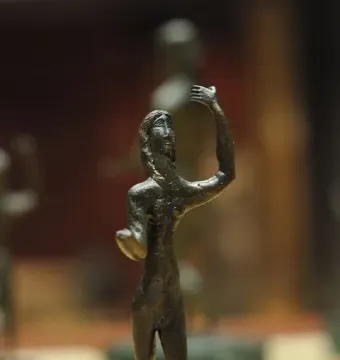
| Great Dancer | A nude, slender woman in a graceful dancer's pose; 13.5 cm tall |
| Trumpet | 1.52 m long and 854 g |
Iconography and meaning | |
| Boars interpretation | Wild boars are Gaulish symbols and war standards |
| Overall interpretation | Now considered a cultic assemblage from one or more Gaulish temples or fanums, possibly including smaller objects from a private lararium or family altar |
| Great Dancer significance | Became known through the 1955 exhibition Pérennité de l'art gaulois in Paris; admired by André Malraux, who chose it to illustrate Les Voix du silence; also reproduced in the Louvre cast series |
| Horse plaque | The base bears a plaque naming the place where it was found and the god to whom it was dedicated |
| Horse significance | Taken as evidence that statue models circulated in antiquity; its compact build has been linked to changes in horse breeding after the Roman arrival in Gaul |
| Horse dedication | The deity remains disputed |
| Horse viewing position | Intended to be seen from the front; the anatomy is rendered correctly in high perspective |
| Horse display | Designed to be placed high up, possibly suspended from the four rings on its base |
Location and ownership | |
| Current location | Most of the treasure is held in the Musée historique et archéologique de l'Orléanais in Orléans |
| Associated museum display | A boar from the hoard is on display at the musée de Bibracte |
History and restoration | |
| Interpretation history | Earlier hypotheses included a bronze worker's stock for recycling, loot from thieves, or a temple treasure hidden to avoid looting |
| Burial context | The container was carefully built, arguing against a hurried or temporary hiding place |
| Research history | First complete study by Philippe Mantellier in 1864; new scientific study from 2003 to 2006; symposium in Orléans in June 2007; exhibitions at the Museum of Fine Arts of Orléans (13 March–26 August 2007) and Bavay (15 January–15 June 2008) |
Significance | |
| Significance | One of the most remarkable sets of Gallo-Roman bronze objects from Gaul |