
Keyboard Monument
Keyboard Monument is a land-art sculpture in Yekaterinburg dedicated to a computer keyboard. It was opened on 5 October 2005 and created by Anatoliy Vyatkin. The monument became known not only as a local landmark but also for its preservation issues: by June 2011 several keys had been stolen, and one key was marked with an Apple logo. The missing keys were restored on 17 August 2011 by a local initiative group, with support from Anton Borisenko, while the artist was present. The monument has also become a site for regular cultural events, including the annual “Cleanup at the Keyboard” and Sysadmin Day celebrations. In May 2019, reports said it was under threat because of nearby development.
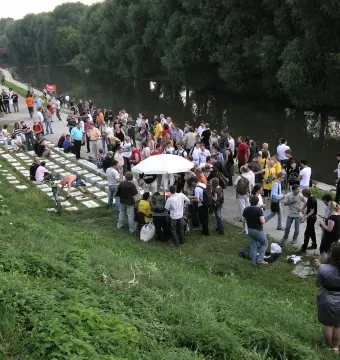
July 2011 © Karelina96 · CC BY-SA 4.0
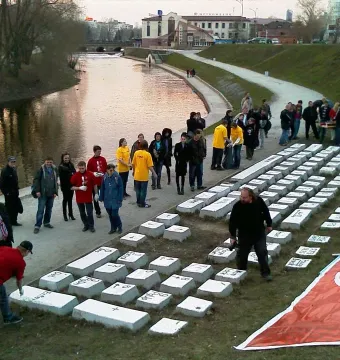
April 2011 © Ssr · CC BY-SA 3.0
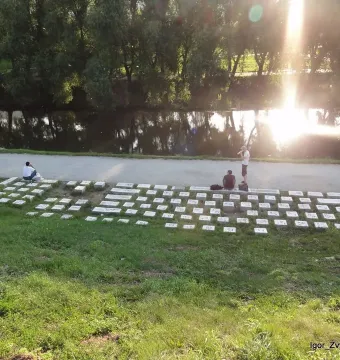
© Igor Zvyaghin · CC BY-SA 3.0
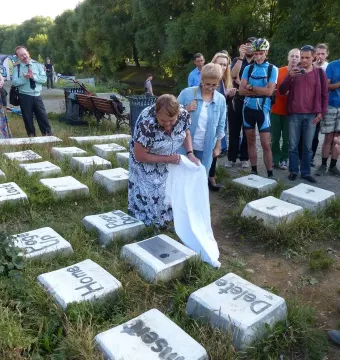
July 2016 © Karelina96 · CC BY-SA 4.0
April 2011 © Ssr · CC BY-SA 3.0
Identification | |
| Title | Keyboard monument |
| Subject | Computer keyboard |
| Original title | Памятник клавиатуре |
| Alternative names | Клава; "The Keyboard"; Clavier |
| Type | Sculpture / monument |
Historical context | |
| Created year | 2005 |
| Unveiled | 5 October 2005 |
| Created for | The festival "Long Stories of Yekaterinburg" |
| Creation concept | Originally conceived as an ironic idea described as "the cemetery of ideas"; the final version removed the irony and was intended as a permanent work for Yekaterinburg |
Creator | |
| Producers and curators | Nailya Allahverdieva and Arseny Sergeev |
| Technical support | Atomstroykompleks |
| Associated group | ArtPolitika |
| Artist | Anatoliy Vyatkin |
Discovery and provenance | |
| Installation period | 27 September to 3 October 2005 |
Physical characteristics | |
| Style | Land art |
| Scale | 30:1 |
| Dimensions | 16 × 4 m |
| Number of keys | 104 |
| Key weight | Each key weighs 100–500 kg; the space bar weighs more than 500 kg |
| Spacing between keys | About 15 cm |
| Layout | Russian Cyrillic ЙЦУКЕН layout with Latin alphabet and Cyrillic scripts; arranged in the standard order of a computer keyboard |
Materials | |
| Material | Concrete |
Technique | |
| Construction material planned by author | Foam concrete |
Appearance | |
| Landscape concept | Intended to blend into the natural setting like a rock garden |
| Function | Each key also serves as a bench |
| Placement | Installed on the Iset River embankment at the foot of a small hill |
| Description | A concrete copy of an enlarged computer keyboard |
| Key details | Flat key surfaces with raised lettering and functional symbols |
Iconography and meaning | |
| Symbolism | Represents the computer era in human history and Yekaterinburg as a city of modern technologies in the 21st century |
| Cultural symbolism | Intended to unite Eastern and Western civilizations and to symbolize communication between people worldwide |
| Geographic symbolism | Suggests Yekaterinburg lies on the border of two worlds |
| Interpretation | Can be seen as both a fetish of the computer era and an industrial garden of stones/pebbles |
| Initial concept | An ergonomic keyboard shape with keys several times larger than the final version |
Location and ownership | |
| Location | Iset River embankment near Gogol Street, central Yekaterinburg, Russia |
| Current route association | Marked by the Red Line tourist route in central Yekaterinburg |
History and restoration | |
| Nearby damage | The nearby stairway was destroyed |
| Memorial plaques | Memorial plaques were installed in 2016 and July 2016 to honor a recently deceased Yekaterinburg FidoNet organiser and Internet pioneer, and Yevhenii Zorin |
| Events near the sculpture | Since 2010, official Sysadmin Day celebrations have been held near the monument; annual Keyboard Subbotniks are also held there |
| Restoration funding | The 2025 restoration cost 600,000 rubles and was funded by donations from local residents and businesses |
| Proposed relocation | In 2011, the Perm Museum of Contemporary Art proposed moving the monument to Perm |
| Restoration | Keys F1, F2, F3, and Y were rebuilt in 2011; the monument was officially restored on 17 August 2011; it was cleaned and restored in 2025 and paint was removed from the keys |
| Demolition threat | In May 2019, the monument was reported to be under threat of demolition |
| Theft and damage | Keys including F1, F2, F3, Y, and the Windows key were stolen; the Windows key was once covered with an Apple logo |
| Red Line event | In spring 2011, the Red Line pavement marking began from the monument |
| Public reception | Highly popular with city residents and visitors; widely included in unofficial guidebooks and guidebooks to Yekaterinburg |
| Official status | Never received official monument status and is not recognized by Yekaterinburg authorities as a culturally significant object |
Significance | |
| Claimed uniqueness | According to the designers and Ural media, it is the only monument of its kind in the world |
| Claimed size | According to the designers and Ural media, it is the largest keyboard in the world |
| Cultural significance | Considered one of the city's top sights and a cultural landmark of Yekaterinburg's modern image |
| Tourism status | Featured in many guidebooks and included in the Red Line tourist route |
| Media coverage | In 2018, The New York Times published a long article about it during the FIFA World Cup |
| Search ranking | In 2019 Yandex search statistics, it ranked second among Russian monuments, behind the Bronze Horseman and ahead of the Monument to Minin and Pozharsky |
| Competition participation | It participated in the 2011 "7 Wonders of Russia" competition |
| Notable visitors | Niklaus Wirth, designer of the Pascal language, saw the sculpture under construction and found it fascinating |