
Rassam Cylinder
The Rassam Cylinder is a ten-sided prism engraved with cuneiform script and dated to 643 BCE. It tells, in the first person, about the military campaigns of Ashurbanipal, king of the Neo-Assyrian Empire. The cylinder was discovered in the North Palace of Nineveh by the Anglo-Iraqi archaeologist Hormuzd Rassam in 1854, which is how it got its name. It is preserved in the British Museum.
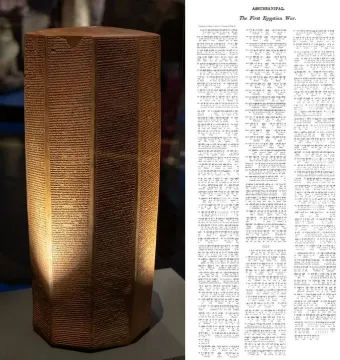
June 2020 © Anthony Huan · CC BY-SA 2.0
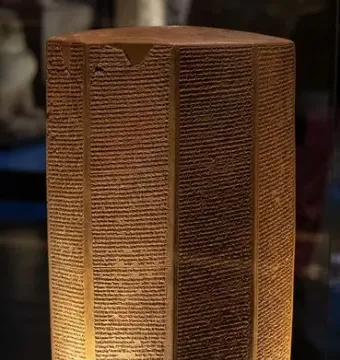
November 2018 © Anthony Huan · CC BY-SA 2.0
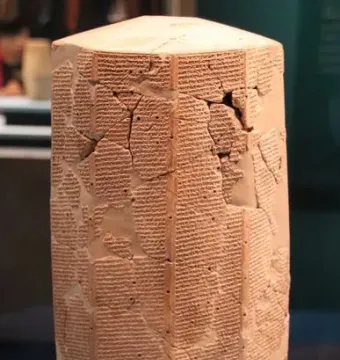
June 2018 © Gary Todd · CC0
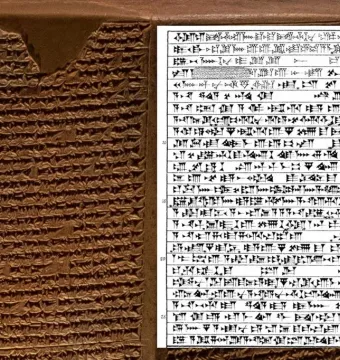
June 2020 © Anthony Huan · CC BY-SA 2.0
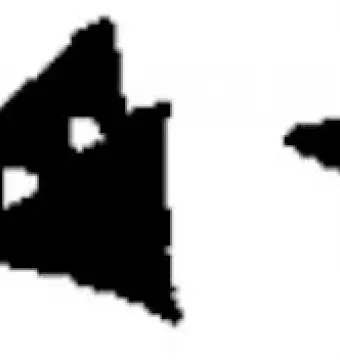
January 1907 © Theophilus Goldridge Pinches M.R.A.S. (1856 – 6 June 1934 Muswell Hill, London) · Public domain
Identification | |
| Title | Rassam cylinder |
| Object type | cuneiform cylinder |
| Shape | prism with ten faces |
Historical context | |
| Date | 7th century BCE, probably 643 BCE |
| Dynasty or period | Neo-Assyrian |
Creator | |
| Inscribed by | Ashurbanipal, king of the Neo-Assyrian Empire |
Materials | |
| Inscription | cuneiform |
Iconography and meaning | |
| Meluhha | Possibly identical with Meroe |
| References in the inscription | Egypt (Mu-ṣur), the Kingdom of Kush (Ku-u2-si), Shabako (Sha-ba-ku-u), Taharqo (Tar-qu-u2 / Tar-qu-u), Tanutamani (Urdamanee), Esarhaddon (An-shar-pap-ash), Ashurbanipal (An-shar-du-a), the city of Aššur (AššurKI), Assyria (mat AššurKI), the supreme god Anshar (An-shar), and Meluhha |
| Content | Narrates in the first person Ashurbanipal's victorious military campaign in Egypt |
Discovery and provenance | |
| Discovered by | Hormuzd Rassam |
| Discoverer | Anglo-Iraqi archaeologist |
| Discovery date | 1854 |
| Discovery location | North Palace of Nineveh |
| Name origin | Named after Hormuzd Rassam |
Location and ownership | |
| Current location | British Museum |
Other | |
| Translation and transcription | A complete translation was made by Daniel David Luckenbill in Ancient Records of Assyria and Babylonia; a complete transcription of the cuneiform is available on CDLI |
| Related reliefs | Some reliefs from Nineveh are known that illustrate these campaigns |