
Equestrian Statue of Gattamelata
The Equestrian statue of Gattamelata is a bronze sculpture by Donatello in Piazza del Santo, Padua. Created between 1447 and 1453, it honors Erasmo da Narni, better known as Gattamelata, a condottiero of the Republic of Venice. Considered one of the earliest and most important equestrian statues of the Renaissance, it is also likely the first large-scale equestrian monument cast since antiquity. The work shows the rider and horse in a calm, controlled motion, with naturalism and psychological depth typical of the Quattrocento. Made as an autonomous sculpture rather than part of an architectural setting, it emphasizes the military leader’s dignity, intelligence, and authority.
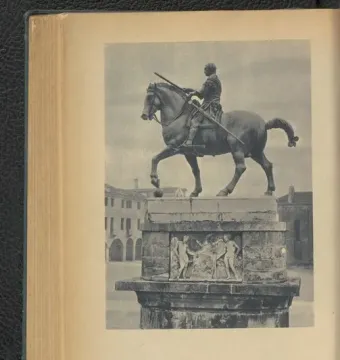
© Jacob Burckhardt · Public domain
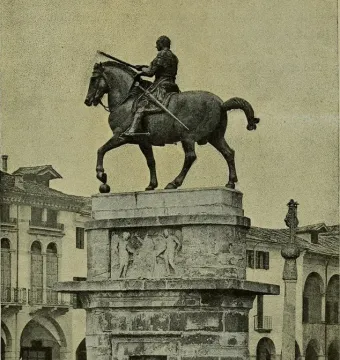
1898 © Internet Archive Book Images · No restrictions
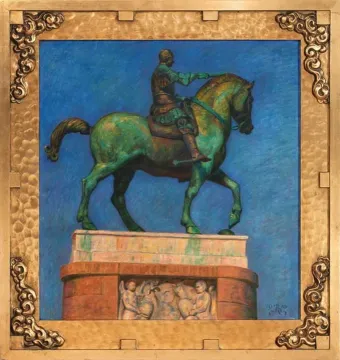
© Kristian Zahrtmann · Public domain
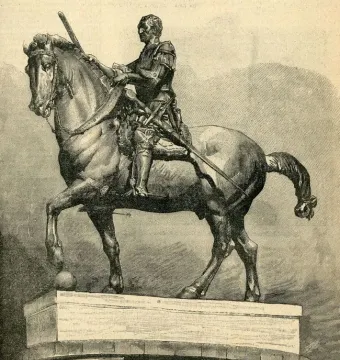
© Autore: Donatello - Incisore: sconosciuto · Public domain
October 2022 © MenkinAlRire · CC BY-SA 4.0
Identification | |
| Title | Equestrian statue of Gattamelata |
| Subject | Erasmo da Narni, known as Gattamelata, a condottiero of the Republic of Venice |
| Alternative names | Il monumento equestre del Gattamelata; Monument équestre à Gattamelata; Памятник Гаттамелате; Pomnik Gattamelaty; Pomnik konny Erasmo de′Narni zwanego Gattamelatą; Gattamelata |
| Type | Equestrian statue |
Historical context | |
| Period | Renaissance; Quattrocento |
Creator | |
| Artist | Donatello (Donato di Niccolò di Betto Bardi) |
| Casting workshop | Workshop of Andrea della Caldiere |
Discovery and provenance | |
| Authorization | Authorized by the Venetian Senate |
| Payment assessment | Assessed by a five-member commission to settle payment to the artist |
| Death of subject | 16 January 1443 |
| Commissioners and patrons | Initiated by Gattamelata's widow and testamentary executors; funded primarily by his widow Giacoma Bocarini Brunori, with possible partial funding by the Venetian Senate |
| Date made | 1446–1453 |
| Commission date | Disputed: 1443 or 1446 |
| Estimated cost | 1650 ducats |
Physical characteristics | |
| Form | Free-standing round sculpture |
| Scale | Life-size figures |
| Figure dimensions | 340 × 390 cm |
| Base dimensions | 7.80 × 4.10 m |
| Pedestal | Tall pedestal with doors |
Materials | |
| Material | Bronze |
Technique | |
| Casting technique | Lost-wax casting |
Appearance | |
| Facial expression | Concentrated, determined expression |
| Age represented | An elderly man |
| Pose and expression | The rider advances bareheaded with an austere gesture; the horse moves firmly and slowly; both are calm, measured, and restrained |
| Stylistic features | Naturalism and psychological penetration |
| Depiction | Gattamelata on horseback |
Iconography and meaning | |
| Pedestal symbolism | The false doors suggest the gates of the underworld and give the monument a funerary appearance without making it a burial place |
| Influence source | Inspired by the horses of the Church of San Marco in Venice; sometimes incorrectly linked to the Roman equestrian statue of Marcus Aurelius |
| Inscriptions and political reference | Later associated with the idea that people should fear him rather than love him, in the Machiavellian sense |
| Marcus Aurelius comparison | The raised leg led to comparison with Marcus Aurelius, but the horse's pose is closer to the San Marco horses |
| Relief decoration | Two reliefs near the top of the pedestal: Gattamelata's coat of arms presented by winged putti, and two putti displaying battle armor |
| Tyrant allegory details | The horse may represent the people, led with a short rein and large spurs; a sphere beneath the front hoof represents the world at his feet |
| Bare head symbolism | The rider is shown bareheaded to stress that he is a man, not a medieval war machine controlled by a higher will |
| Interpretation | Presents Gattamelata as a man who triumphs through intelligence; also has a possible allegorical reading as a tyrant |
| Function | Public celebratory portrait monument glorifying Gattamelata and emphasizing his military virtues |
Location and ownership | |
| Current location | Piazza del Santo, in front of the Basilica of Saint Anthony, Padua, Veneto, Italy |
| Site note | Located on the forecourt of the basilica, near the site of an old cemetery |
History and restoration | |
| Execution and installation | Models prepared in spring 1447; casting completed in 1447; finishing completed in 1450; installed on its pedestal in 1453 |
| Artist departure | Donatello left Padua in 1453 after the statue was placed on its pedestal |
| Work conditions | Work proceeded with delays because Donatello was occupied with other commissions for the Basilica of Saint Anthony |
| Burial context | Erasmo da Narni was buried inside the Basilica of Saint Anthony from 1458 according to his testamentary wishes |
Significance | |
| Historical significance | Probably the first monumental equestrian statue cast since antiquity; the oldest surviving Renaissance equestrian statue; the first full-size equestrian statue of the Italian Renaissance; one of the first modern sculptural works detached from architectural integration |
| Artistic significance | A masterpiece of Italian Renaissance art and the first to reintroduce the grandeur of Classical equestrian portraiture |
| Innovation | Autonomous sculptural form conceived in space rather than as part of architecture; one of the first works of the modern era freed from architectural integration |
| Influence | Served as a model and precedent for later sculptures honoring military heroes |