
Cantoria by Luca della Robbia
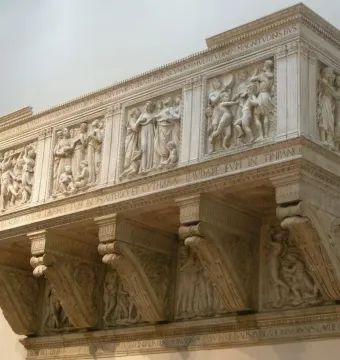
Cantoria by Luca della Robbia is an early Florentine Renaissance masterpiece carved between 1431 and 1438 for the cathedral of Santa Maria del Fiore in Florence. It is a marble tribune, or singing gallery, created for the cathedral choir. According to the illustrated panels on its facades, children or young choir students would have stood on this balcony to sing and possibly play musical instruments. Installed in 1438, the work is now conserved in the Museo dell'Opera del Duomo in Florence, where it stands opposite Donatello’s Cantoria.
May 2009 © sailko · CC BY 2.5
© Marie-Lan Nguyen · Public domain
© Rijksmuseum · CC0
1910 © Internet Archive Book Images · No restrictions
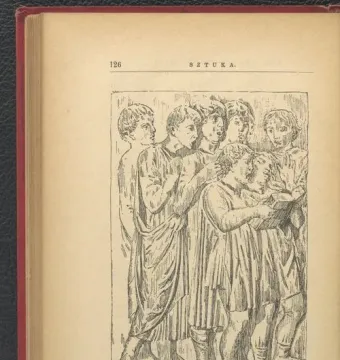
© Elie Jean Pécaut · Public domain
Identification | |
| Title | Cantoria |
| Type | Choir loft (cantoria, singing gallery) with relief sculptures |
Historical context | |
| Style | Early Florentine Renaissance |
| Date of creation | 1431–1438 |
| Completion date | 1438 |
| Function | Tribune for singers, used by boys or young students of the professional choir, and possibly for some musical instruments |
| Iconographic subject | Psalm 150 (Laudate Dominum) |
Creator | |
| Attribution significance | The first work securely attributed to Luca della Robbia |
| Artist's broader reputation | Mainly known for glazed reliefs in fired clay |
| Artist's lifespan | 1400–1482 |
| Relation to artist | One of Luca della Robbia's first works |
| Artist | Luca della Robbia |
Discovery and provenance | |
| Model for the figures | Children singing Mass in the Compagnia del Vangelista near Luca's workshop in Via Guelfa |
| Display condition | Reassembled in a museum hall at the height it originally had in the Duomo; the panels are copies, while the originals are displayed below for closer viewing |
| Removal status | Dismantled and moved to the museum |
| Display context | Displayed opposite Donatello's cantoria |
| Current location | Museo dell'Opera del Duomo, Florence, Italy |
| Original location | Florence Cathedral (Duomo di Santa Maria del Fiore), in the presbytery on the north wall, beside the high altar, on the Sacristy of the Masses side |
| Associated paired work | A second cantoria was intended for the side of the Canons' Sacristy |
| Original orientation | North-facing placement, lit by light from the south |
| Possible earlier project date | The project may have begun earlier than 1431, as cathedral funding had been frozen for the previous three years because of the war against Milan |
| Commissioned date | 1431 |
| Commissioned for | Cathedral of Santa Maria del Fiore, Florence |
Physical characteristics | |
| Height | 348 cm |
| Form | Parallelepiped supported by five corbels |
| Panel layout | Ten relief panels: four square panels on the front, two rectangular panels on the sides, and four panels between the corbels |
| Corbels | Five corbels decorated with scrolls and volutes |
| Parapet details | Pairs of small fluted pilasters with Corinthian capitals at each corbel and at the corners |
| Cornice details | Cornice with dentils and classical mouldings |
Materials | |
| Material | Marble |
Technique | |
| Production method | Panels carved in sequence, beginning with the side panels, at a rate of about two per year |
| Technique | High relief |
Appearance | |
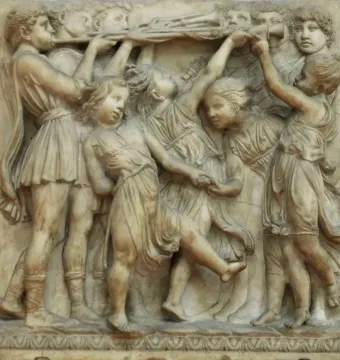
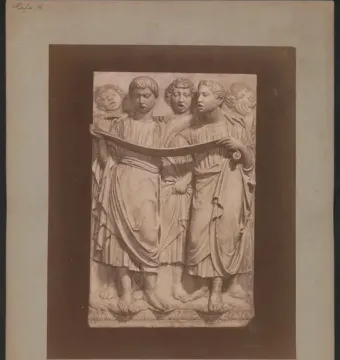
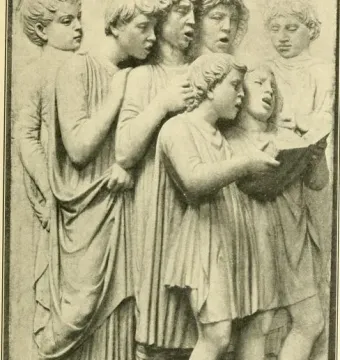
| Depicted figures | Boys of different ages, shown singing, dancing, and playing instruments |
| Costume style | Classical Roman clothing |
| Accessories | Some figures wear laurel wreaths or flower garlands |
| Expression and psychology | Figures show varied moods, from joyful participation to contemplation, concentration, and childish playfulness |
| Overall character | Serene, calm composition with classical ideals of beauty |
| Artistic effect | Graceful, balanced, and technically masterful |
| Relief style | Fairly high relief with strong chiaroscuro against a smooth background; some figures are almost independent sculptures |
Iconography and meaning | |
| Stylistic allusion | The figures are posed as if about to welcome a hero returning to Rome |
| Later influence | Some later panels show the influence of Donatello's dancing putti in the pulpit of the Duomo of Prato |
| Suggested iconographic source | Psalm 150, suggested by Matteo da Prato |
| Biblical inscription | Latin text of Psalm 150 carved in three bands: on the upper edge, on the lower edge, and beneath the corbels, in ancient-style capital letters |
| Subject matter of reliefs | Psalm 150 is illustrated by trumpets, harps, citharas, tambourines, dances, lutes, flutes, loud cymbals, and clashing cymbals |
Location and ownership | |
| Historical location in cathedral | Hung on one of the cathedral walls, about 9 meters above the faithful |
History and restoration | |
| 19th-century intervention | During renovation work directed by Gaetano Baccani, the remaining parts were removed and two simple stone cantorie were installed |
| Museum restoration | The two cantorie were reassembled, restored, and reintegrated with only minor interventions in 1887 |
| Museum purpose | Created so the cantorie could be admired alongside other works from the cathedral, satellite monuments, and the Opera's deposits |
| Museum architect | Luigi del Moro |
| Museum founding | In 1887 it was decided to dedicate a new museum to the cantorie, the Museo dell'Opera del Duomo |
| Reassembly proposals | Controversial proposals were made to reassemble it, possibly in the cathedral |
| Museum history | In the 19th century it was proposed for recomposition and musealization, and displayed at different times at the Uffizi and the Bargello |
| Completion chronology | Completed one year before Donatello's cantoria |
| Reuse of structural parts | The bases and brackets were kept to support two new inlaid wooden cantorie |
| Reason for removal | Removed because it was considered too small and old-fashioned when the cathedral was redecorated in lavish Baroque style for the wedding of Grand Prince Ferdinando de' Medici and Violante of Bavaria |
| Removal date | 1688 |
| Original crowning elements | Two bronze figures mentioned by Vasari, possibly the two candlestick-bearing putti now in the Musée Jacquemart-André in Paris |
| Contemporary documentation | Payment and completion are recorded in contemporary documents |
| Payment | 382 florins |
| Installation date | 1438 |
Significance | |
| Description | Considered a masterpiece of the early Florentine Renaissance |
| Historical significance | Described as the first choir loft in Europe |