
Apennine Colossus
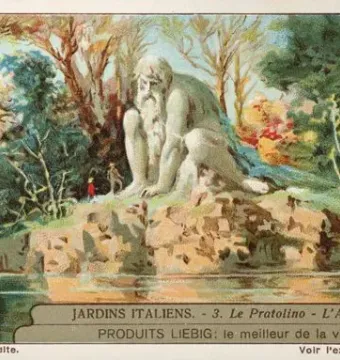
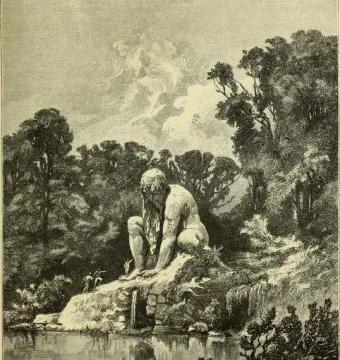
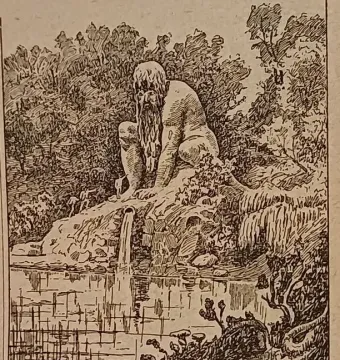
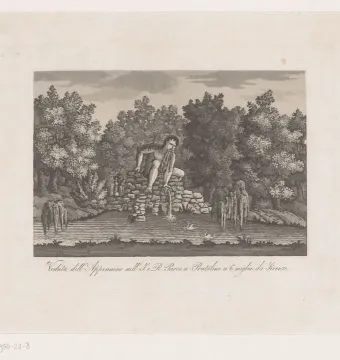
Apennine Colossus is a towering stone statue about 14 meters high, located in the grounds of Villa Demidoff in Vaglia, Tuscany. Made in the 1580s by the Flemish sculptor Jean de Boulogne, known as Giambologna, it was conceived as a personification of the Apennines and also as a fountain for Pratolino. The figure appears as an elderly man crouching by a lake, surrounded by mythological references from Ovid and Virgil. Built of stone and plaster, it contains caves and rooms on three levels, including a grotto with an octagonal fountain dedicated to Thetys. The sculpture was later altered and restored, and it remains partially covered with mosses and lichens.
April 2018 © PMRMaeyaert · CC BY-SA 4.0
1877 © Stieler, Karl, 1842-1885; Cavagna Sangiuliani di Gualdana, Antonio, conte, 1843-1913, former owner. IU-R; Paulus, Eduard, 1837-1907; Kaden, Woldemar, 1838-1907; Trollope, Frances Eleanor, d. 1913; Trollope, Thomas Adolphus, 1810-1892 · No restrictions
December 2024 © Correogsk · CC BY-SA 4.0
© Rijksmuseum · CC0
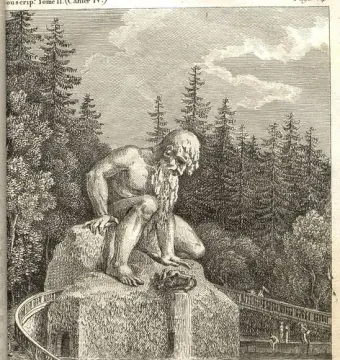
March 2017 © Université de Caen Normandie · No restrictions
Identification | |
| Title | Apennine Colossus |
| Type | monumental stone sculpture; water sculpture |
| Original Italian name | Il colosso dell'Appennino |
| Alternative names | Colossus of the Apennines; Apennine; Il Gennaio; Il Colosso; Le colosse de l'Apennin |
Historical context | |
| Date created | late 1580s; 1579-1583 |
| Historical mention | Mentioned by Michel de Montaigne during a visit while the park was still unfinished and the colossus was under construction |
Creator | |
| Artist | Giambologna (Jean de Boulogne; Juan de Bolonia), Flemish sculptor (1529-1608) |
| Patron | Francesco de' Medici, Grand Duke of Tuscany |
| Earlier estate architect | Bernardo Buontalenti |
Discovery and provenance | |
| Current location | Villa Demidoff estate, Vaglia, Tuscany, Italy |
| Associated site history | Villa di Pratolino was built from 1569 for Francesco de' Medici; it later fell into disrepair and was replaced by Villa Demidoff in the 1800s; the Pratolino estate was inscribed on the UNESCO World Heritage List in 2013 |
| Original location | Villa di Pratolino grounds, Pratolino park, Vaglia, north of Florence, Tuscany, Italy |
Physical characteristics | |
| Height | about 11 meters |
| Subject | Personification of the Apennine Mountains; sometimes identified as Jupiter, the god of the mountains, or as a representation of old age, winter, or January |
| Appearance | A colossal nude elderly man crouching at the edge of a lake, with a thick beard and long hair formed with stalactites; partly covered with moss and lichens |
| Pose | Left hand held in front as if crushing the head of a sea monster |
| Water feature | Water flowed from the sea monster's open mouth into the pond in front of the statue |
Iconography and meaning | |
| Inspiration | Possibly inspired by Atlas in Ovid's Metamorphoses; another hypothesis cites Atlas in Virgil's Aeneid |
| Meaning | A metamorphic allegory of man and mountain, blending the body with surrounding nature; may also symbolize the harshness of the Apennines |
Location and ownership | |
| Setting | Set in a landscape with aquatic vegetation and other mythological figures, including Pegasus, Mount Parnassus, and Jupiter |
| Function | Water source for Pratolino, including its fountains and hidden water games |
Materials | |
| Materials | Stone and plaster |
Technique | |
| Internal structure | A series of chambers and caves arranged on three levels inside the sculpture |
| Lower chamber | A cave with an octagonal fountain dedicated to the Greek goddess Thetis/Tethys |
| Lower chamber decoration | Decorated in 1586 by Jacopo Ligozzi with frescoes of villages and coastal peoples from the Mediterranean coast of Tuscany |
| Other interior decoration | Mining scenes based on Georgius Agricola's De re metallica |
| Upper chamber | A chamber on the upper level large enough for a small orchestra |
| Head chamber | A small chamber in the head with a fireplace and chimney flue through the nostrils, plus slits in the eyes and ears |
History and restoration | |
| Water and seasonal effects | Internal water pipes made the figure appear to sweat and weep; in winter it was covered with icicles, and in spring with moss |
| Original rear structure | The back was initially protected by a cave-like structure with a terrace above it, shown in Stefano della Bella's sketches/etchings and compared to Michelangelo's non-finito |
| Alteration in 1690 | Giovan Battista Foggini demolished the rear structure around 1690 and added a dragon statue on the back, probably a former fountain later used as a fireplace/chimney |
| Restoration | Renovated in 1876 by Rinaldo Barbetti |
Significance | |
| Historical significance | One of the earliest foreign visitors to the site was Montaigne |