
Pulpit of Prato Cathedral
The Pulpit of Prato Cathedral is a work by Donatello and Michelozzo, dated to 1428–1438. Made of marble, bronze, and mosaic tesserae, it is located on the southeast side of Prato Cathedral. The original reliefs are now kept in the Museo dell’Opera del Duomo. The pulpit stands 210 cm high without its roof, and each panel measures 73.5 x 79 cm. It has long been used for the public showing of the Madonna’s Sacred Belt, which is still displayed on Christmas, Easter, 1 May, 15 August, and in more solemn form on 8 September, the Feast of the Nativity of Mary.
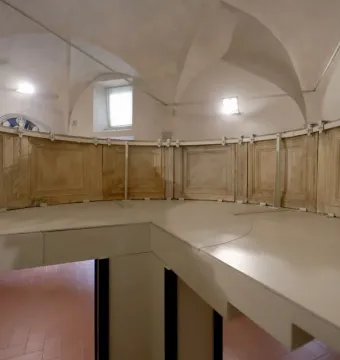
December 2024 © Fabrizio Garrisi · CC0
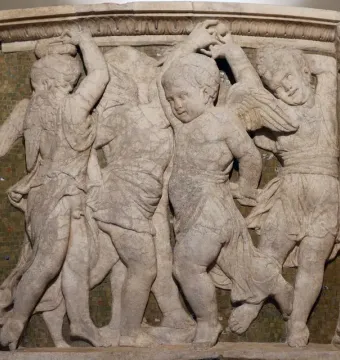
December 2024 © Fabrizio Garrisi · CC0
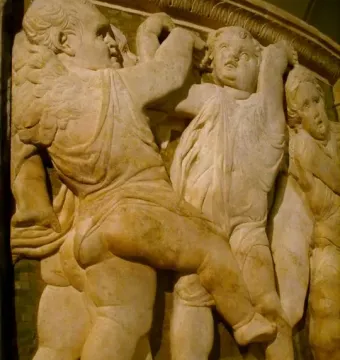
August 2007 © sailko · CC BY 2.5
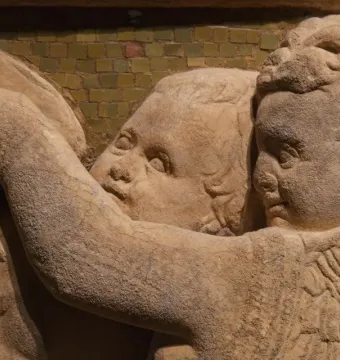
October 2022 © MenkinAlRire · CC BY-SA 4.0
May 2016 © Francesco Bini · CC BY-SA 4.0
Identification | |
| Title | Pulpit of Prato Cathedral |
| French title | La chaire du dôme de Prato |
| Type | Exterior pulpit |
| Italian title | Il pulpito del Duomo di Prato |
Historical context | |
| Date | 1428–1438 |
| Commission date | July 1428 |
| Historical context | Created during the late 14th- and early 15th-century remodeling of the cathedral/church complex in Prato |
| Purpose | To replace the earlier 14th-century pulpit and to display the Holy Girdle (Sacra Cintola) of the Virgin Mary |
| Relic displayed | Holy Girdle (Sacra Cintola) of the Virgin Mary |
| Relic display occasions | Christmas, Easter, May 1, August 15, and September 8, the Feast of the Nativity of Mary |
Creator | |
| Assembly and canopy finishing | Maso di Bartolomeo |
| Patrons / commissioners | The cathedral chapter or authorities of Prato |
| Parapet relief attribution | The central panel is attributed to Donatello himself rather than a workshop craftsman |
| Parapet reliefs | Donatello |
| Reliefs and ornaments | Donatello |
| Bronze capital execution | Michelozzo and Maso di Bartolomeo |
| Bronze capital design | Donatello |
| Architectural design | Michelozzo |
| Artists | Donatello and Michelozzo |
Discovery and provenance | |
| Final payment to Donatello | September 1438 |
| Original bronze capital location | Museo dell'Opera del Duomo since 2011 |
| Original reliefs location | Museo dell'Opera del Duomo, Prato |
| Earlier pulpit remains | The Assumption and other reliefs are in the Museo dell'Opera del Duomo |
| Replacement for | An earlier 14th-century pulpit on the side of the church |
| Original commission purpose | A new exterior pulpit was decided upon when construction of the new façade began in 1385 |
| Inauguration | Later in 1438 |
| Completion | Summer 1438 |
| New contract | 1434 |
| Rome interruption | Cosimo de' Medici helped bring the artists back from Rome after about two years |
| Construction delays | Work began slowly because both artists had many other commitments |
| Model presented | 1428 |
Location and ownership | |
| Location | Southeast corner of Prato Cathedral, Prato, Italy |
| Placement | Placed at the corner of the church, linking the Romanesque side and the late Gothic façade, and between the two squares where pilgrims gathered |
Physical characteristics | |
| Canopy colors | Originally painted red, blue, and gold |
| Parapet form | A white marble parapet suggesting a circular tempietto |
| Canopy | A slender umbrella-shaped or baldachin canopy with a wooden coffered underside and radial compartments |
| Panel size | 73.5 × 79 cm each |
| Parapet division | Seven panels |
| Parapet support | Supported by paired small pillars |
| Shape | Circular |
| Corbels | Fifteen volute-shaped corbels support the platform |
| Central support element | An original angel at the center supports the first marble cornices above |
| Support | Resting on a richly decorated bronze capital with classical motifs |
| Base | The edge of the church forms the base; it was planned to be fluted |
| Height | 210 cm without the canopy |
| Cornices | Marble cornices arranged in progressively projecting concentric bands |
Materials | |
| Materials | Marble, bronze, mosaic tesserae, and wood |
| Parapet material | White marble from Carrara |
| Background material | Mosaic |
Technique | |
| Relief technique | Stiacciato |
Appearance | |
| Decoration | Richly ornamented with classical reminiscences |
| Relief imagery | Lively groups of winged dancing putti |
| Background effect | Mosaic reflections intensify the sense of movement |
| Visual effect | The corbels create a rotating, centrifugal effect |
Iconography and meaning | |
| Possible inspiration | Inspired by Roman tomb putti and by Antiquity, especially Bacchic sarcophagi |
| Possible source of inspiration | Donatello may have been inspired by the Sarcophagus of the Drunken Putti in the Camposanto |
| Theme | Joyful exposition of the Holy Girdle |
| Interpretation | Some authors relate the putti to Psalms 148–150; others connect them with singing and dancing angels associated with the Assumption or the Coronation of the Virgin |
| Theme unusualness | The choice of dancing putti as the theme was unusual |
History and restoration | |
| Outdoor exposure | Exposed outdoors for more than 500 years |
| Condition before restoration | The marble showed severe deterioration with almost irreversible changes |
| 1970 intervention | The original parapet sculptures were replaced by fiberglass or copy reliefs; the originals were moved to the Museo dell'Opera del Duomo awaiting restoration |
| 1970 intervention status | Controversial |
| Restoration method | An infrared laser cleaning method developed by the Opificio delle Pietre Dure of Florence |
| Cleaning effect | Removed organic residues |
| Restoration result | Recovered legibility and unity |
| Restoration completed | 1999 |
| Post-restoration display | The Museo dell'Opera del Duomo renovated the display in a climate-controlled room |
Significance | |
| Literary description | Described by the poet Gabriele D'Annunzio, who grew up in Prato |