
Royal Artillery Memorial
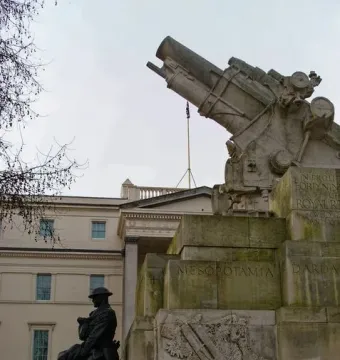
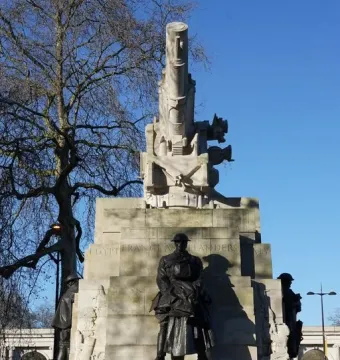
Royal Artillery Memorial is a First World War memorial in London, created by sculptor Charles Jagger with architect Lionel Pearson. Commissioned by the Royal Artillery War Commemoration Fund, it was designed to commemorate soldiers of the Royal Artillery who died in the war. The memorial stands on a Portland stone base in a cruciform plan, with a stone howitzer at its centre and bronze figures on each side representing an officer, a shell carrier, a driver, and a dead soldier. Opened in 1925, it was later criticized for its realism but eventually became recognized as one of Britain’s finest war memorials. It was restored in 2011 and is now a Grade I listed monument under English Heritage.
January 2009 © Txllxt TxllxT · CC BY-SA 4.0
January 2024 © kitmasterbloke · CC BY 2.0
April 2017 © PAUL FARMER · CC BY-SA 2.0
1924 © Cornell University Library · No restrictions
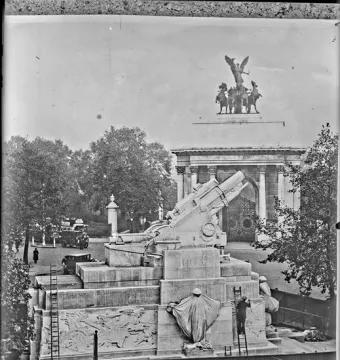
© Agence Rol · Public domain
Identification | |
| Title | Royal Artillery Memorial |
| Original title | Мемориал Королевской артиллерии |
| Type | First World War memorial |
Iconography and meaning | |
| Howitzer symbolism | Symbol of the artillery's power and effectiveness in battle |
| Subject | The Royal Artillery and its service in the First World War |
| Commemorated group | 49,076 soldiers of the Royal Artillery killed in the First World War |
Historical context | |
| Historical context | Created after the First World War in response to the major role of artillery in trench warfare, especially on the Western Front, and to dissatisfaction with earlier war memorials |
Creator | |
| Sculptor | Charles Sargeant Jagger |
| Architect | Lionel Pearson |
| Sculptor background | Former soldier wounded during the war; served in the infantry and was awarded the Military Cross |
Discovery and provenance | |
| Construction delays | Staff shortages, the need to approve each amendment, and practical site problems |
| Design development | Jagger modified the design several times before construction; further changes were made in early 1924 |
| Review period for model | Two months |
| Model presented | June 1921 |
| Contract awarded | March 1922 |
| Design accepted | 1922 |
| Initial design year | 1921 |
| Designer selection | Charles Sargeant Jagger was chosen in early 1921 because of his reputation and war service |
| Purpose of commissioning body | To remember fallen Royal Artillery artillerymen and create a single memorial to them |
| Commissioning body | Royal Artillery War Commemoration Fund (RAWCF) |
| Design consultation requirement | The designer was to consult war veterans and RAWCF representatives and follow their guidance |
| Commissioning body formed | 1918 |
| Alternative designers consulted | Adrian Jones, Sir Edwin Lutyens, Herbert Baker, Sir Aston Webb |
| Initial memorial ideas considered | Buying a house for wounded soldiers or building several small memorials across the country |
| Other commemorative schemes considered | Possible participation in a national commemoration, including proposals near Buckingham Palace, on The Mall, or as a memorial cloister at Westminster Abbey |
| Reason national proposals were rejected | Concerns that individual regiments would lose their identity; the Westminster Abbey cloister proposal was also unlikely to gain approval from church authorities |
| Design requirement | The memorial had to be unmistakably recognizable as an artillery memorial |
Physical characteristics | |
| Main sculpture | Stone howitzer |
| Howitzer size | About one-third larger than an actual artillery gun |
| Howitzer orientation | Aligned with the main axis of the base and pointing south |
| Figurative elements | Four bronze figures at the ends of the cross-shaped base |
| Bronze figures | South: officer; east: shell carrier; west: driver; north: fallen soldier |
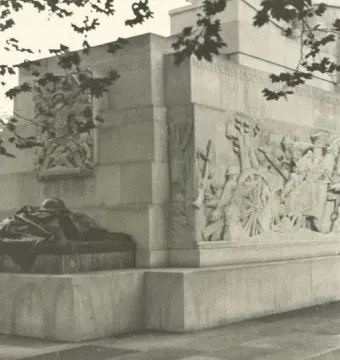
| Reliefs | Battle scenes on the side faces of the base |
| Base shape | Cross-shaped base |
Materials | |
| Figurative material | Bronze |
| Base material | Portland stone |
| Howitzer model source | A gun from the Imperial War Museum |
Technique | |
| Style | Highly realistic realism |
| Design approach | A realist sculpture intended as a historical record of the war |
Appearance | |
| Composition | A cruciform stone base supporting a howitzer with bronze soldiers and a recumbent dead soldier figure |
| Original composition | Two artillerymen figures with a howitzer crowning the structure |
| Original howitzer description | Slightly smaller than the later version and with its barrel pointing sideways |
| Final figure arrangement | Three bronze soldiers plus a dead soldier on the fourth side |
| Model names for figures | William Fosten for the driver; Metcalfe, an ex-gunner, for the ammunition carrier; Lieutenant Eugene Paul Bennett, VC, for the commander |
Location and ownership | |
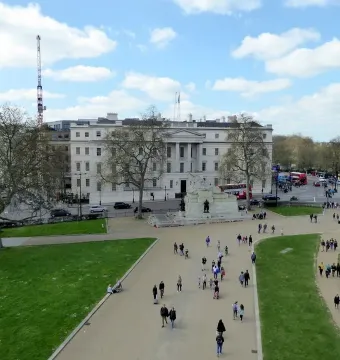
| Location | Hyde Park Corner, London, England |
| Site | Near the Wellington Arch; on the edge of Buckingham Palace gardens / Hyde Park Corner |
| Custodian | English Heritage |
| Heritage status | Grade I listed building |
History and restoration | |
| Later dedication | Plaques were later installed dedicating the memorial to 29,924 Royal Artillerymen killed in the Second World War |
| Restoration | Restored in 2011 after serious weathering and rain damage |
| Opened | 18 October 1925 |
| Opened by | The Duke of Connaught |
Significance | |
| Reception | Initially controversial, later popular with former servicemen |
| Later assessment | Later recognized as Jagger's masterpiece and one of the best war memorials in Britain |
| Comparison with other memorials | It differs from the Cenotaph's pure architectural forms and classical symbolism |
| Controversy | Critics thought the dead soldier was too naturalistic or graphic, and some doubted a howitzer could be carved in stone |
Other | |
| Committee vote | 50 in favor, 15 against |
| Earlier memorial criticized | The Royal Artillery memorial to the South African War on The Mall |
| Planned site options | Hyde Park Corner or the edge of the garden of Buckingham Palace |
| Proposed cost | £25,000 |
| Jagger's reputation in 1921 | Known for war memorial design, with realism and starkness seen as unconventional but highly celebrated |
| Jagger's artistic stance | He valued artistic independence, accepted technical advice on artillery details, and insisted on including the dead soldier figure |
| Reason Jagger was chosen | His reputation as a designer and his war service; General Sir John Du Cane said it would establish Jagger's reputation and bring out his best work |
| Other works by Jagger | Hoylake and West Kirby War Memorial; Great Western Railway War Memorial at Paddington station in London; Portsmouth War Memorial; Anglo-Belgian Memorial in Brussels |
| Jagger's earlier training | Trained as a metal engraver before attending the Royal College of Art |
| Jagger's military background | He served in the infantry during the First World War, was wounded at Gallipoli and Neuve-Église, and was already working on war memorial projects by the end of the war |
| Additional context | The committee wanted more care, time, and funding for war memorials, following criticism of earlier South African War memorials as unimaginative |