
Aboriginal Memorial
Aboriginal Memorial is a contemporary Australian Indigenous artwork from the late 1980s, made up of 200 decorated hollow log coffins, also known as commemorative poles, dupun, ḻarrakitj and other terms. Conceived by Djon (John) Mundine in 1988, it was created by 43 artists from Ramingining and nearby communities in Central Arnhem Land, Northern Territory. The artists included David Malangi and George Milpurrurru. Made to coincide with Australia’s Bicentenary, the work commemorates Indigenous Australians who died as a result of European settlement. It was acquired by the National Gallery of Australia, where it remains on permanent display.
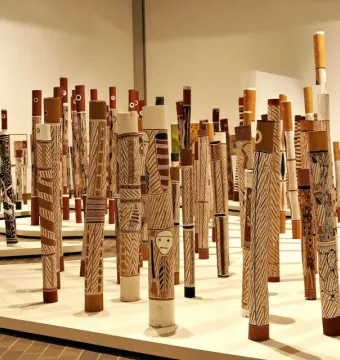
· GFDL 1.2
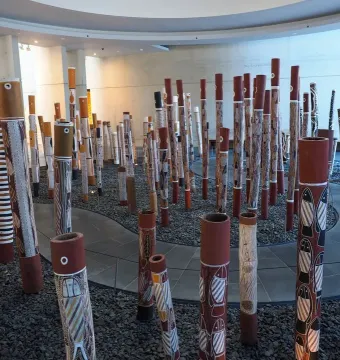
May 2018 © Nick-D · CC BY-SA 4.0
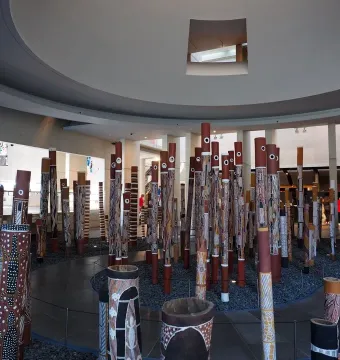
May 2018 © Nick-D · CC BY-SA 4.0
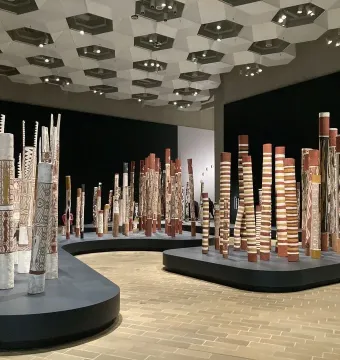
June 2022 © Nick-D · CC BY-SA 4.0
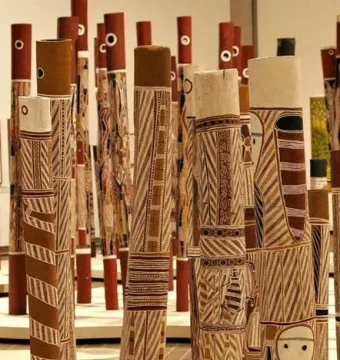
April 2009 © Aboriginal_holllow_log_tombs02.jpg · GFDL 1.2

Identification | |
| Title | Aboriginal Memorial |
| Type | Contemporary Indigenous Australian memorial sculpture |
| Alternative title | Le Mémorial Aborigène |
Historical context | |
| Purpose | Created for Australia's Bicentenary |
| Historical reference | Commemorates Indigenous Australians who died as a result of European settlement and for whom proper mortuary rites could not be performed |
| Date | 1987–1988 |
Creator | |
| Created by | 43 artists from Ramingining and nearby communities of Central Arnhem Land, Northern Territory |
| Named artists | David Malangi; George Milpurrurru; Paddy Dhathangu; Jimmy Wululu |
| Conceptualized by | Djon (John) Mundine |
Discovery and provenance | |
| Place of origin | Ramingining, Northern Territory, Australia |
| Offered to | National Gallery of Australia |
| Year offered | 1987 |
Physical characteristics | |
| Symbolic meaning of number | Chosen to represent 200 years of European settlement |
| Number of elements | 200 |
| Alternative names for form | Memorial poles; dupun; ḻarrakitj |
| Form | 200 decorated hollow-log coffins (dupun) |
Materials | |
| Material | Wood |
| Material source | Trees naturally hollowed out by termites |
Technique | |
| Preparation process | Cut, cleaned, and painted with natural pigments |
| Creation setting | Ceremonial camp |
Appearance | |
| Decoration | Aboriginal symbols and traditional clan designs |
Iconography and meaning | |
| Central pathway | A central path runs between the poles |
| Path symbolism | Represents the Glyde River and its meanders in central Arnhem Land; also symbolizes the scar left by colonization and the Rainbow Serpent |
| Cultural basis | Based on traditional Arnhem Land funerary art used in reburial ceremonies |
| Opening near the top | A small opening near the top allows the spirit of the deceased to see what is happening on their land |
| Use in artwork | The poles were made specifically for the artwork and have never contained human remains or been used in burial ceremonies |
| Cultural meaning of designs | The designs identify the artists' clan responsibilities and significant Dreamings |
Location and ownership | |
| Current owner | National Gallery of Australia |
| Current location | National Gallery of Australia |
| Current display status | On permanent display |
| Gallery location within NGA | Level 1 of the NGA (since June 2022) |
| Intended viewing role | Planned to be the first work seen by visitors |
History and restoration | |
| Temporary removal for conservation | Temporarily removed from display in the late 2000s for major conservation work |
| Restoration completed | October 2009 |
| Major later exhibition | Centerpiece of a major exhibition of Australian Indigenous art at the Hermitage Museum, Saint Petersburg, Russia, in 2000 |
| First exhibition | Sydney Biennale, 1988 |
| Reception of later exhibition | Received positive reviews from Russian critics |
| Reinstallation | Reinstalled in 2010 in the entrance area of the new gallery building |
Significance | |
| Collection status | Described as an icon of the National Gallery's collection |
| Recognition | Described as one of the most outstanding works of art created in Australia |
| Collection ranking | Included in the late-2000s list of the 20 most valuable works in the National Gallery's collection |
| Uniqueness in ranking | Only Australian artwork on that list; among the 20 most valuable Australian artworks, the only one by Indigenous artists |
| Assessment by Andrew Sayers | Andrew Sayers described it as one of the most profound works of art to emerge in the last 20 years |