
Way of Human Rights
Way of Human Rights is a monumental outdoor sculpture in Nuremberg, Germany, opened on 24 October 1993. Located on the street between the old and new buildings of the Germanisches Nationalmuseum, it links Kornmarkt street with the medieval city wall. The work was created by Israeli artist Dani Karavan after a 1988 design competition. It includes a gate, 27 round white concrete pillars, two pillars buried in the ground with only a round plate visible, and one columnar oak, making 30 pillars in total. Each pillar is engraved with one article of the Universal Declaration of Human Rights in German and another language. The monument is part of Nuremberg’s effort to present itself as a city of peace and human rights.
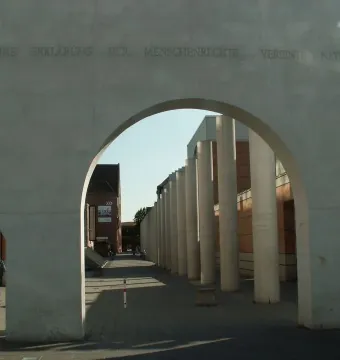
April 2007 © Michael Mertens · CC BY-SA 2.0
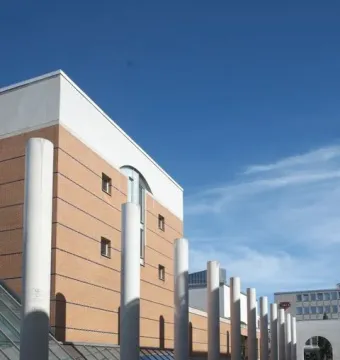
July 2022 © GFreihalter · CC BY-SA 4.0
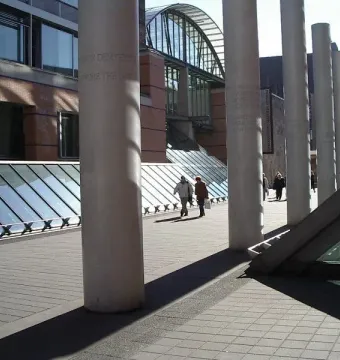
© Keichwa · CC BY-SA 3.0
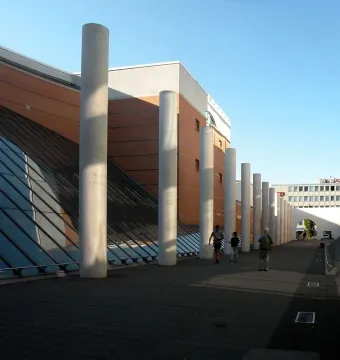
January 2019 © Vitold Muratov · CC BY-SA 4.0
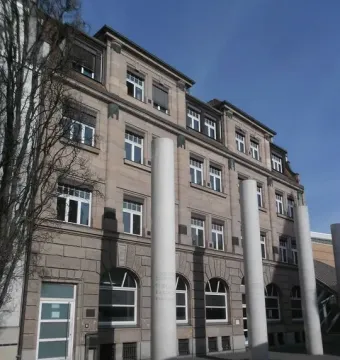
April 2013 © Aarp65 · CC BY-SA 3.0
Identification | |
| Title | Way of Human Rights |
| Spanish title | Calle de los Derechos Humanos |
| Type | Large-scale outdoor sculpture, memorial, and public artwork |
| German title | Straße der Menschenrechte |
| Original-language name | Die Straße der Menschenrechte |
| Polish title | Droga Praw Człowieka |
Creator | |
| Artist | Dani Karavan |
| Nationality | Israeli |
Historical context | |
| Historical intent | Part of Nuremberg's effort to distance itself from Nazi-era associations and present itself as a city of peace and human rights |
| Recognition | In 2001, Nuremberg received the UNESCO Prize for Human Rights Education, with the Way of Human Rights specifically cited |
| Interpretation | Intended as a repudiation of Nazi crimes and a warning that human rights are still being violated around the world |
| Opened | 24 October 1993 |
| Selection context | Design competition related to the Germanisches Nationalmuseum extension and the artistic design of Kartäusergasse street |
| Design selected | 1988 |
Discovery and provenance | |
| Site history | The site includes remnants of a monastery, the medieval city wall, Sep Ruf buildings from the 1950s and 1960s, and a glass-enclosed entrance designed by ME DI UM in 1993 |
| Associated institution | Germanisches Nationalmuseum |
Location and ownership | |
| Location | Kartäusergasse, Nuremberg, Germany |
| Site | Between Kornmarkt and Frauentormauer, between the new and old buildings of the Germanisches Nationalmuseum, along the full length of Kartäusergasse |
| Orientation | A straight-line ensemble placed between a symbolic north gate and a south gate echoing the medieval city gate |
| Related institution | Human Rights Office in Nuremberg |
Physical characteristics | |
| Pillar diameter | 80 cm |
| Spacing | 5.7 m apart |
| Tree | 1 columnar oak |
| Buried pillars | 2 pillars are buried in the ground, with only slabs visible at sidewalk level |
| Number of pillars | 29 concrete pillars, of which 2 are buried |
| Pillar height | 8 m |
| Pillar shape | Round |
| Central elements | 27 round concrete pillars, 2 buried pillars visible only as round plates at sidewalk level, and 1 columnar oak |
| North gate | Free-standing wall of white exposed concrete, 16 m wide and 8 m high, serving as a symbolic gate and echoing a medieval city gate |
| Overall length | 170 m |
Materials | |
| Material | White concrete, concrete, and oak |
Technique | |
| Layout | Straight line of elements leading from the entrance gate |
Iconography and meaning | |
| Symbolic meaning | Affirms human rights as universal for all peoples and cultures |
| Symbolic meaning of tree | The oak tree symbolizes the remaining languages |
| Exception to inscriptions | Article 21 is inscribed on a plaque embedded in the wall of a building behind the oak tree |
| Languages represented | 30 languages, including Yiddish, Quechua, Spanish, and languages from Europe, Africa, and Asia |
| Inscription | Each of the 30 articles of the Universal Declaration of Human Rights is inscribed in German and one other language |
Significance | |
| Public use | Schoolchildren visit periodically to learn about the history of human rights and their current reality around the world |
| Activism use | Used by alternative groups and movements to show examples of human rights violations and demand respect for them |
| Award site | The Nuremberg International Human Rights Award is awarded on the site every two years |
| Nearby event | A biannual 'Lunch for Peace' is held nearby at Hallplatz to honor the award recipient |
History and restoration | |
| Inauguration attendees | Federico Mayor Zaragoza, Danielle Mitterrand, and Hebe Pastor de Bonafini attended the inauguration |
| Mayor statement | Peter Schönlein said that from this city there should now be only signs of peace, reconciliation, and understanding among peoples |
| Award initiative | The city of Nuremberg's initiative to award the International Human Rights Award arose as a consequence of the sculpture's construction in 1993 |
| Award start | The Human Rights Office began awarding the International Human Rights Award in 1995, first awarded on 17 September 1995 |
| Award frequency | Every two years |