
Serpent Column
The Serpent Column is the surviving part of the famed Tripod of Plataea, a Greek offering made to Apollo at Delphi after the victory over the Persians at Plataea in 479 BC. It was originally a bronze column formed from the intertwined bodies of three serpents, supporting a golden tripod. The tripod’s gold was later confiscated and melted down during the Third Sacred War. The monument remained at Delphi until the reign of Constantine, who ordered its transfer to Constantinople for the hippodrome of his new capital. Over time, the column was damaged, and in 1700 the three serpent heads were lost. Today, the column still stands in Sultanahmet Square in Istanbul.
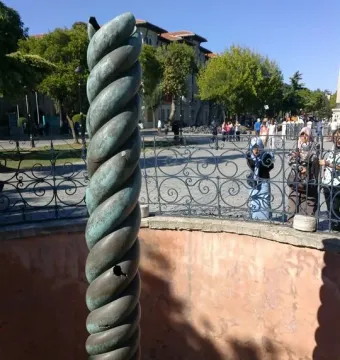
August 2012 © Henri Bergius · CC BY-SA 2.0
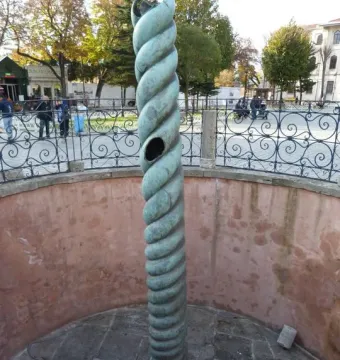
October 2014 © Derzsi Elekes Andor · CC BY-SA 4.0
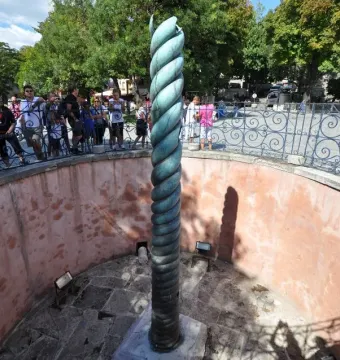
August 2012 © Jorge Láscar · CC BY 2.0
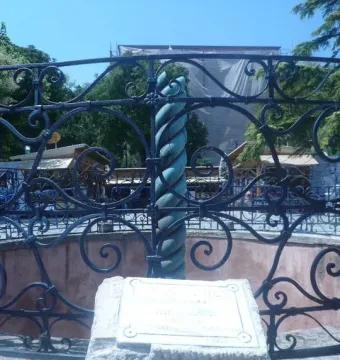
© Sogal · CC BY-SA 3.0
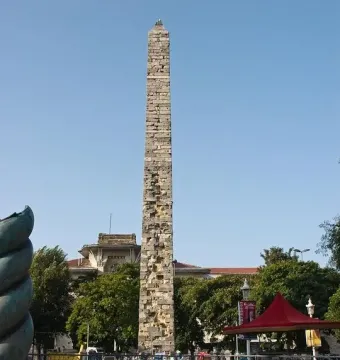
© Vadim Zhivotovsky · CC BY 3.0
Identification | |
| Title | Serpent Column |
| Alternative names | La Colonne serpentine; Kolumna Wężowa; Зміїна колона; Columna de las Serpientes; Colonna serpentina; Serpentine Column; Three-headed Serpent; Tripod of Delphi; Tripod of Plataea; Serpentine Column, Plataean Tripod; Colonne des serpents; Trikarenos Ophis (Τρικάρηνος Ὄφις / Τρικάρηνος Όφις) |
| Type | Ancient bronze column monument |
Historical context | |
| Original monument | The tripod of Plataea, or tripod of Delphi |
| Origin | Part of a sacrificial tripod dedicated to Apollo at Delphi |
| Date of dedication | Spring of 478 BC |
| Historical context | Created to commemorate the Greek victory over the Persians at the Battle of Plataea in 479 BC, as one of three dedications made by the Greek coalition after the battle |
| Commemorated event | The Battle of Plataea and the victory of 31 Greek city-states over the Persian army |
| Offered by | The allied Greeks |
| Battle commander names | Mardonius; Pausanias, Regent of Sparta |
Creator | |
| Associated deity | Apollo |
Discovery and provenance | |
| Original associated sanctuary | Sanctuary of Apollo at Delphi |
| Original base | Stone base, described as an inverted Byzantine capital; the base of the column has been found |
| Construction material source | According to Herodotus, cast from bronze weapons taken from the Persians |
| Original top element | A golden tripod or cauldron |
| Tripod fate | The gold from the tripod was confiscated and melted down by the Phocians during the Third Sacred War |
| Relocation to Constantinople | Moved by order of Constantine the Great in 324 CE to Constantinople, to decorate the Hippodrome |
| Later display location | The spina of the Hippodrome of Constantinople (now Sultanahmet Square, Istanbul, Turkey) |
| Current location | Sultanahmet Square, Istanbul, Turkey |
| Original location | Delphi, at the sanctuary of Apollo beside the altar of Apollo |
Physical characteristics | |
| Column shaft | Bronze shaft composed of 29 coils formed by three intertwined serpents |
| Decorative form | Three intertwined serpents whose heads originally supported the tripod |
| Current height | About 5 metres |
| Original height | About 8 metres |
Materials | |
| Material | Bronze |
| Upper element material | Gold |
Appearance | |
| Base form | Bell-shaped base |
| Greek name meaning | ‘Three-headed serpent’ |
| Turkish name | Yılanlı Sütun ('Snake Column') |
| Turkish site name | At Meydanı ('Horse Square') |
| Alternative site name | Atmeydanı ('horse square') |
| Original form | A bronze column of three intertwined serpents, originally topped with a golden tripod |
| Symbolism | Symbolized the Greek victory over the Persians at Plataea; a trophy or offering reminding of a military victory |
Location and ownership | |
| Interpretation of relocation | Its placement in the Hippodrome may have suggested that Constantinople had become the new center of the world, replacing Delphi as the omphalos |
| Byzantine use | Used as a fountain in Byzantine times |
History and restoration | |
| Damage history | Over the centuries the column suffered various damages; one serpent head had its jaw broken off |
| Loss of heads | All three serpent heads were lost in 1700, with different accounts saying they fell or were destroyed |
| Reported date of head loss | The heads are reported by Silahdar Findiklili Mehmed Aga to have fallen on the night of 20 October 1700 |
| Recovered fragment | A fragment of one serpent head, including the upper jaw, was found in 1848 by Gaspare Fossati during excavations near Hagia Sophia |
| Current fragment location | Istanbul Archaeological Museum |
| Serpent head status | Two of the three serpent heads are missing; one fragmentary head survives in museum collections |
| Survival status | The column still stands today |
Significance | |
| Significance | One of the very few artistic works that once adorned ancient Constantinople to have survived |
| Literary references | Mentioned by Herodotus, Thucydides, pseudo-Demosthenes, Diodorus Siculus, Pausanias, Cornelius Nepos, Plutarch, and later described by Edward Gibbon using Byzantine historians Zosimus, Eusebius of Caesarea, Socrates Scholasticus, and Sozomen |
| Ancient literary history | Described as having one of the longest literary histories of any surviving object from Greek and Roman antiquity |
Other | |
| Modern replica | A bronze copy was erected in 2015 at the original site in Delphi |
| Age statement | Said to have turned 2,500 years old in 2022 |