
James A. Garfield Monument
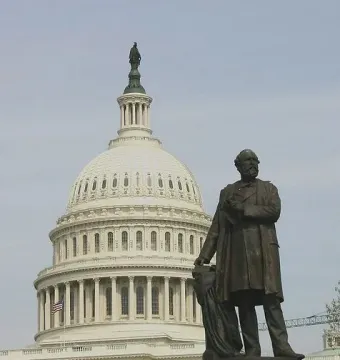
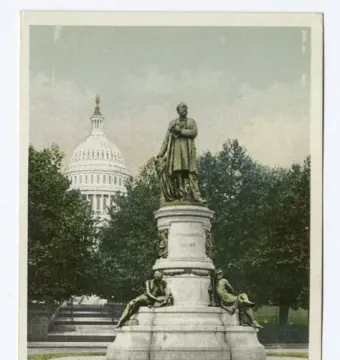
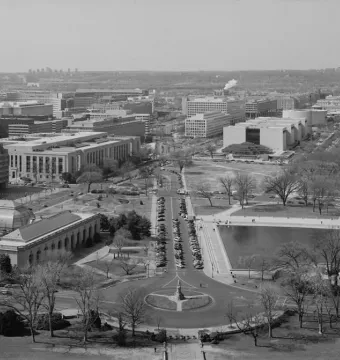
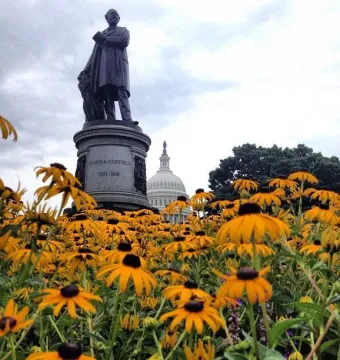
The James A. Garfield Monument stands in Garfield Circle on the grounds of the United States Capitol in Washington, D.C. It memorializes U.S. president James A. Garfield, who was elected in 1880 and assassinated in 1881 after serving only four months in office. The monument was sculpted by John Quincy Adams Ward, cast by The Henry-Bonnard Co. of New York, and designed with a pedestal by Richard Morris Hunt. Unveiled on May 12, 1887, it is considered an outstanding example of Beaux-Arts architecture. The bronze statue rests on a granite pedestal featuring three sculptures representing periods in Garfield’s life. It became part of the United States Capitol Complex in 1975.
August 2004 © David · CC BY 2.0
© Detroit Publishing Company · Public domain
© unknown creator · Public domain
July 2013 © USCapitol · Public domain
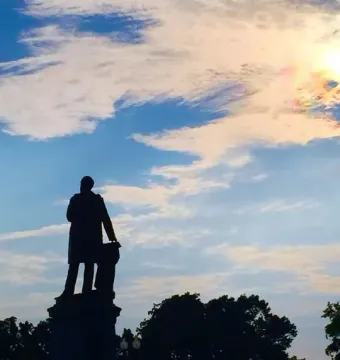
July 2015 © Chewdigest · CC BY-SA 4.0
Identification | |
| Title | James A. Garfield Monument |
| Subject | James A. Garfield |
| Type | Memorial monument |
Historical context | |
| Honoree | James A. Garfield (1831–1881), elected in 1880 and assassinated in 1881 after serving only four months in office |
| Assassin | Charles J. Guiteau, an attorney and disgruntled office-seeker |
Creator | |
| Sculptor | John Quincy Adams Ward |
| Foundry | The Henry-Bonnard Bronze Co. of New York |
| Pedestal designer | Richard Morris Hunt |
Discovery and provenance | |
| Commissioned by | Society of the Army of the Cumberland |
| Commissioned year | 1884 |
| Fundraising | The Society of the Army of the Cumberland raised nearly $28,000 for the sculptor's fee |
| Fundraising event | Garfield Monument Fair, held in 1882 in the Capitol Rotunda and National Statuary Hall |
| Congressional funding | $7,500 in 1882 from the sale of condemned cannons |
| Pedestal funding | $30,000 contributed in 1884 |
| Total price | $62,539 including installation |
Physical characteristics | |
| Pedestal figures | Three seated allegorical figures representing Garfield's life as a student/teacher, soldier, and statesman |
| Pedestal details | Plaques with swords and globes on the second tier above the figures |
| Pedestal form | Tapered cylindrical granite pedestal |
| Dimensions | Bronze Garfield figure: 9 feet (2.7 m) high; pedestal: 16 feet (4.9 m) high; three bronze pedestal figures: 5 feet (1.5 m) high |
| Material | Bronze statue on a granite pedestal |
Appearance | |
| Main figure pose | Standing and looking into the distance |
| Main figure clothing | Long coat over a suit |
| Main figure features | Beard, moustache, and wavy hair |
| Main figure attribute | Holding a stack of inauguration papers and resting a hand on an open book on a small draped column |
| Pedestal figures appearance | Roman males seated near the base: a barefoot student in a sheep-skin tunic holding paper, a middle-aged soldier in wolf skin and fur boots reaching for a sword, and a statesman in sandals and a long robe holding a tablet inscribed 'Law Justice Prosperity' |
| Inscriptions | Garfield statue: 'J.Q.A. Ward Sculp. 1887; The Henry-Bonnard Bronze Co. New York'; base figures: 'J.Q.A. Ward Sculp'; front base: 'James. A. Garfield 1831–1881'; left base: 'Major-General U-S-V, Member of Congress, Senator, and President of The United States of America'; right base: 'Erected by his Comrades of the Society of the Army of the Cumberland May 18, 1887' |
Location and ownership | |
| Historic listings | National Register of Historic Places; District of Columbia Inventory of Historic Sites |
| Contributing property to | The National Mall and L'Enfant Plan |
| Jurisdiction | West side of the United States Capitol Complex, under the jurisdiction of the Architect of the Capitol |
| Setting | In Union Square near the Capitol Reflecting Pool, alongside the Peace Monument and the Ulysses S. Grant Memorial |
| Location | Garfield Circle on the grounds of the United States Capitol at First Street and Maryland Avenue, Washington, D.C. |
History and restoration | |
| Unveiled | May 12, 1887 |
| Erected | May 18, 1887 |
| Incorporated into United States Capitol Complex | January 2, 1975 |
| Conservation treatment | Cleaned in 1992 by the Architect of the Capitol with low-pressure washing, corrosion inhibitor, repatination, acrylic lacquer and wax protection, lead joint repairs, and sidewalk improvements around the circle |
Significance | |
| Style | American Beaux-Arts monument |
| Significance | Notable example of American sculpture |
| Erected by | His comrades in the Society of the Army of the Cumberland |
Other | |
| Related collection | National Statuary Hall Collection |