
Equestrian Statue of Andrew Jackson
The Equestrian Statue of Andrew Jackson is a bronze monument on a pedestal, surrounded by four cannons, located in Washington, D.C. It was created by the American sculptor Clark Mills. The sculpture shows General Andrew Jackson, later president of the United States, seated on a horse in a rearing pose, with a saber at his left side and a bicorne in his right hand. The monument refers to the American victory at the Battle of New Orleans in 1815 during the War of 1812, credited to Jackson’s command. It was ceremonially unveiled on 8 January 1853, the 38th anniversary of the battle, by Senator Stephen A. Douglas.
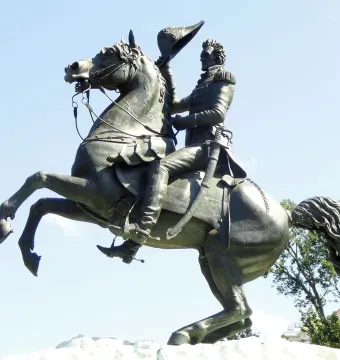
June 2012 © Daderot · CC0
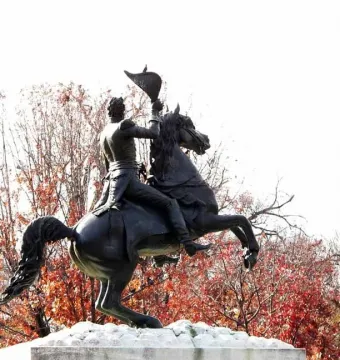
November 2005 © Koshy Koshy · CC BY 2.0
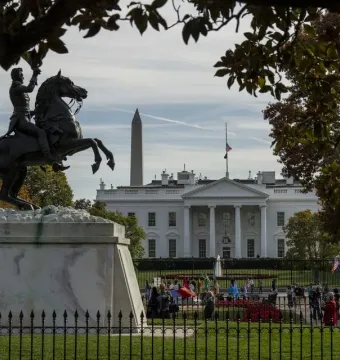
October 2023 © The White House · Public domain
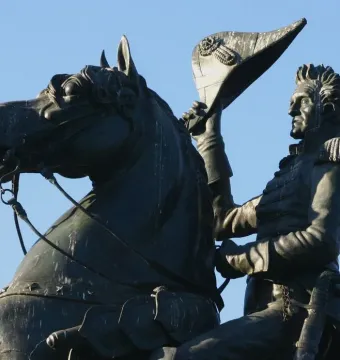
September 2005 © David · CC BY 2.0
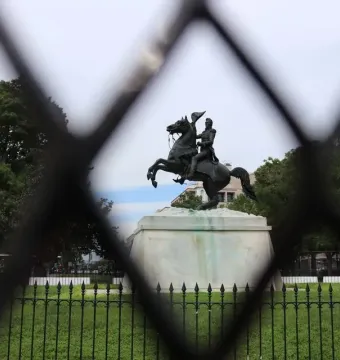
August 2020 © Elvert Barnes · CC BY-SA 2.0
Identification | |
| Title | Equestrian statue of Andrew Jackson |
| Date | 1852 |
| Alternative title | Andrew Jackson Monument in Washington |
| Original title | «Эндрю Джексон» |
| Type | Bronze equestrian statue |
Historical context | |
| Dedicated to | Andrew Jackson, President of the United States |
Creator | |
| Artist | Clark Mills |
| Artist nationality | American |
| Sculptor background | Self-taught sculptor who had studied in Italy |
| Designer and caster | Clark Mills |
| Competition result | Mills's proposal won ahead of Hiram Powers and Robert Mills |
Discovery and provenance | |
| Approval and payment | In March 1848 Mills won the competition and received US$12,000 from the committee for the monument |
| Inquiry about cost | In 1846 Jeremiah Harris wrote to Hiram Powers in Italy asking about the cost of a bronze equestrian statue |
| Estimated cost by Hiram Powers | About US$30,000, including casting costs; the casting cost was half the total |
| Agent involved | Miner Kilbourne Kellogg |
| Replicas created by Mills | Two replicas: one for Jackson Square in New Orleans (1856) and one for the Tennessee State Capitol in Nashville (1880) |
| Additional payment by Congress | Congress paid US$8,000 for the pedestal and later US$20,000 personally to Mills because the earlier US$12,000 covered only the casting costs |
| Government ownership | Afterward the U.S. government affirmed ownership of the work |
| Original intended location | Washington, D.C., near 15th Street and Pennsylvania Avenue |
| Early design status | Rejected because of its high cost |
| Alternative sculptor contacted | Hiram Powers |
| Later replica | A third replica was installed in downtown Jacksonville in 1987 |
| Early design proposal | A 130-foot triumphal arch with a full-length statue of Jackson on top, designed by Robert Mills |
| Chair died before completion | Yes |
| James K. Polk's response | He refused to join the committee but agreed to head the subscription list |
| Commissioned | May 1847 |
| Commissioning body | Jackson Monument Committee |
| Committee chair | John Peter Van Ness |
| Original castings locations | Jackson Square in New Orleans, Louisiana; Tennessee State Capitol building in Nashville, Tennessee |
| Commissioned after Jackson's death | Almost two years after Jackson's death at The Hermitage, his plantation near Nashville, Tennessee |
| Promoters | John O'Sullivan and James Buchanan |
| Fundraising purpose | To raise money for a monument to Jackson |
| Initial fundraising appeal date | July 1845 |
| Initial fundraising appeal source | United States Magazine and Democratic Review |
| President asked to join fundraising committee | James K. Polk |
Physical characteristics | |
| Horse modeled on | Mills's own horse, Olympus |
| Plaster model | A full-size plaster model of the horse was completed by December 1849 |
| Construction | Final casting made in ten pieces: six for Jackson and four for the horse |
| Horse name | Duke |
| Horse training | Mills trained his horse to pose on its haunches |
| Depicted action | Raising his hat with his right hand and controlling the reins with his left hand |
| Depicted attire | Military uniform |
| Pose | Jackson seated on a horse rearing up on its hind legs, balanced only on the rear legs |
| Weight | About 15 tons |
| Size | About a third larger than life |
| Attributes | Sword at his left side and bicorne in his right hand |
Materials | |
| Support structure | Rear legs have iron cores covered with bronze |
| Base material | White marble |
| Material | Bronze |
Technique | |
| Foundry | A new bronze foundry established at Mills's studio on 15th Street and Pennsylvania Avenue NW, south of the Treasury Building |
| Casting completion | By August 1851 he had completed casting Jackson's figure |
| Plaster model completed | Yes |
| Assistant in casting | Phillip Reid, an enslaved apprentice |
| Casting method | Bronze casting |
| Casting accident | When attempting to lift the horse statue with a crane, the furnace exploded |
| Bronze experiments | In June 1850 Mills melted about two bronze bells and later several old cannons supplied by the government |
| Studio location | 15th Street and Pennsylvania Avenue NW, south of the Treasury Building |
| Technical study | Mills studied European casting molds, horse anatomy, different breeds of horses, and practiced dissection |
| Modeling method | Jackson modeled from portraits of contemporaries; military uniform, saddle, and bridle borrowed from Patent Office relics |
Appearance | |
| Base | Tapering rectangular marble base placed on a pedestal |
| Surroundings | Surrounded by four cannons |
| Site setting | Raised circular grassed area with railings |
| Orientation | On the alignment of the North Portico of the White House and 16th Street NW |
Iconography and meaning | |
| Comparison to earlier equestrian bronzes | Earlier examples such as Pietro Tacca's statue of Philip IV and Étienne Maurice Falconet's statue of Peter the Great used the horse's tail as a third support |
| Firsts | First equestrian statue made in the United States; first bronze statue cast in the United States; first monument to show a horse balanced only on its hind legs |
| Historical reference | Refers to the American victory at the Battle of New Orleans in 1815 during the Anglo-American War |
| Source of quote | A toast offered by Jackson at a Democratic Party banquet in 1830 to celebrate the birthday of Thomas Jefferson |
| Depicts | Jackson on horseback, emphasizing his military achievements rather than his political career |
| Reason for historical reference | Attributed to Jackson's excellent command |
History and restoration | |
| Urn bases | Placed on square granite pedestals and decorated on the sides with classical allegorical figures |
| Inscription | JACKSON; OUR FEDERAL UNION / IT MUST BE PRESERVED |
| Inscription addition date | 1909 |
| Memorial inscriptions | Added to the pedestal in 1909 |
| Decorative additions | In 1872 naval urns were installed on the west and east sides of the statue, in the centers of small flower beds |
| Urn inspiration | Copies of the Medici vases |
| Urn maker | Made in furnaces at the Washington Navy Yard by German immigrant Adolf Cluss, at the direction of Secretary of the Navy George Robeson |
| Urn relocation | During the 1936 park reconstruction they were moved to Madison Place and Jackson Place |
| Urn modification | In 1879 the urns were fitted with metal vases planted with flowers |
| Cannons' barrels placement | Initially rested on the grass for several years |
| Opposition to relocation | Commission secretary Charles Moore insisted it should remain in place for historical reasons |
| Relocation effort involving Roosevelt | Moore's position ended even President Franklin D. Roosevelt's efforts in 1935 |
| Structural tests | 1993 tests showed the rear legs have central cores of iron covered with bronze, providing additional strength and weight to support and counterbalance the suspended parts of the statue |
| Documentation | Described by Save Outdoor Sculpture! in 1993 |
| Anniversary noted | On 2 July 2013 the statue marked its 160th anniversary |
| Cannons' carriages | Later raised on new wooden gun carriages, subsequently replaced several times |
| Proposed relocation history | From 1920 to 1940 many Washington residents tried to persuade the Commission of Fine Arts to move the statue to the site where the Washington statue now stands |
| Original intention for cannon metal | To cast the statue itself using metal from captured cannons, but the tin content was too high |
| Opening attendees | President Millard Fillmore, his cabinet, members of Congress, and army and navy personnel |
| Surrounding elements origin | Four cannons captured by Jackson from the Spanish at Pensacola, Florida in 1818 |
| Location | Center of Lafayette Square, within President's Park, Washington, D.C., just north of the White House |
| City | Washington |
| Unveiling date | 8 January 1853 |
| Unveiling anniversary | 38th anniversary of the Battle of New Orleans |
| Unveiled by | United States Senator Stephen A. Douglas |
| Country | United States |
| Opening procession route | From City Hall to Lafayette Square along Pennsylvania Avenue |
| Dedication description | Described as a national event |
| Opening ceremony officiant | Reverend Clement Butler, chaplain of the Senate |
| Opening speech | Delivered by Senator Stephen Douglas |
| Opening unveiling | Clark Mills unveiled the statue by indicating it and pulling off the covering |
| Opening ceremony closure | Reverend James Gallagher, chaplain of the House of Representatives, declared the ceremony closed |
| Public reaction at unveiling | Crowds admired the work and cheered 'hurrah' |
| Procession participants | George Hughes, Winfield Scott, Stephen Douglas, military representatives of all branches, Washington/Georgetown/Alexandria Democratic associations, and delegates from Baltimore |
Other | |
| Conflict with the Creek | Called for retaliation after the Creek resisted white settlement in what later became Alabama and killed more than 400 American settlers in 1813 |
| Military victory | Creek defeated at the Battle of Horseshoe Bend in 1814 |
| Treaty | By the Treaty of Fort Jackson, the Creek ceded their lands in Georgia and Alabama to the U.S. government |
| Military fame | Won greatest military fame in the Battle of New Orleans on 8 January 1815 |
| Death place | The Hermitage |
| War involvement | His victory over the British ended the War of 1812 |
| National status | Became a national hero after securing the peace treaty |
| Presidency | Served as the seventh President of the United States for two terms, 1829–1837 |
| Death date | 8 June 1845 |
| Militia service | Joined the Davidson County militia in 1791 |
| Military promotion | Promoted to major general in 1802 |
| Imprisonment | Captured with his brother and imprisoned by the British Army |
| Judicial office | Judge in 1798 |
| Senate service | Senator in 1797 |
| Political office | Representative to Congress after Tennessee became a state in 1796 |
| Plantation | The Hermitage, near Nashville |
| Profession | Successful lawyer |
| Move to Tennessee | 1787 |
| Education | Brief legal training in Salisbury |
| Injury | As a teenager, he was struck on the head with a saber by a British officer, leaving a facial scar and a lifelong hatred of the English |
| Early wartime role | Courier in the local militia during the American Revolution |
| Family background | Born into a Presbyterian family of Scottish-Irish immigrants |
| Subject birthplace | North Carolina, near the border with South Carolina |
| Subject lifespan | 1767–1845 |
| Age at death | 78 |