
Gloria Victis
Gloria Victis is a sculpture by Antonin Mercié created after France’s defeat in the Franco-Prussian War. It honors fallen French soldiers, especially Mercié’s friend Henri Regnault. The work shows a winged female allegorical figure of Fame or Hope carrying a dying French hero upward, while his broken sword symbolizes defeat. Mercié altered the hero’s head from lifted to fallen after France’s defeat. The original plaster version won a medal at the 1874 Paris Salon, and bronze casts were later made by Ferdinand Barbedienne in different sizes and finishes. Examples are held at the National Gallery of Art in Washington, DC, in Bordeaux facing Saint André’s Cathedral, and at the Ny Carlsberg Glyptotek in Copenhagen.
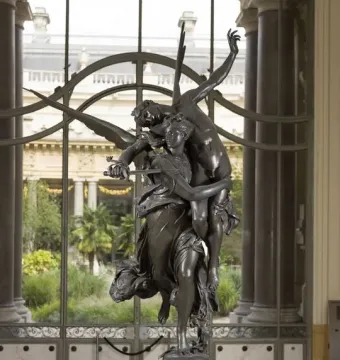
© Mercié, Antonin (Toulouse, 30–10–1845 - Paris, 13–12–1916), sculpteur · CC0
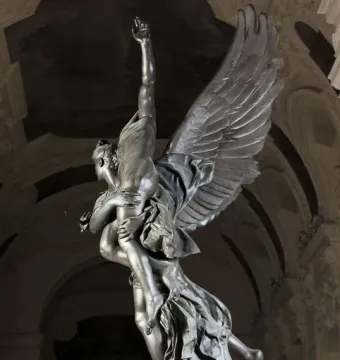
© Mercié, Antonin (Toulouse, 30–10–1845 - Paris, 13–12–1916), sculpteur · CC0
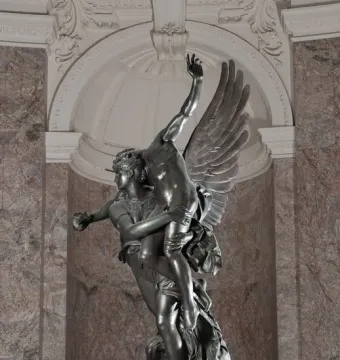
© Mercié, Antonin (Toulouse, 30–10–1845 - Paris, 13–12–1916), sculpteur · CC0
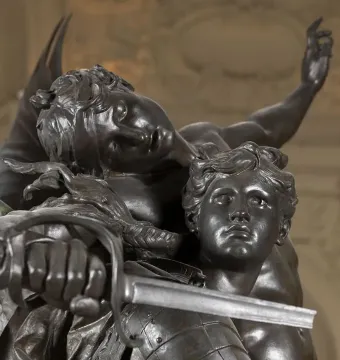
© Mercié, Antonin (Toulouse, 30–10–1845 - Paris, 13–12–1916), sculpteur · CC0
© Mercié, Antonin (Toulouse, 30–10–1845 - Paris, 13–12–1916), sculpteur · CC0
Identification | |
| Title | Gloria Victis |
| Type | group sculpture |
| Title translation | Glory to the vanquished |
Creator | |
| Artist | Antonin Mercié |
| Artist nationality | French |
Historical context | |
| Date | 1872 |
| Historical context | Created in response to France's defeat in the Franco-Prussian War of 1870–71 |
| Purpose | A tribute to the young men who died defending France in the Franco-Prussian War, and to glorify patriotism |
| Historical association | Closely associated with French remembrance of the Franco-Prussian War |
| Political significance | One of the best-known visual manifestations of the French revanchist movement until the end of the First World War |
Discovery and provenance | |
| Bordeaux cast placement | Faces Saint André's Cathedral |
| Placed in Auteuil depot | 1934 |
| Current location | Kept at the Petit Palais since 1976 |
| Other casts | Many casts exist, including casts in the National Gallery of Art, Washington, DC; Bordeaux, France; and the Ny Carlsberg Glyptotek, Copenhagen, Denmark |
| Copenhagen cast status | The only signed cast made for a location outside France and the only one commissioned by a non-governmental institution |
| Copenhagen cast placement | Overlooks the museum's Winter Garden |
| Approval of city copies | All were approved and signed by Antonin Mercié himself |
| Additional cast | One further cast was commissioned in 1906 for the Glyptotek in Copenhagen |
| Relocation | Moved to the courtyard of honour of the Hôtel de Ville in 1884 |
| Later assignment | Assigned to the Petit Palais in 1930 |
| City copies | Copies were commissioned for Niort (1881), Bordeaux (1883), Châlons-sur-Marne / Châlons-en-Champagne (1890), and Cholet (1901) as local memorials to the war dead |
| Installation date at Place Montholon | 1879 |
| Bronze casting | Bronze copies were cast in different sizes by Thiébaut Frères / Thiébaut and sons, and reproduced in several casts with different finishes |
| Purchase | Purchased by the Paris Prefecture of the Department of the Seine, including the cast and copyright, to decorate a public square in Paris |
| Reception | It won great success at the 1874 Salon and was well received by the French public |
| Award | Honour medal at the 1874 Paris Salon |
| Exhibited in Paris | 1873 at the Salon de Paris |
| Original model exhibited | 1873 under the loggia of the Villa Medici in Rome |
| Creator status at completion | Antonin Mercié was living in Rome as a pensioner |
| Place of creation | Villa Medici, Rome |
| Original model material | plaster |
| Original bronze location | Place Montholon, Paris |
Physical characteristics | |
| Pose | The soldier's lower limbs are almost crossed and his arms are spread apart; the winged figure's heel is raised, with only the tip touching the ground |
| Material | Plaster version; bronze casts |
| Height | Not specified in the source |
| Winged figure attire | The winged figure wears a cuirass |
| Figure identity | The winged figure is Glory or Fame (possibly Hope), and the male figure is a young naked soldier who has just died |
| Composition | A winged female allegorical figure carrying a dying young warrior |
| Figure attributes | The soldier has a bandaged forehead, holds a broken sword in his right hand, and raises his left arm toward the sky |
Technique | |
| Alteration made by the artist | After France's defeat, Mercié changed the hero's head from lifted to fallen |
Appearance | |
| Symbolic objects | An olive branch symbolizes peace |
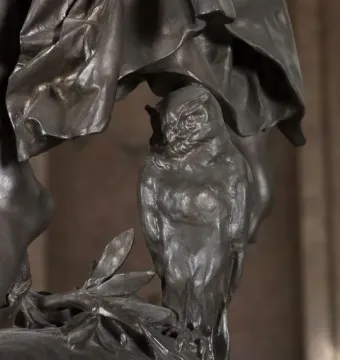
| Symbolic animal | An owl symbolizes the wisdom of Athena, goddess of war |
Iconography and meaning | |
| Related artistic tradition | Found in numerous victory allegories from the 17th to the 19th century |
| Interpretation of soldier's pose | Often described as an allusion to the pose of Christ in Peter Paul Rubens' The Descent from the Cross (1612–14, Cathedral of Our Lady, Antwerp) and described as more active than passive |
| Pose influence | The pose of Gloria recalls Raphael's figure 'i' |
| Compositional influence | The dynamic composition recalls Giambologna's The Rape of the Sabine Women |
| Stylistic influences | Florentine Renaissance and the work of Benvenuto Cellini |
| Interpretation of title | An inversion of the Roman phrase Vae Victis, meaning 'Woe to the vanquished'; the title is also rendered as 'Honor to the defeated' |
| Interpretation by University of Clermont-Ferrand | The message was that those defeated were nevertheless cared for and granted immortality |
| Interpretation of pose | The soldier's pose has been read as Christ-like, evoking the Descent from the Cross and suggesting martyrdom, resurrection, and possible future victory |
| Intended meaning | To honor French soldiers who fell in the conflict, especially Mercié's friend Henri Regnault (1843–1871) |
| Overall symbolism | The group personifies defeated but heroic France |
| Symbolism | The broken sword symbolizes defeat |
Significance | |
| Influence | Inspired several artists in commemorative monuments to the Franco-Prussian War and influenced Auguste Rodin's design for La Défense de Paris |
| Related later work by artist | Mercié returned to this formula in his 1882 Belfort war memorial, nicknamed Still |
Other | |
| Pariser Gemeinderat statement | In 1881, the Paris municipal council declared that the sculpture belonged to all of France and was not merely a work of art but a national work capable of awakening and developing patriotic feelings in the French people |