
Frederic Chopin Monument in Warsaw
The Frederic Chopin Monument in Warsaw is a bronze statue by Wacław Szymanowski, located in the upper part of Łazienki Park. Designed in 1907, it was first erected in 1926 after delays caused by controversy and the outbreak of World War I. The monument was blown up on 31 May 1940 during World War II, becoming the first Warsaw monument destroyed during the occupation of Poland. Its pedestal and base, made of red sandstone, were created by Professor Oskar Sosnowski. Using the surviving original mold, the statue was reconstructed and returned to its former site in 1958. Since 1959, free performances of Chopin’s compositions have been held there on summer Sundays.
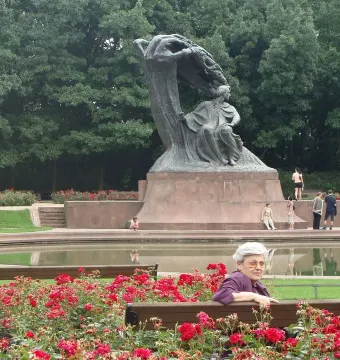
July 2010 © DIMSFIKAS · CC BY-SA 3.0
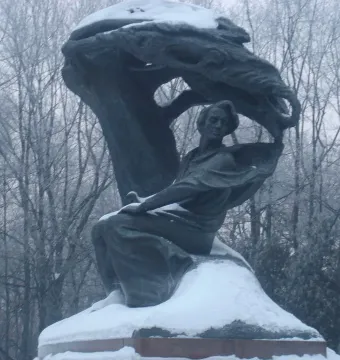
2006 © Gusgus · CC BY-SA 3.0
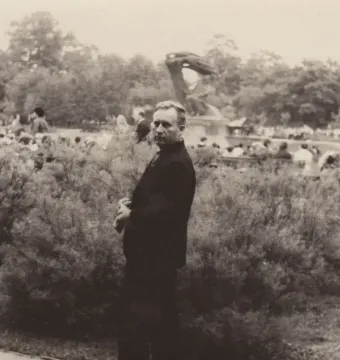
May 1970 © TarikBat · CC BY-SA 4.0
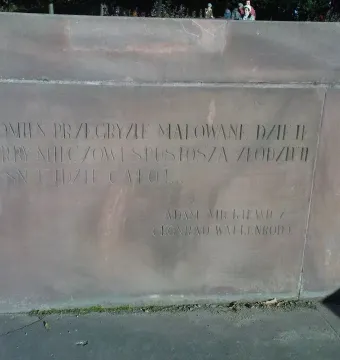
October 2010 © Jolanta Dyr · CC BY-SA 3.0 pl
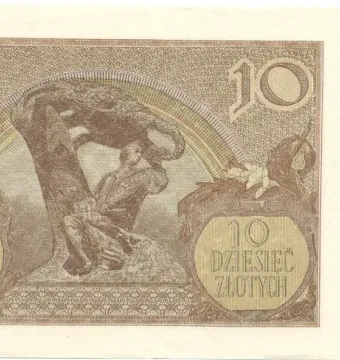
March 1940 © "Emissionbank in Polen" mit Sitz in Krakau i.A. der Reichsbank Berlin · Public domain
Identification | |
| Title | Frédéric Chopin Monument in Warsaw |
| Subject | Frédéric Chopin (1810–1849) |
| Original title | Памятник Шопену в Варшаве |
| Type | monumental bronze sculpture |
Creator | |
| Sculptor | Wacław Szymanowski |
| Architect | Franciszek Mączyński |
| Pedestal and basin designer | Oskar Sosnowski |
Historical context | |
| Idea first proposed | 1876, among members of the Warsaw Music Society |
| Committee established | 1 January 1902, Committee for the Construction of the Chopin Monument in Warsaw |
| Design year | 1907 |
| Competition announced | 1908 |
| Competition decided | May 1909 |
| Intended inauguration | 1910, for the centenary of Chopin's birth |
| Delays in fabrication | Controversy over the design and the outbreak of World War I |
| First permission to build | 1901, when Adelajda Bolska obtained verbal consent from Tsar Nicholas II |
Discovery and provenance | |
| Winning design | Wacław Szymanowski's sculpture with architectural design by Franciszek Mączyński |
| Foundry fate | Fulda's foundry went bankrupt shortly after the model arrived, just before World War I |
| Model sent to | France |
| Jury members | Antoine Bourdelle, Józef Pius Dziekoński, and Leopold Méyet |
| Original planned location | Warecki Square (now Powstańców Warszawy Square) |
| Competition entries | 66 submitted works |
| Competition restrictions | Only Polish artists could take part |
Appearance | |
| Original composition element | A pond with small figures around it, including large carved frogs on both sides |
| Depiction | A seated Fryderyk Chopin under a stylized Masovian willow bent by the wind |
| Symbolism of willow | It echoes a pianist's hand and fingers, and the head of the Polish eagle at the right end |
Physical characteristics | |
| Willow height | 7 meters |
| Statue height | 5 meters |
Materials | |
| Statue material | bronze |
| Pedestal and basin material | Wąchock red sandstone |
Technique | |
| Modeling location | Szymanowski's studio in Kraków |
| Model completed | September 1912 |
| Foundry contract | May 1914 with Anciennes Fonderies Thiebaut Frères, owned by René Fulda |
| Casting company | Barbedienne in Paris |
Location and ownership | |
| Replica in Japan | A 1:1 replica stands in Hamamatsu, Japan |
| Planned replica location | Along Chicago's lakefront |
| Current location | Upper part of Łazienki Park, Warsaw, Poland |
| Installed at | Warsaw's Łazienki Park |
| Nearby landmarks | Ujazdowskie Avenue and Belweder Palace |
History and restoration | |
| Additional inscription text | Lines from Adam Mickiewicz's Konrad Wallenrod: 'Płomień rozgryzie malowane dzieje, / Skarby mieczowi spustoszą złodzieje, / Pieśń ujdzie cało...' |
| Additional inscription | A note saying the monument was rebuilt from contributions of the Social Fund for the Reconstruction of the Capital |
| Reconstruction | Rebuilt after World War II using a surviving original mould and other sources, with a replica cast by Brąz Dekoracyjny (formerly Bracia Łopieńscy) and placed at the original site in 1958 |
| Pedestal inscription | 'Posąg Fryderyka Chopina zburzony i zagrabiony przez Niemców w dniu 31 maja 1940 roku odbuduje Naród. 17-X-1946 r.' |
| Reconstruction sources | Author's 1:10 model, a wooden sculpture of Chopin's head by Władysław Szymanowski, photogrammetric analysis by Leon Suzin, and pre-war photographs |
| Reconstruction workshop | Works of Fine Arts Studio |
| Reconstruction team | A group of sculptors led by Władysław Wasiewicz |
| Pedestal and basin redesign | Oskar Sosnowski changed the shape of the pedestal and basin and removed the large carved frogs |
| Original mold | Survived the war and made reconstruction possible |
| Destruction significance | According to the text, it was the first monument destroyed by the Germans in occupied Warsaw; according to other sources, the second, after the monument to Ignacy Mościcki |
| Destruction | 31 May 1940, blown up by the Germans on the order of Governor-General Hans Frank and cut into smaller pieces with torches |
| Final approval | Tsar Nicholas II signed permission to erect the monument in Warsaw after Grand Duchess Maria Pavlovna's intervention |
| Willow revision | Wacław Szymanowski later changed the shape of the willow tree |
| Unveiled | 14 November 1926 |
| Construction completed | 1926 |
| Post-destruction fate | Transferred for scrap metal |
Significance | |
| Concert canopy | The pianist-and-piano canopy was modeled on the concert shell of the Sydney Opera House |
| World's largest Chopin monument status | It was the world's tallest Chopin monument until 3 March 2007, when a slightly taller modernist bronze monument was inaugurated in Shanghai, China |
| Artistic style | Modernist; Warsaw's only example of Art Nouveau in monumental architecture |
| Cultural status | One of the most recognizable landmarks of Warsaw and one of the landmarks of the Polish capital |
| Concert season and organizers | Every Sunday from May to September, organized by the Fryderyk Chopin Society and Stołeczna Estrada |
| Concerts | Since 1959, free Chopin piano recitals have been held at the statue's base every summer Sunday; in 2020 they were moved online because of the pandemic |
| Reproductions | Widely reproduced on calendars, reproductions, postcards, postage stamps, and similar items |
| Associated landmarks | Warsaw Mermaid, Sigismund's Column, the Palace on the Water, Łazienki Palace, and the Palace of Culture and Science |
Other | |
| Local legend | A handwritten sign allegedly appeared at the site the day after destruction, saying: 'I don’t know who destroyed me, but I know why: so that I won’t play the funeral march for your leader.' |