
Taras Shevchenko Memorial
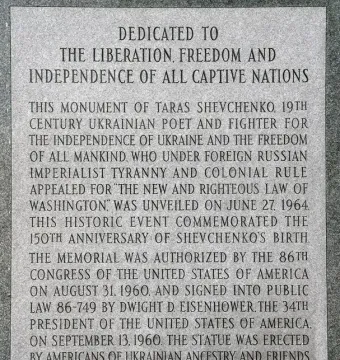
Taras Shevchenko Memorial is a historic monument in Washington, D.C., located near Dupont Circle on P Street. It consists of a bronze statue on a granite pedestal, accompanied by a commemorative stele with a relief. The memorial stands 7 meters tall and weighs 45 tons. Dedicated to Ukrainian poet and artist Taras Shevchenko, it honors his major influence on modern Ukrainian literature and national consciousness. The monument was unveiled in 1964 to mark the 150th anniversary of his birth. It was designed by Canadian sculptor of Ukrainian origin Leo Mol and architect Radoslav Zuk, and is now maintained by the U.S. federal government along with the surrounding park.
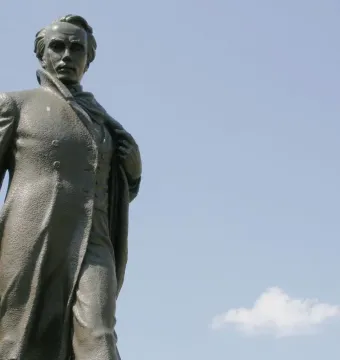
April 2009 © David · CC BY 2.0
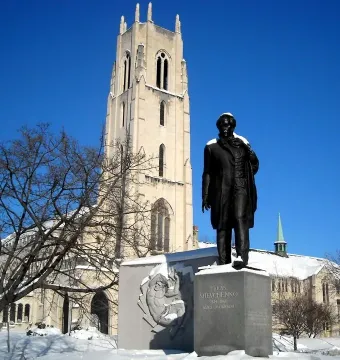
February 2010 © AgnosticPreachersKid · CC BY-SA 3.0
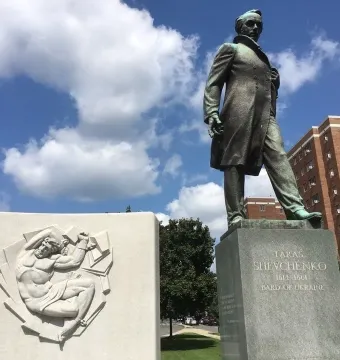
© NPS Photo · Public domain
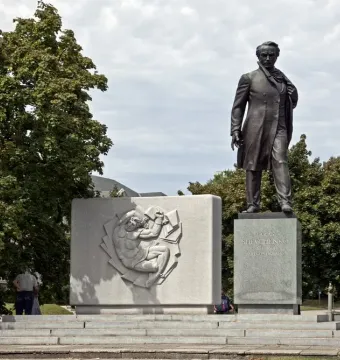
© Carol M. Highsmith · Public domain
April 2009 © dbking · Public domain
Identification | |
| Name | Taras Shevchenko Memorial |
| Type | Historical monument / memorial statue |
| Original-language name | Меморіал Тарасові Шевченку |
| Alternative name | Monumento conmemorativo a Taras Shevchenko |
Historical context | |
| Commemorative purpose | Memorial honoring Taras Shevchenko and, more broadly, Ukrainian freedom, independence, and Ukrainian-American heritage |
| Historical significance | One of many monuments in Washington, D.C. honoring foreign heroes who symbolize freedom in their home countries; also described as a landmark in Ukrainian-American history and a symbol of Cold War-era Ukrainian nationhood aspirations |
| Honoree | Taras Shevchenko (1814–1861), Ukrainian poet, artist, and national hero |
Creator | |
| Sculptor | Leo Mol (Leonid Molodozhanyn; Canadian-Ukrainian sculptor) |
| Architect | Radoslav Zuk |
Discovery and provenance | |
| Design competition | Announced in late 1960; 17 sculptural designs were submitted; the committee unanimously approved the design 'Prometheus' |
| Soviet reaction | Soviet officials initially opposed the memorial and twice asked the U.S. State Department via the UN to cancel it, but later accepted it and asked to send representatives to the unveiling |
| Support and controversy | The project received strong support from the Ukrainian diaspora, but The Washington Post editorial board and some officials criticized it; opponents called Shevchenko little known in America and described him as a Soviet Communist idol, anti-Semitic, and anti-Polish |
| Funding | Cost about US$250,000, paid for by the UCCA and donations from more than 50,000 people, mostly Ukrainian Americans |
| Committee leadership | Lev Dobriansky served as president/organizer; Harry S. Truman was honorary chairman; Roman Smal-Stocky and George Shevelov were on the leadership board |
| Memorial committee | Taras Shevchenko Memorial Committee of America, Inc. |
| Initiated by | Exiled Ukrainians, including Lev Dobriansky and Roman Smal-Stozkyj; the idea was first begun by the Shevchenko American Society (founded 1898) |
| Congressional authorization | Public Law 86-749, signed by President Dwight D. Eisenhower on 13 September 1960, authorized construction on U.S. property in the District of Columbia |
Physical characteristics | |
| Location | 2200 block of P Street NW, Dupont Circle, Washington, D.C., United States |
| Site | A triangular site near the Ellipse in Dupont Circle, Washington, D.C. |
| Components | Bronze statue on a granite pedestal, with a nearby commemorative stele or wall with stone reliefs |
| Height | About 7 meters (24 feet) overall |
| Statue height | About 14 feet (4.3 meters) |
| Pedestal height | About 7 feet (2.1 meters) |
| Weight | 45 tons |
Materials | |
| Foundation addition | A stainless-steel urn was later placed in the base |
| Statue material | Bronze |
| Stele material | Stone |
| Pedestal material | Granite |
Appearance | |
| Depicted form | Statue of Shevchenko as a young man |
| Project nickname | Prometheus |
| Setting | Installed on a granite pedestal with a relief-adorned commemorative wall or stele nearby |
Location and ownership | |
| Current management | Managed by the National Park Service, a federal agency of the U.S. Department of the Interior |
| Park | The surrounding park is maintained by the U.S. federal government and was renamed Ukrainian Independence Park in 2023 |
| Registry listing | Listed in the National Register of Historic Places in 1993 |
History and restoration | |
| Dedication music | The Star-Spangled Banner, Shevchenko's 'Testament', and the Ukrainian national anthem 'Shche ne vmerla Ukraina' were performed or sung |
| Later commemorations | Visited by Viktor Yushchenko in 2004/2005; a prayer service was held there in 2014; flowers were laid in 2014 and 2017; a 50th-anniversary ceremony was held in 2014; activists chained the memorial in 2015 |
| Later use | The memorial has been used for Ukrainian-American protests and celebrations, as well as by the local gay community |
| Dedication attendees | Representatives from Argentina, Australia, Belgium, Canada, France, Germany, and the United Kingdom attended, along with Ukrainian-American leaders and other dignitaries |
| Foundation contents | A stainless-steel urn containing soil from Shevchenko's grave, a memorial book, a list of major donors, and other documents were placed in the foundation/base in May 1965 |
| Dedication attendance | About 100,000 people attended the unveiling, including about 35,000 people of Ukrainian descent, foreign delegations, U.S. government representatives, members of Congress, clergy, and actors |
| Dedication speeches | Eisenhower called Shevchenko a Ukrainian hero and linked the statue to freedom, anti-communism, and resistance to tyranny; other speakers included Lev Dobriansky, Roman Smal-Stocky, and members of Congress |
| Dedication procession | A day-long procession from the Ellipse past the White House along Pennsylvania Avenue and north on 23rd Street was part of the dedication festivities |
| Unveiled by | Former U.S. President Dwight D. Eisenhower |
| Dedication occasion | 150th anniversary of Taras Shevchenko's birth |
| Construction dates | Foundation-laying ceremony on 21 September 1963; statue installed on pedestal on 3 June 1964; unveiled on 27 June 1964 |
Significance | |
| Interpretation | Seen as a symbol of Ukrainian independence, Ukrainian-American community identity, and anti-Soviet political expression |
| Comparison | Supporters compared the monument favorably with other Washington statues and with the Statue of Liberty |
| Scholarly interpretation | Kirk Savage described it as having 'stepped into an unpredictable future,' linking Ukrainian nationhood dreams with the realities of the American superpower |