
Fountain of Neptune
Fountain of Neptune in Madrid is a neoclassical fountain representing the god Neptune. It stands at the center of the roundabout that popularly bears its name, within Plaza de Cánovas del Castillo. The monument was proposed in 1777, and construction began in 1782 and was completed in 1786. Originally, it stood at the bottom of Carrera de San Jerónimo, facing the Fountain of Cibeles. In 1898, it was moved to its present location in the center of the square. It is one of the five large sculptural groups designed for the Prado promenade by Ventura Rodríguez, alongside the Fountain of Cibeles, the Fountain of Apollo, the Four Fountains, and the Fountain of the Artichoke.
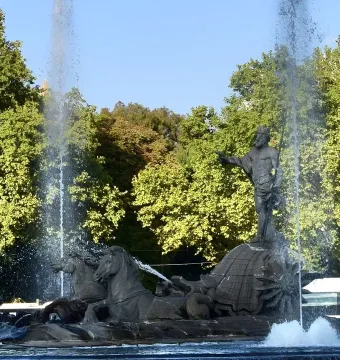
September 2014 © Ank Kumar · CC BY-SA 4.0
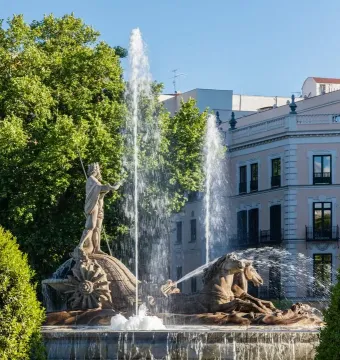
May 2017 © Diego Delso · CC BY-SA 4.0
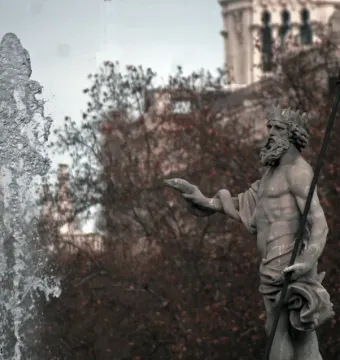
© José Maria Cantero Rojas · CC BY 3.0
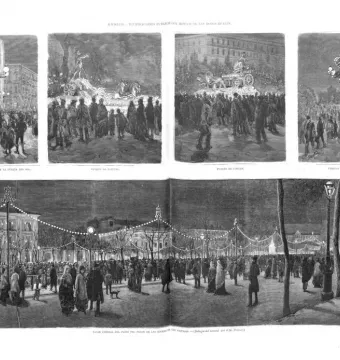
© Josep Lluis Pellicer · Public domain
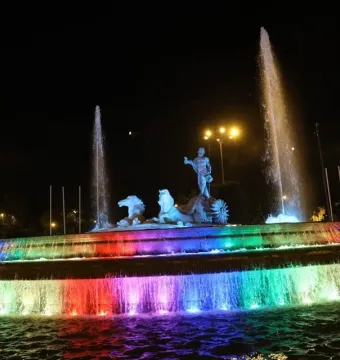
July 2018 © Diario de Madrid · CC BY 4.0
Identification | |
| Name | Fountain of Neptune |
| Type | Fountain |
| Spanish name | Fuente de Neptuno |
Historical context | |
| Style | Neoclassical |
| Commissioned as part of | The urban modernization and embellishment of Madrid under Charles III, as part of the works for the Paseo del Prado and Salón del Prado |
| Associated sculptural groups | Fountain of Cibeles, Fountain of Apollo, the Four Fountains, and the Fountain of the Artichoke |
Creator | |
| Designer | Ventura Rodríguez |
| Sculptor | Juan Pascual de Mena |
| Other sculptors involved | José Arias, José Rodríguez, Pablo de la Cerda, and José Guerra |
Discovery and provenance | |
| Relocated to current site | 1898 |
| Model used for the design | Wooden sketches by Miguel Ximénez |
| Drawing provenance | A drawing by Ventura Rodríguez is preserved at the Municipal Museum of Madrid, where it entered from the Archivo de Villa in 1926 |
| Current location | Center of the roundabout in Plaza de Cánovas del Castillo, Madrid, Spain |
| Original location | At the lower end of Carrera de San Jerónimo, facing the Fountain of Cibeles |
| Construction period | 1780 to 1786 |
| Design date | 1777 or 1782 |
Physical characteristics | |
| Form | A circular basin or pylon with the sculptural group at its center |
| Central figure | Neptune, the Roman god of the sea |
| Depiction | Neptune rides a shell-shaped carriage pulled by two hippocampi, with seals and dolphins around it |
| Attributes | Neptune holds a trident and a sea snake |
| Water effect | The seals and dolphins spray jets of water to a great height |
Materials | |
| Material | White marble from Montesclaros (Toledo) |
Technique | |
| Maximum water capacity | 305 m3 |
Iconography and meaning | |
| Mythological basis | Greco-Roman mythology |
| Possible symbolism | The figure may allude to Charles III's reform of the Navy |
Location and ownership | |
| Popular name of roundabout | The roundabout is popularly named after the fountain |
| Cultural use | Gathering place for Atlético Madrid supporters to celebrate titles and victories |
History and restoration | |
| Historical incidents | During the Spanish Civil War, a sign reading 'Give me food or take away my fork' was hung around Neptune's neck; in 2012 the fountain's waters were dyed red during a trade union demonstration |
| Celebratory example | After Atlético Madrid won La Liga in 2014, captain Gabi climbed the statue and draped a club flag over the trident and a club scarf around Neptune's head |
Significance | |
| Classification | Monument in Madrid |