
Pan and Daphne
Pan and Daphne is an ancient Roman marble sculpture, now in the collection of the National Archaeological Museum of Naples. From the Farnese family collection, it depicts the god Pan teaching the youth Daphnis to play the syrinx. Carved in white marble, the group stands 158 cm high and shows the two figures seated together on a slanting rock covered with a lion skin. Pan, shown with horns, a beard, and goat legs, embraces Daphnis while guiding his hands. Daphnis is turned partly away, holding the instrument to his lips with a hesitant, lowered gaze. The work is associated with themes of homoeroticism, nature, bucolic poetry, and tragic death.
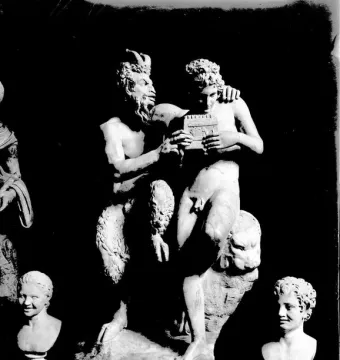
© William Henry Goodyear · Public domain
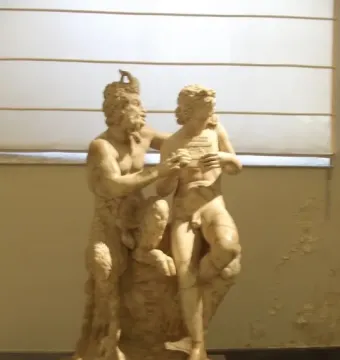
July 2012 © ell brown · CC BY 2.0
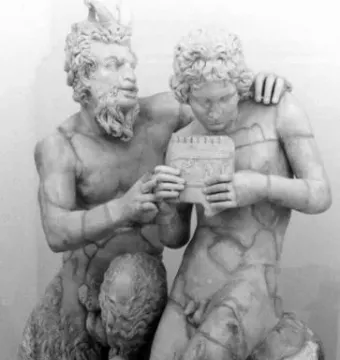
© Haiduc · Public domain
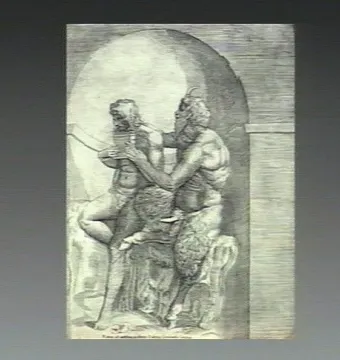
· CC BY 4.0
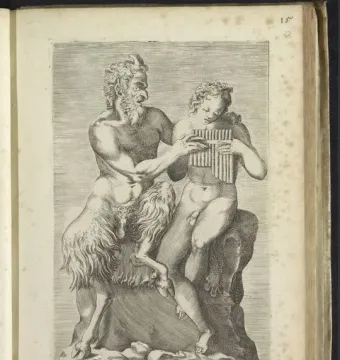
1584 © Rijksmuseum · CC0
Identification | |
| Title | Pan and Daphnis |
| French title | Pan et Daphnis |
| Variant title | Pan and Daphne |
| Type | Ancient Roman marble sculptural group |
Historical context | |
| Original work | Roman copy of a Greek original, possibly an ancient Greek original known through Roman copies |
| Original date | 2nd century BC, possibly 2nd–1st century BC |
| Roman copy date | 1st century |
Creator | |
| Attribution | Attributed to Heliodorus of Rhodes |
Discovery and provenance | |
| Provenance | From the Farnese family collection |
| Roman copy provenance | The Uffizi copy came from the Medici collections; the Torlonia copy from the former Albani collection; the Palazzo Altemps copy from the collection of Cardinal Federico Cesi-Aldobrandini-Ludovisi |
| Known Roman copies | Three Roman copies are known |
Physical characteristics | |
| Height | 158 centimeters |
Materials | |
| Material | White marble |
Appearance | |
| Daphnis expression | He looks sideways and downward, appearing embarrassed, confused, trembling, and modestly pulling away |
| Daphnis pose | He is shown partly turned away from Pan, holding the syrinx with both hands and raising it to his lips |
| Pan legs | His right leg is extended; his left leg is raised, bent at the knee, and touches Daphnis's knee with a hoof |
| Pan expression | His mouth is slightly open and his nostrils are flared, suggesting passion |
| Pan gesture | Pan embraces Daphnis with his left arm and touches Daphnis's right hand as if instructing him |
| Pan iconography | Shown with horns, a beard, goat legs or goat feet, and an erect penis |
| Composition | Pan sits on the right of Daphnis, turned toward him, and the pair sits side by side on a slanting rock covered with a lion skin |
| Depicted figures | Pan and Daphnis |
Iconography and meaning | |
| Daphnis | A very beautiful young shepherd in Greek mythology, idealized in antiquity as an eromenos and called the beloved of Apollo and Pan |
| Themes | Homosexuality, nature, bucolic poetry, and tragic death |
| Subject | Pan teaching Daphnis to play the flute (syrinx) |
Location and ownership | |
| Current location | National Archaeological Museum of Naples |
| Roman copy locations | Uffizi Gallery, Florence; Torlonia Foundation, Rome; Palazzo Altemps, Rome |
History and restoration | |
| Restoration | At least once rebuilt; fragments were taken to Carlo Albacini's workshop for restoration in 1781 or 1786 |
| Museum transfer | Transferred with part of the Farnese collection to the National Archaeological Museum of Naples in 1870 |
| Museum display | Placed in the Secret Cabinet, a room for erotic artworks |
| Related engraving | An engraving for the Speculum Romanae Magnificentiae was made in the 1540s–1580s after one of the copies, probably the Palazzo Altemps copy, and is described as closer to the Neapolitan composition |
Significance | |
| Later influence | Annibale Carracci used a sculpture from the Farnese collection as inspiration for Marsyas and Olympus in the late 1590s |
Other | |
| Related bronze statuette | A bronze statuette in the Kunsthistorisches Museum, Vienna, was made as a copy of the sculpture around 1550 |