
Nenningen Pietà
Nenningen Pietà is the last completed work by the sculptor Franz Ignaz Günther. Made in 1774 for the newly built field chapel in Nenningen, it was delivered on 8 December of that year and later installed in the cemetery chapel there. The figure group is probably carved from lime wood and measures 163 cm high and 142 cm wide. It consists of 18 joined parts and is signed on the back. Mary sits on a rocky base with Christ laid diagonally across her knees. The sculpture has undergone restoration and changes in surface treatment, and it was shown in several exhibitions before returning to Nenningen after conservation work in 2003–2005.
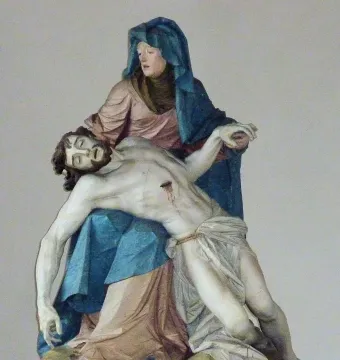
February 2016 © Xocolatl · CC BY-SA 4.0
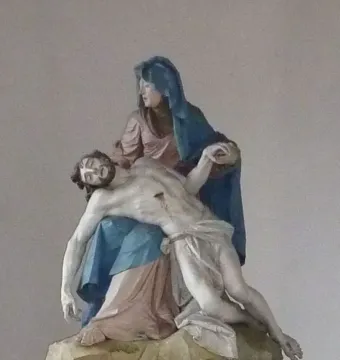
February 2016 © Xocolatl · CC BY-SA 4.0
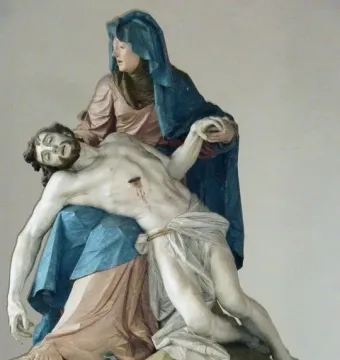
February 2016 © Xocolatl · CC BY-SA 4.0
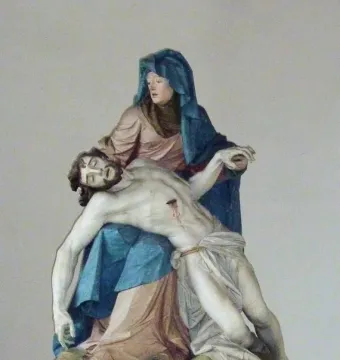
February 2016 © Xocolatl · CC BY-SA 4.0
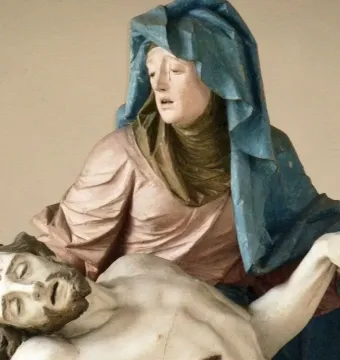
February 2016 © Xocolatl · CC BY-SA 4.0
Identification | |
| Title | Nenninger Pietà |
| Type | Pietà; sculptural group |
Creator | |
| Artist | Franz Ignaz Günther |
Historical context | |
| Date commissioned | 1774 |
| Date delivered | 8 December 1774 |
| Date consecrated | shortly after 8 December 1774 |
| Commissioned by | Oberhofmeister Max Emanuel von Rechberg und Rothenlöwen |
| Commissioned for | the newly built field chapel in Nenningen, later the cemetery chapel |
| Original location | Nenningen, a district of Lauterstein, Göppingen district, Baden-Württemberg, Germany |
| Historical note about chapel | The field chapel later became the cemetery chapel about a century later |
| Related work by artist | Günther had previously treated the theme of the Lamentation of Mary in his Pietà of Weyarn |
Significance | |
| Artistic evaluation | According to the cited assessment, Günther went beyond what he had achieved in his earlier works with the Nenninger Pietà |
| Style | A characteristic combination of naturalism and expression in the tradition of international Gothic |
| Artistic assessment | Compared with the Weyarn Pietà, it shows the greatest possible reduction to the essential figures and details; Christ is rendered with a high degree of graceful naturalness, surpassing the broken posture of the Weyarn Christ |
| Unique status | The only work by Günther that came to Württemberg |
| Significance | The last completed work by Franz Ignaz Günther |
Physical characteristics | |
| Signature | Signed on the reverse: "1774 F. J. Güntter" |
| Dimensions | 163 cm high, 142 cm wide |
| Construction | Core made from a single tree trunk piece; assembled from 18 parts glued and doweled to the main piece |
| Material | Probably linden wood |
| Original polychromy | The sculpture had an original painted surface; the blue areas were made with azurite |
Iconography and meaning | |
| Depicted figures | The Virgin Mary seated with the dead body of Christ lying across her knees |
| Central motif | The wound in Christ's body is at the center of the composition |
Appearance | |
| Mary's clothing | Azure-blue widow's veil, earth-colored neck scarf, pink dress tending toward gray, and a blue overmantle with angular folds |
| Mary's facial expression | Mourning expression with an open lamenting mouth, a sorrow wrinkle on the forehead, and a tear under the left eye |
| Christ's pose | Lies diagonally across Mary's knees, upper body raised forward, lower body almost slipping to the ground, right arm hanging down, left hand held by Mary |
| Mary's pose | Seated on an implied naturalistically modeled rock, upper body upright, head turned to the right |
History and restoration | |
| Restoration history | The 1855 repainting was removed in 1951; during conservation cleaning and restoration, retouching was used to make the original polychromy perceptible again |
| Scientific examination and restoration | In 2003–2005, during chapel renovation, it was examined, cleaned, and restored in the workshop of the Baden-Württemberg State Office for Monument Preservation in Esslingen am Neckar |
| Location history | It has remained in the Nenningen cemetery chapel since 1774, with interruptions caused by restorations and temporary exhibitions |
| Return to site | Returned to Nenningen after the 2003–2005 conservation work |
| Temporary relocation and exhibitions | Around 1951 the group was temporarily moved and shown in Munich in the 1950s, then in London, Paris, and Brussels; it was also exhibited in Bruchsal in 1982 |
| Chapel climate conservation measure | Since the last restoration, the cemetery chapel in Nenningen has not been heated to help preserve the wooden sculpture |
| Later repainting | Repainted in 1855 by the painter Klein from Schwäbisch Gmünd |
Location and ownership | |
| Current location | Nenningen cemetery chapel |
Other | |
| Museum model | A model for the Nenningen Pietà, also carved by Günther from linden wood, has been in the Bavarian National Museum, Munich, since 1974 |
| Interpretive hypothesis | A description of the cemetery chapel and Pietà speculated that the seriously ill sculptor, who lost his wife during the work, may have portrayed her in the sculpture as a memorial |