
End of the Trail
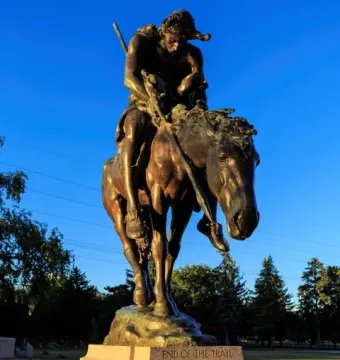
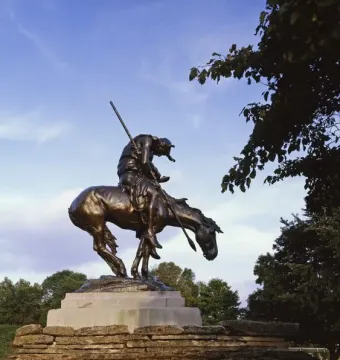
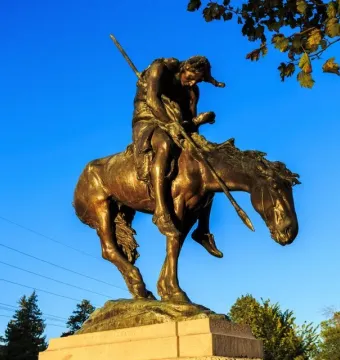
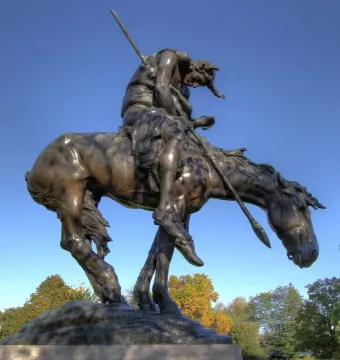
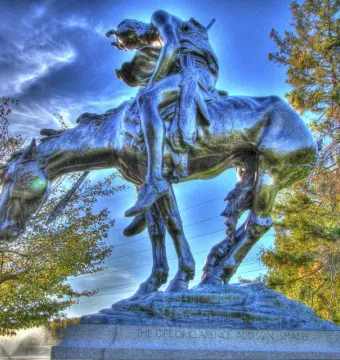
End of the Trail is a sculpture by James Earle Fraser, first created in 1894 and later reproduced in plaster and bronze. It shows a weary Native American man carrying a spear and wrapped in the remains of a blanket, hanging limp over an exhausted horse with swollen eyes. Fraser used the work to comment on the damage caused by Euro-American settlement to Native Americans. The sculpture became widely known after being shown at the 1915 Panama–Pacific International Exposition. Fraser intended it as a critique of the United States government, though it has also been criticized for portraying Native Americans as a dying race. The 1915 version is now in the National Cowboy Hall of Fame and Western Heritage Museum.
© Shawn Conrad · CC BY-SA 3.0
© Carol M. Highsmith · Public domain
© Shawn Conrad · CC BY-SA 3.0
© Veever · CC BY-SA 3.0
© Veever · CC BY-SA 3.0
Identification | |
| Title | End of the Trail |
Creator | |
| Artist's cultural connection | Fraser felt a connection to Native American culture, which influenced the sculpture |
| Related work detail | The Buffalo-Indian Head nickel appeared on the five-cent coin from 1913 to 1938 |
| Related works | The Buffalo-Indian Head nickel and The Buffalo Prayer |
| Artist | James Earle Fraser |
| First model exhibited at | A competition sponsored by the American Art Association |
| Artist's age at first model | 17 years old |
| Source of horse figure | Adapted from a horse in another work, In the Wind |
| Possible model for main figure | Seneca Chief John Big Tree |
| Personal memory behind the concept | He recalled an old Dakota trapper saying, 'The Indians will someday be pushed into the Pacific Ocean.' |
| Inspiration | Fraser drew inspiration from childhood memories of frontier life and Native American experience in the Dakota Territory, and from a piece of art he saw at the 1893 Columbian Exposition |
| First model award | First place |
Historical context | |
| Recognition | The 1915 Panama–Pacific International Exposition brought the work national popularity and wide fame |
| 1915 exposition version | A plaster monument displayed at the Panama–Pacific International Exposition in San Francisco in 1915, where it stood on an eight-foot pedestal at the entrance and won a gold medal |
| Study and assistantship | In 1897 Fraser went to Paris to continue his studies and later became an assistant to Augustus Saint-Gaudens after winning the John Wanamaker Prize in 1898 at the American Artists Association exhibition in Paris |
| Style development | Augustus Saint-Gaudens strongly influenced Fraser's stylistic development |
| Artist's stated intention for related work | When asked to create something uniquely American, Fraser said the buffalo and the American Indian were integral parts of American culture and history |
| Date created | 1894 |
| Original model size | Seventeen-year-old Fraser created the first model |
Materials | |
| Materials | Plaster and bronze |
| Large model material | Plaster |
| Bronze version | A bronze version was planned but not cast at the time because of wartime metal shortages |
Physical characteristics | |
| Scale | Two-and-a-half times life size |
| Height | Not specified in the source fragment |
Appearance | |
| Depicted clothing | Only the remains of a blanket |
| Depicted horse | A weary horse with swollen eyes |
| Depicted figure | A weary Native American man |
| Depicted posture | Hanging limp |
| Depicted object carried | A spear |
| Horse action | Stopping to observe the ground ahead |
| Wind direction implied | They have their backs to the wind, suggested by the horse's blowing tail |
| Modifications for the monumental version | The shield was replaced with a medicine bag, some buffalo-hide robe was removed to expose the figure's musculature, and the strong wind from behind was included |
Iconography and meaning | |
| Main figure interpretation | Embodies the suffering and exhaustion of people driven from their native lands |
| Theme | Commentary on the damage Euro-American settlement inflicted upon Native Americans |
| Interpretive readings | Seen variously as a statement that Native Americans were destined to die out, or as an indictment of settler and government actions that destroyed autonomous Indigenous nations |
| Historical theme | The displacement of Native Americans westward or their confinement to Indian reservations |
| Conceptual idea | An Indian representing his race reaching the end of the trail at the edge of the Pacific |
| Artist's intended meaning | A critique of the United States government |
| Artist's own description | A 'weaker race' being 'pushed to the wall by a stronger (race)' |
| Symbolic meaning of the modifications | They represent the spirituality of Native American people and the strength of the figure |
| Interpretation in exposition catalog | A reminiscence of early American history and its traditions of courage and endurance, and the pathos of the Indian's decline |
| Critical reception | Criticized for depicting Native Americans as a dying race |
Discovery and provenance | |
| Rescue and deterioration | The plaster version deteriorated significantly outdoors and was in poor condition with large surface cracks |
| Visalia transfer | After the exposition, the plaster monument was thrown into a mud pit in Marina Park, rescued by the Tulare County Forestry Board in 1919 from Mooney Grove Park, Visalia, and later replaced there by a bronze casting in 1971 |
| Other versions | A 1929 version is at Riverside Cemetery in Oshkosh, Wisconsin |
| Museum copies | The Metropolitan Museum of Art in New York City and Winona State University in Winona, Minnesota hold copies |
| Waupun quote | Fraser said it was fitting that in Wisconsin, where the Indian made one of his last stands, he could offer this slight tribute to his memory |
| Bronze dedication purpose | A tribute to Native Americans |
| Bronze unveiling | 23 June 1929 in Waupun, Wisconsin |
| Large bronze commission | Commissioned by Clarence A. Shaler, a wealthy art patron, in 1926 and reduced to life size as a compromise |
| Small bronze replicas | Fraser sold small-scale bronze replicas in two sizes within a few years after the exposition |
| Paris trip | In 1897 Fraser took a small bronze version to Paris while continuing his studies |
| Original bronze version | A small bronze version was created in 1894 |
| Commission purpose | To donate the sculpture to the city of Waupun, Wisconsin |
History and restoration | |
| Restoration and acquisition | In 1968 the National Cowboy and Western Heritage Museum acquired the plaster version and restored it for display |
| Restoration work | Leonard McMurry removed six layers of paint, closed fissures in the horse's body, refined the surface for molding, and used enlarged photographs to restore the original appearance |
| Most difficult features to recreate | The chin and upper chest of the Native American figure |
| Restoration completed | 1971 |
Location and ownership | |
| Cemetery version location | Riverside Cemetery, Oshkosh, Wisconsin |
| Current display location | The entrance of the National Cowboy & Western Heritage Museum in Oklahoma City, Oklahoma |
| Smaller bronze copy location | Winona State University library, Winona, Minnesota |
| Current Visalia location | Mooney Grove Park, Visalia, California |
Significance | |
| National Register listing | The Waupun bronze statue was listed in the National Register of Historic Places in 1980 |
| Cultural impact | Reproductions, prints, miniatures, postcards, traveling-show and rodeo imitations, and a painting on the original cover of the Beach Boys' Surf's Up made it a recognizable symbol across America |
| Later cultural reference | A painting inspired by the sculpture appeared on the original cover of the Beach Boys album Surf's Up in 1971 |
| Museum importance | The National Cowboy Hall of Fame and Western Heritage Museum considered it imperative to feature End of the Trail as Fraser's most renowned work |
| Fraser Memorial Studio plan | After Fraser's death in 1953, plans were made for a Fraser Memorial Studio in the National Cowboy Hall of Fame and Western Heritage Museum in Oklahoma City |
Other | |
| Artist name variant | James Fraser |