
Nature by Alfons Mucha
Nature is a bronze sculpture by Alfons Mucha, created between 1899 and 1900. Seven examples are known today, though there may originally have been about ten. One is displayed at the Fin-de-Siècle Museum in Brussels, two are in Germany, and others are held by the Virginia Museum of Fine Arts and the Alfons Mucha Museum in Sakai, Japan. Each version has different patina and ornamental materials. The sculpture shows a female bust with an enigmatic face, half-closed eyes, dangling earrings, and long hair beneath a striking tiara. It is considered an allegory and a representation of the Belle Époque ideal of femininity, and is widely seen as a masterpiece of Art Nouveau.
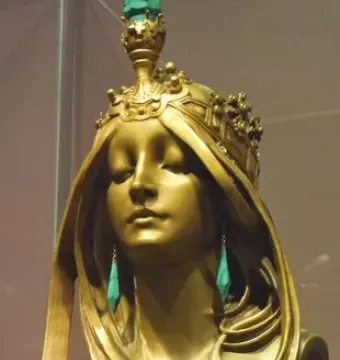
October 2017 © Chatsam · CC BY-SA 3.0
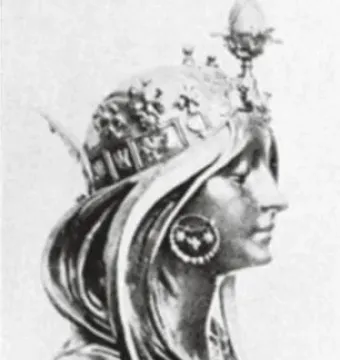
May 1900 © Abel Fulcran César Fabre · Public domain
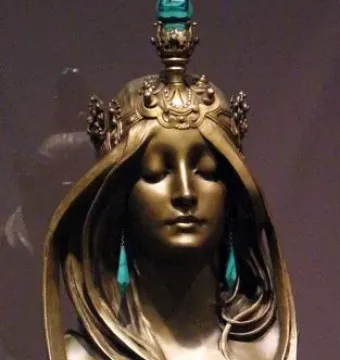
March 2016 © Sailko · CC BY 3.0
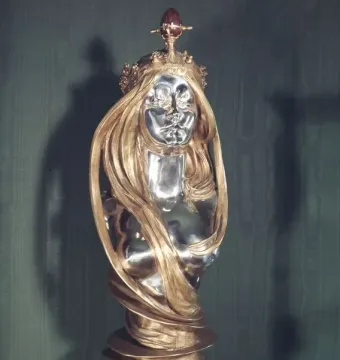
© Françoise Foliot · CC BY-SA 4.0
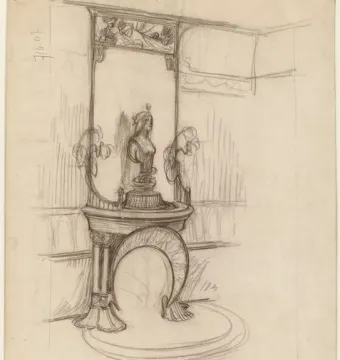
1900 © Alphonse Mucha · Public domain
Identification | |
| Title | Nature |
| Original title | Природа |
| Type | Bust |
Historical context | |
| Date of creation | 1899-1900 |
| Created for | The Paris World’s Fair of 1900 |
| Intended destination | Austrian Pavilion |
| Commission purpose | To represent the nobility of the Nation |
Creator | |
| Artist | Alphonse Mucha |
| Artist professions | sculptor, painter, and designer |
| Foundry / execution entrusted to | Auguste Seysses |
| Artist nationality | Czech |
Discovery and provenance | |
| Number of known examples | Seven currently known examples |
| Possible total number of examples | About ten may exist |
| First known version | Until the 1960s, only the version made for the Fouquet jewelry shop was known |
| Resurfacing years of other busts | 1965, 1971, 1972, 1988, and 2002 |
| Later history | The statues disappeared into private collections |
Materials | |
| Base | Some examples are mounted on a round marble base |
| Material | Bronze |
| Surface finish | The patina differs for each example; one example has a matte patina |
| Decorative materials | Silver, gold, malachite, lapis lazuli, red porphyry; some examples have bronze-gilt or silvered bronze parts |
Physical characteristics | |
| Depicted subject | A female bust |
| Facial expression | Enigmatic face with half-closed eyes |
| Jewelry | Dangling earrings; some examples have hoop earrings |
| Hair | Long hair |
| Headpiece | An imposing tiara rests on the hair; some examples have a porphyry ornament or an egg on the crown |
| Visual description | Long golden curls fall over the bare breast and wrap around the conical torso |
Appearance | |
| Stylistic effect | Enigmatic, femme fatale character |
Iconography and meaning | |
| Interpretation | An allegory representing the feminine ideal of the Belle Époque |
| Possible model | Cléo de Mérode has been suggested, but this is probably incorrect; Sarah Bernhardt has also been suggested |
Style | |
| Art style | Art Nouveau |
Significance | |
| Effect on artist's reputation | Helped Mucha reach the height of his fame |
| Subsequent artistic opportunity | After the exhibition, Mucha was offered the decoration of the famous Fouquet jewelry shop |
| Artistic period | Late 19th century to early 20th century decorative sculpture |
| Reason for acclaim | Attracted by the 48 million visitors over the 212 days of the exhibition |
| Artistic importance | Considered one of the masterpieces of Art Nouveau and of decorative sculpture of the late 19th and early 20th centuries |
| Reception | Exceptionally successful; unprecedented reception at the 1900 exhibition |
Location and ownership | |
| Example in Belgium | Fin-de-Siècle Museum, Brussels, Belgium |
| Example in Germany | One example is in the Ferdinand Wolfgang Ness collection at the Wiesbaden Museum; another is at the Badisches Landesmuseum |
| Example in the United States | Virginia Museum of Fine Arts |
| Example in Japan | Musée Alphonse Mucha collection, Sakai, Japan |
| Current reconstruction note | The Fouquet jewelry shop is reconstructed at the Musée Carnavalet in Paris |
History and restoration | |
| Sotheby's copy | A seventh known copy was sold at auction by Sotheby's in a prestigious sale |
| Christie's copy | Baroness Anne-Marie Crowet acquired a copy at Christie's |
| New York copy | A sixth copy was sold in New York in 2002 |
| Collection after donation | The collection was temporarily exhibited, then returned to storage until the opening of the Fin-de-Siècle Museum |
| Also proposed for | Turin Universal Exposition in 1902 |
| First exhibited | Paris Universal Exposition (Exposition universelle de Paris) in 1900 |
| Collection donation | Baroness Anne-Marie Crowet donated her entire Art Nouveau collection in 2005 to the Royal Museums of Brussels |
Other | |
| Compared copy | Almost identical to the copy in the Museum of Brussels |
| Virginia Museum of Fine Arts specimen maker | Cast by Émile Pinédo |
| Virginia Museum of Fine Arts specimen | A bust in silvered bronze with gilded hair |
| Museum of Wiesbaden specimen | A bust with a silvered bronze torso and face, and gilded bronze hair and ornaments |
| Museum of Fin-de-Siècle specimen | A bronze-gilt Art Nouveau bust with malachite ornaments; the tiara stone and earrings are made of malachite |
| Photograph note | A photo shows the sculpture as presented during the 1900 exhibition |
| Description by Anna Dvorak | A bronze bust of La Nature with gold earrings and a porphyry ornament on the head |
| Museum view | The Fin-de-Siècle Museum sculpture shown in profile on its base |
| Shown at | The 1900 exhibition |
| Original model documented in | Photograph illustrated under number 102 in the official catalogue |
| Description source | Anna Dvorak, in a publication on the exhibition devoted to the Art of the Small European States |
| Related design | A decorative mantelpiece with a bust of La Nature, designed by Alphonse Mucha and preserved at the Musée Carnavalet in Paris |
| Musée Alphonse Mucha specimen | Another bust with a matte patina |