
Equestrian statue of Joseph Hooker
The Equestrian statue of Joseph Hooker is a 1903 bronze monument in front of the Massachusetts State House on Beacon Street in Boston, Massachusetts. It honors Joseph Hooker, a U.S. Army officer in the Mexican–American War and a Union major general during the Civil War. Designed by Daniel Chester French and Edward Clark Potter, the sculpture stands on a granite base and is 4.6 meters tall. It was inaugurated in June 1903 with an artillery salute at a ceremony attended by military and civilian officials. The statue was inspected in 1997 as part of the Smithsonian’s Save Outdoor Sculpture! program. Its commemoration has long been controversial, including debate over an original bronze plaque and criticism of Hooker’s reputation.
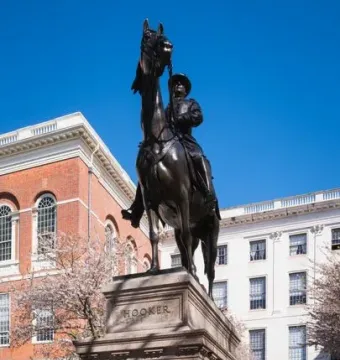
© Christian David · CC BY-SA 4.0
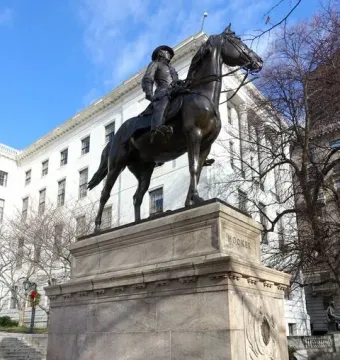
December 2014 © Daderot · Public domain
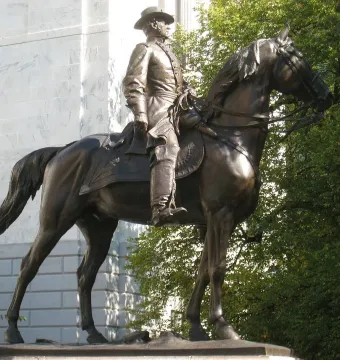
© Daderot · Public domain
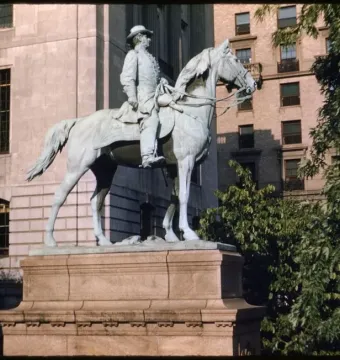
© Edmund L. Mitchell · No restrictions
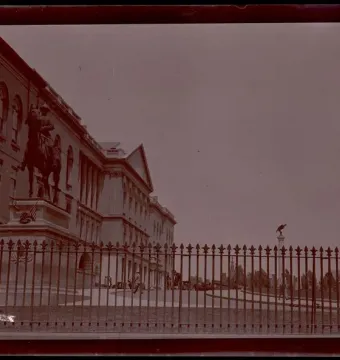
© Edmund F. Arras · Public domain
Identification | |
| Title | Equestrian statue of Joseph Hooker |
| Type | Equestrian statue |
| Subject | Joseph Hooker |
| Alternative name | General Joseph Hooker |
Historical context | |
| Dedication | Dedicated to Joseph Hooker, a U.S. Army officer in the Mexican–American War and a major general in the Civil War |
Creator | |
| Designers | Daniel Chester French and Edward Clark Potter |
Discovery and provenance | |
| Commissioning funds | $55,000 in public funds approved by Massachusetts legislators |
| Date of creation | 1903 |
Physical characteristics | |
| Height | 4.6 m |
Materials | |
| Main material | Bronze |
| Base material | Granite |
| Plaque material | Bronze |
Appearance | |
| Inscription on original plaque | A Soldier in the Army that Kept the Nation Whole |
Location and ownership | |
| Location significance | The statue stands in front of the main public entrance to the State House and gives the entrance its name |
| Nearby statue | Mary Dyer statue |
| Associated entrance name | General Hooker Entrance |
| Location | In front of the Massachusetts State House, facing Beacon Street, Boston, Massachusetts, United States |
| Installed at | Massachusetts State House |
History and restoration | |
| Inauguration date | June 1903 |
| Inauguration ceremony | Opened with an artillery salute and attended by military and civilian officials |
| Surveyed by | Smithsonian Institution's Save Outdoor Sculpture! program |
| Survey year | 1997 |
| Public access after September 11 attacks | It remained open to the public after the September 11, 2001 attacks, when state authorities closed the State House lawn gates and restricted access to other nearby statues |
| Inscription controversy | Veterans' groups demanded removal of the original plaque inscription because they felt it diminished Hooker's leadership role in the war |
Significance | |
| 2011 media reference | In 2011, actor Kevin Bacon tweeted a photo of the entrance with the question, "Where do special hookers enter?" |
| Impact on women workers | DuBois said women who work in the State House face uncomfortable "good-old-boy, schoolyard jokes" because of the name |
| Michelle DuBois statement | She described the name as "tone deaf" and said it shows disregard for most women's feelings and dignity by elevating and falsely protecting a statue of a long-dead general |
| 2018 controversy | In 2018, State Representative Michelle DuBois called for the entrance name to be changed |
| Historical criticism | Charles Francis Adams Jr. reportedly said he refused to walk on the same side of the street as the statue and called it a disgrace to Massachusetts men who served in the Civil War |
| Public reaction to entrance name | The entrance sign is often the source of double entendres, especially among schoolchildren on field trips |
| Interpretation of its presence | Drummey speculated that the statue's presence at the State House may be a testament to the political power of veterans' groups rather than a tribute to Hooker himself |
| 2017 assessment | Peter Drummey of the Massachusetts Historical Society said Hooker did not have a very good reputation as a soldier or as a person |
| 2017 commentary | The Boston Globe said the statue belongs to the category "Why Are These Statues Even Here At All?" |
| Public reception | Its commemoration in one of the most prominent places in Massachusetts has been controversial |
| Government response | Governor Charlie Baker and other state officials rejected changing the sign |