
The Quest
The Quest, also known as Saturday Night at the Y or Three Groins in a Fountain, is a public marble sculpture and fountain in Portland, United States, designed by Alexander von Svoboda. Commissioned by Georgia-Pacific in 1967, it was carved in Italy from a single 200-ton block of white marble quarried from Mount Pentelicus in Greece. Installed in front of the Standard Insurance Center in 1970, the work depicts five nude figures: three women, one man, and a child. According to the artist, they represent humankind’s eternal search for brotherhood and enlightenment. The sculpture has received mixed criticism and was later surveyed by the Smithsonian’s Save Outdoor Sculpture! program in 1984.
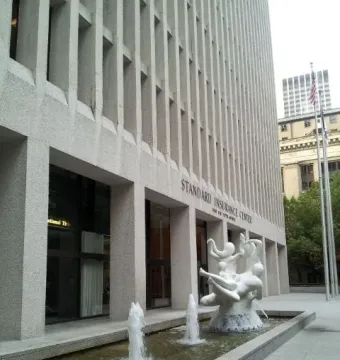
© User:Another Believer · CC BY-SA 3.0
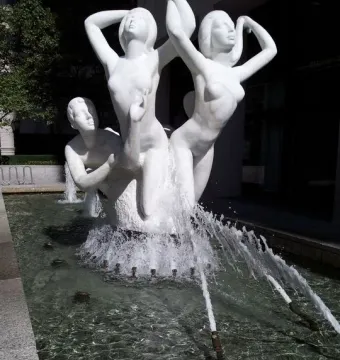
© User:Another Believer · Public domain
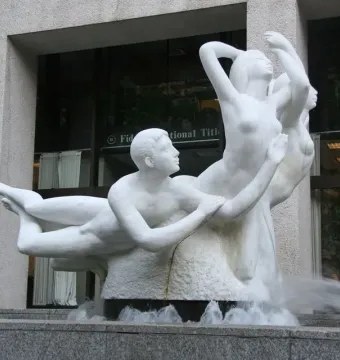
September 2009 © Jesús Corrius · Public domain
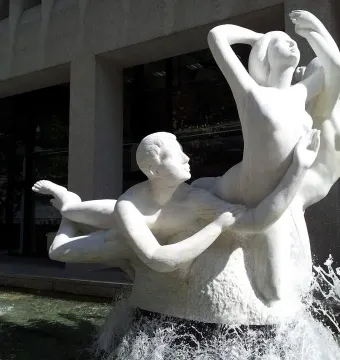
September 2013 © User:Another Believer · Public domain
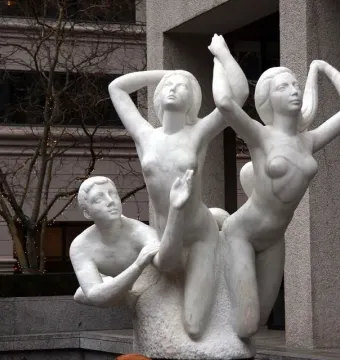
December 2007 © Christopher · Public domain
Identification | |
| Title | The Quest |
| Type | Outdoor marble sculpture and fountain |
| Style | Abstract and figurative |
| Alternative names | Saturday Night at the Y; Three Groins in a Fountain |
Creator | |
| Designer / sculptor | Alexander von Svoboda |
| Designer nationality | Austrian-born |
| Designer base | Toronto-based |
Discovery and provenance | |
| Public presentation | Presented by the Rose Festival princesses in a formal ceremony |
| Associated collection | One of nearly 400 works in Georgia-Pacific's private collection, unveiled in Portland with the opening of its world headquarters |
| Carved in | Carrara, Italy |
| Commissioned year | 1967 |
| Commissioned by | Georgia-Pacific |
Location and ownership | |
| Original installation site | In front of the Standard Insurance Center (formerly the Georgia-Pacific Building) at Southwest 5th Avenue and Southwest Taylor Street, downtown Portland, Oregon, United States |
| Display status | Privately owned but publicly displayed |
| Current location | Portland, Oregon, United States |
Physical characteristics | |
| Base weight | 17 tons |
| Figure arrangement | Two of the female figures have raised hands; another female figure is reclining or sleeping at the back; the male figure appears to float forward with reaching hands; the child is behind one of the female figures |
| Depicted figures | Five larger-than-life nude figures: three women, one man, and one child |
| Setting | Set on a pedestal inside a fountain, surrounded by water jets |
| Base dimensions | About unspecified x unspecified x unspecified |
| Base material | Concrete or stone |
| Dimensions | About unspecified x unspecified x unspecified |
| Source block | A single 200-ton block quarried from Mount Pentelicus near Athens, Greece |
| Material | White Pentelic marble |
Technique | |
| Construction labor | 35 stonemasons assisted with the sculpture's creation |
| Construction time | Two and a half years |
Iconography and meaning | |
| Artist interpretation | The symbolic and eternal search of humankind for fraternity and enlightenment |
| Inspiration | Michelangelo |
| Artistic approach | More humanist in approach |
History and restoration | |
| Maintenance | Waxing and repairs to the male figure's nose |
| Condition | Well maintained; underwent minor repairs |
| Survey year | 1994 |
| Surveyed by | Smithsonian Institution's Save Outdoor Sculpture! program |
| Companion sculpture location | Originally along the southwest side of Fourth Avenue; later moved to the World Forestry Center |
| Companion sculpture | Perpetuity, a hollowed-out cross-section of a redwood log with a bronze seedling radiating outward |
| Installation year | 1970 |
Significance | |
| Largest sculpture claim | Considered Portland's largest single piece of carved white marble from 1990 onward |
| Reception | Received mixed reviews |
| Positive critical comment | A Building Stone News contributor praised the flowing white lines, their contrast with the adjacent building's rigid vertical white quartz pillars, and called the marble impressive |
| Negative critical comment | A writer for The Oregonian described widespread dislike of the sculpture and called it a free sex-education lesson for schoolchildren |
| Inauguration reaction | Reportedly met with momentary stunned silence, then growing applause, at the unveiling |
| Public description | Described by Sallie Tisdale of The Oregonian in 2002 as a large tangle of snow-white bodies in a fountain |
| Public familiarity note | By 2002, its provenance and purpose had become obscure |
| Seattle Times reference | A writer for The Seattle Times used 'Three Groins in a Fountain' as an example of Portland's kitschier art |
| Eugene Weekly mention | Eugene Weekly suggested readers unfamiliar with 'Three Groins in a Fountain' look up Fugitives and Refugees by Chuck Palahniuk |
| Chuck Palahniuk reference | Included in Palahniuk's Portland vocabulary lesson |
| Walking tour inclusion | Included in at least one published walking tour of Portland |