
Spirit of Haida Gwaii
Spirit of Haida Gwaii is a sculpture by British Columbia Haida artist Bill Reid. It exists in three versions: the black canoe, the jade canoe, and a full-sized plaster original. The work represents the Aboriginal heritage of Haida Gwaii and shows a traditional Haida cedar dugout canoe about six metres long. Its passengers include Raven, Mouse Woman, Grizzly Bear, Bear Mother, their cubs, Beaver, Dogfish Woman, Eagle, Frog, Wolf, a small human paddler known as the Ancient Reluctant Conscript, and a human Shaman at the focal point. The black canoe appeared on Canadian $20 bills issued between 2004 and 2012. The sculpture’s varied figures symbolize interdependence and the natural environment.
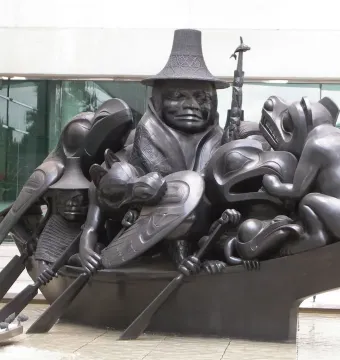
June 2006 © Boberger · CC BY-SA 3.0
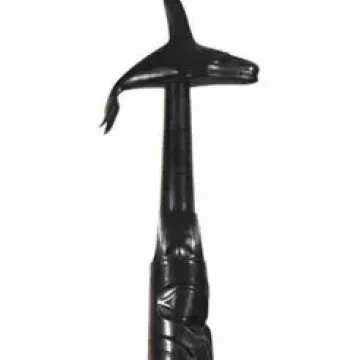
1900 © Unknown authorUnknown author · CC BY-SA 4.0
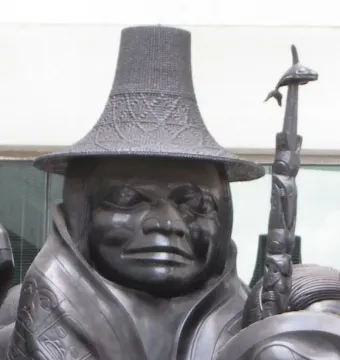
© Boberger · CC BY-SA 3.0
Identification | |
| type | Sculpture |
| title | Spirit of Haida Gwaii |
Creator | |
| artist | Bill Reid |
| artist ethnicity | Haida |
| artist origin | British Columbia |
| artist lifespan | 1920–1998 |
Historical context | |
| creation date | 1986 |
| enlargement date | 1988 |
| bronze casting date | 1991 |
| version count | Three versions: the black canoe, the jade canoe, and a full-sized plaster original |
Materials | |
| material | Bronze |
| original model material | Clay |
| original plaster pattern material | Plaster |
| main version colors | Black bronze and green-colored bronze |
Technique | |
| casting | Bronze casting |
| original form | Scale clay model |
| enlarged form | Life-size clay model |
Physical characteristics | |
| length | Six metres |
| height | Not precisely specified; measured from the base to the top of the Shaman's staff |
| weight | Not specified |
| depicted object | A traditional Haida cedar dugout canoe |
Iconography and meaning | |
| Raven symbolism | Raven holding the steering oar is likely symbolic of nature's unpredictability |
| symbolic meaning | The passengers' variety and interdependence represent the natural environment on which the ancient Haida relied for survival; they are diverse and not always in harmony, yet must depend on one another to live |
| Shaman staff | Tall staff carved with images of Seabear, Raven, and Killer Whale |
| Wolf action | Claws imbedded in Beaver's back and teeth in Eagle's wing |
| Shaman clothing | Haida cloak and woven spruce root hat |
| Shaman identity | The human Shaman, or in Haida |
| Shaman position | At the sculpture's focal point |
| Ancient Reluctant Conscript description | A small human paddler in Haida garb |
| Mouse Woman position | Crouched under Raven's tail |
| Beaver relationship | Raven's uncle |
| Good Bear description | One of the cubs; ears pointed forward |
| Bear Mother identity | Grizzly's human wife |
| Grizzly Bear position and pose | Sitting at the bow and staring toward Raven |
| Raven role | Traditional trickster of Haida mythology; holds the steering oar |
| passengers | Raven; Mouse Woman; Grizzly Bear; Bear Mother; Good Bear; Bad Bear; Beaver; Dogfish Woman; Eagle; Frog; Wolf; a small human paddler known as the Ancient Reluctant Conscript; the human Shaman |
| represents | The Aboriginal heritage of Haida Gwaii, formerly called the Queen Charlotte Islands |
| Bad Bear description | One of the cubs; ears pointed back |
Location and ownership | |
| banknote status | No longer issued; a new design entered service in 2012 |
| stamp description | Perforated, 12.5 mm × 13 mm |
| stamp basis | A sculpture Spirit of Haida Gwaii (1991) by Bill Reid in the Canadian Embassy, Washington, United States |
| stamp issue | Canada Post 90¢ stamp issued 30 April 1996 in the Masterpieces of Canadian Art series, designed by Pierre-Yves Pelletier and printed by Ashton-Potter Limited |
| second bronze casting first exhibited | Canadian Museum of History |
| black canoe banknote depiction | Featured on the reverse of Canadian $20 bills of the Canadian Journey series issued between 2004 and 2012 |
| original plaster pattern location | Main hall of the Canadian Museum of History |
| second bronze casting relocation date | 1996 |
| second bronze casting relocation | Vancouver International Airport international terminal |
| first bronze casting location | Outside the Embassy of Canada in Washington, D.C. |
Significance | |
| currency depiction | An image of the sculpture appears prominently on the reverse of the 2004 edition of the Canadian twenty-dollar bill |