
Sam'al Lions
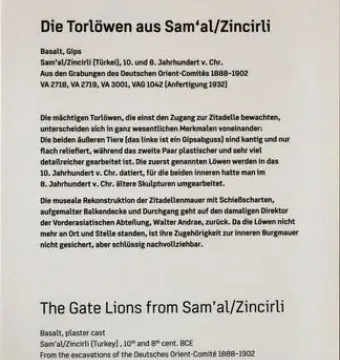
The Sam'al lions are four animal statues in the form of lions from Sam'al, the modern site of Zincirli, dated to around the 10th to 8th century BCE. They likely belonged to the inner castle gate on the east side, though they were found in secondary context. Two of the lions are dated to the 10th century BCE and two to the 8th century BCE; the later figures were reworked from earlier ones and are more fully modeled. Made of dolerite, the sculptures served both as decorative elements and as part of the structure. Three are originals and one is a plaster cast. They are now displayed in the Vorderasiatisches Museum Berlin, Pergamon Museum, in Hall 2.
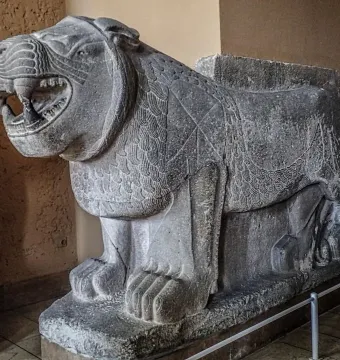
June 2016 © Mary Harrsch · CC BY 2.0
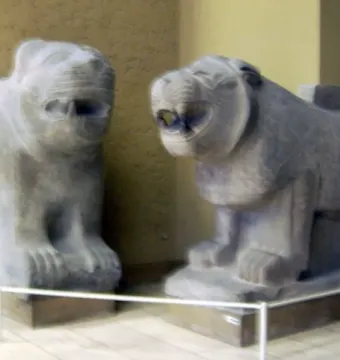
© Marcus Cyron · CC BY-SA 3.0
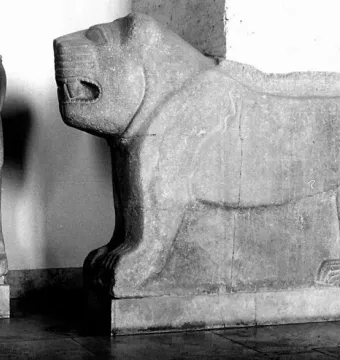
1983 © Kiss Tamás · CC BY-SA 3.0
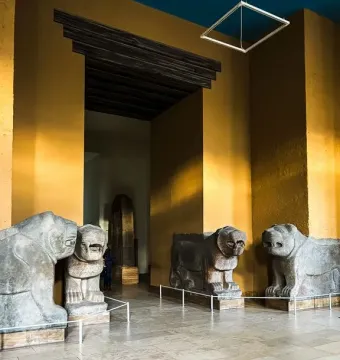
October 2023 © Woleonard · CC BY 4.0
September 2021 © Dosseman · CC BY-SA 4.0
Identification | |
| Title | Sam'al lions |
| Alternative name | Gate lions from Sam'al |
| Type | Four lion statues |
| Subject | Lions |
Historical context | |
| Date | Generally dated to the 10th to 8th century BC; current scholarship assigns the outer lions to the 10th century BC and the inner lions to the 8th century BC |
Creator | |
| Reworking | The later lions were created by reworking older statues |
Discovery and provenance | |
| Original location | Sam'al (today Zincirli), probably the inner part of the east gate / inner castle gate on the east side |
| Discovery context | Found in a secondary deposit during the Orient Committee excavations of 1890/91 |
| Acquisition | Brought to Berlin as partage after excavation |
Physical characteristics | |
| Dimensions | Height 1.9 m; length 2.9–3.05 m; width 0.85–0.9 m |
| Condition | Three of the lions are originals and one is a plaster cast |
| Number of sculptures | 4 |
Materials | |
| Material | Dolerite |
Technique | |
| Relief treatment | The sides are only shallowly relief-carved |
Appearance | |
| Arrangement | The two statues stand almost at right angles to each other |
| Stylistic features | The later lions are more strongly worked out from the wall, with more elaborate manes and limbs, wider-open mouths, and a more threatening gesture |
| Stylistic differences | All four lions differ in details |
| Spatial relation to wall | The later lions are more detached from the wall than the older ones |
Function | |
| Structural role | They served as orthostats and had both decorative and structural functions |
Location and ownership | |
| Current location | Vorderasiatisches Museum Berlin (Pergamon Museum), Hall 2, Syria and Asia Minor section, Berlin, Germany |
| Associated works | Two additional related lion figures are in the Museum of the Ancient Orient, Istanbul |
| Museum context | Displayed as part of the ensemble of the gate of Sam'al; located at the opposite end of the processional way of Babylon from the Ishtar Gate |
Other | |
| Inventory numbers | VAG 1042, VA 2719, VA 2718, VA 3001 |