
George Gordon Meade Memorial
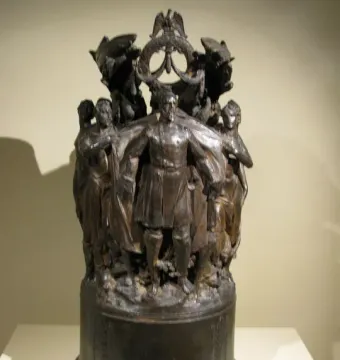
George Gordon Meade Memorial is a public artwork in Washington, D.C., honoring George Meade, the Pennsylvania military officer known for defeating Robert E. Lee at Gettysburg. Sculpted by Charles Grafly and gifted by the state of Pennsylvania, it was dedicated in 1927 with President Calvin Coolidge and other notable attendees present. The marble and granite sculpture includes representations of Meade and seven allegorical figures and rests on a granite base and platform. It was originally installed in Union Square, later removed and stored for fourteen years, and is now located on the 300 block of Pennsylvania Avenue NW opposite the E. Barrett Prettyman United States Courthouse. It is one of the Civil War monuments in Washington, D.C., listed on the National Register of Historic Places in 1978.
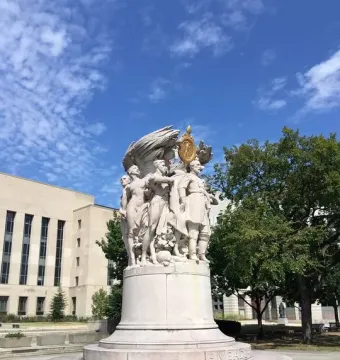
September 2016 © Thirivikraman Raghavan · CC BY-SA 4.0
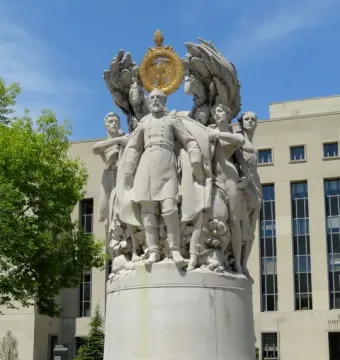
April 2013 © Daderot · CC0
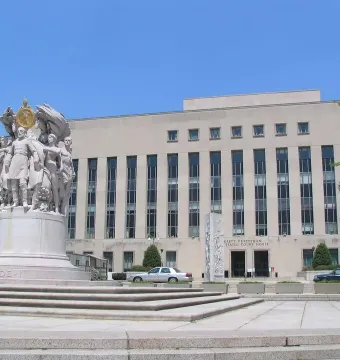
© Phyzome · CC BY-SA 3.0
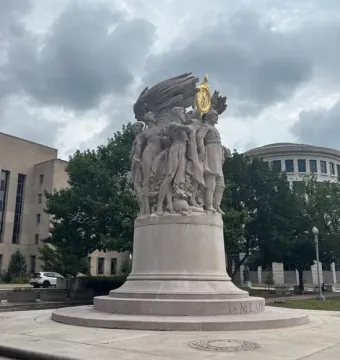
1925 © BumbleBeetle3 · CC0
© Team_Gene · CC BY-SA 2.5
Identification | |
| Title | George Gordon Meade Memorial |
| Type | Memorial sculpture / monument / Civil War monument |
| Alternative names | Meade Memorial; Major General George Gordon Meade |
Historical context | |
| Subject | George Gordon Meade (1815–1872), Pennsylvania-born career military officer and Union general in the American Civil War |
Iconography and meaning | |
| Symbolic meaning of cloak | The removal of Meade's military cloak represents the 'cloak of battle' that Meade leaves behind |
| Symbolic release | A flock of doves symbolizing peace was released from an altar bearing the Army of the Potomac emblem |
| Commemorated for | Defeating General Robert E. Lee at the Battle of Gettysburg |
Creator | |
| Sculptor background | Pennsylvania native; educator at the Pennsylvania Academy of the Fine Arts; founder of the National Sculpture Society; known for portrait busts |
| Architects | Grant Simon and Edward P. Simon of Philadelphia |
| Sculptor | Charles Grafly (1862–1929) |
| Stone carving | Piccirilli Brothers |
Discovery and provenance | |
| Required approvals | Design and site had to be approved by the Commission of Fine Arts (CFA) |
| Commissioned by | Commonwealth of Pennsylvania |
| State appropriation | $200,000 |
| Commission date | 18 October 1913 |
| Storage location | 42nd Street and Hunt Place NE |
| Memorial commission | Meade Memorial Commission appointed by the governor of Pennsylvania |
| Contractor | George A. Fuller Company |
| Total cost | $400,000 |
| Preliminary design approval | August 1918 |
| Congressional authorization date | 21 January 1915 |
| Sculptor commission fee | $85,000 |
| Commission chairman | John W. Frazier |
| Original site | Near 3rd Street NW in Union Square, a public park on Capitol Hill, Washington, D.C., near the Ulysses S. Grant Memorial |
History and restoration | |
| Reinstallation date | 1983 |
| Ceremonial transfer | Fisher presented the memorial on behalf of Pennsylvania to Coolidge on behalf of the American people |
| Rededication date | 3 October 1984 |
| Alternative relocation proposal | Marjorie Holt requested placement in her district at Fort George G. Meade |
| People involved in repair and reinstallation | Representative William F. Goodling; NPS National Capital Region commemorative coordinator; Gettysburg Civil War Round Table members; Jeff Wolf; Representative Marjorie Holt |
| Repair efforts | The sculpture had cracked in several places and was repaired |
| Public concern while in storage | Members of the public questioned why the memorial had not been replaced |
| Removal reason | Dismantled and placed in storage when the Capitol Reflecting Pool was built over Interstate 395's Third Street Tunnel |
| Removal date | 1969 |
| Veteran incident | An elderly Gettysburg veteran collapsed during a speech about his battle experience, was helped by Blanton Winship and James F. Coupal, and then finished speaking |
| Coolidge quotation | He said the nation accepted the memorial erected by the Commonwealth and praised Meade's service, reconciliation, loyalty to the flag, and 'immortal flame' |
| Artillery salute | Army cannons were fired during the unveiling |
| Dedication prayer | Led by Reverend J. H. Pershing |
| Invocation | Delivered by Hugh K. Fulton, minister of Northminster Presbyterian Church |
| Flags displayed | A 35-star Civil War-era U.S. flag and a current 48-star U.S. flag |
| Speaker's stand decoration | Palms, ferns, and autumn-colored flowers |
| Dedication setting | White temporary pavilions decorated with greenery, national shields, and the Pennsylvania coat of arms |
| Dedication attendees | President Calvin Coolidge; Grace Coolidge; Governor John Stuchell Fisher; Secretary of the Navy Curtis D. Wilbur; Secretary of the Treasury Andrew W. Mellon; Secretary of Labor James J. Davis; Senator Simeon D. Fess |
| Dedication date | 19 October 1927 |
| Site preparation | The last Botanic Garden greenhouses were demolished and the Bartholdi Fountain was moved to make room for the memorial |
| Dedication speech | Delivered by Governor John Stuchell Fisher |
| Groundbreaking date | 28 March 1922 |
| Unveiling | Unveiled by Henrietta, Meade's daughter, escorted by Ulysses S. Grant III |
| Music at dedication | The Army Band played 'The Star-Spangled Banner'; the ceremony ended with 'Taps' |
Significance | |
| National Register status | Collectively listed on the National Register of Historic Places in 1978 as one of eighteen Civil War monuments in Washington, D.C. |
| Dedication significance | One of the last Civil War monuments erected in Washington, D.C. |
| District of Columbia historic inventory listing | Included in the District of Columbia Inventory of Historic Sites on 3 March 1979 |
| Related monument | A separate monument to Meade by Henry Kirke Bush-Brown is located on the Gettysburg battlefield, near the point where Pickett's Charge was repulsed |
| Related monument date | Dedicated in 1896 |
| Related monument significance | Equestrian monument and first of its kind erected on the Gettysburg battlefield; contributing property to the Gettysburg Battlefield Historic District |
Location and ownership | |
| Reinstalled location | A new plaza on Pennsylvania Avenue NW, Washington, D.C. |
| Current location | 300 block of Pennsylvania Avenue NW, Judiciary Square, Washington, D.C., in front of the E. Barrett Prettyman United States Courthouse and across from the East Building of the National Gallery of Art |
| Current setting | Centered in a public plaza and small park |
| Agency | National Park Service, a federal agency of the Department of the Interior |
| Maintenance | National Park Service |
| Ownership | National Park Service |
Materials | |
| Main materials | Marble and granite |
| Base material | Pink Milford granite |
Physical characteristics | |
| Dimensions | Height and width unspecified |
| Inscriptions | Present, but text not provided |
| Form | Cylindrical |
Appearance | |
| Military Courage figure | Male figure behind Chivalry, locking arms with War |
| Progress figure | Male figure behind Chivalry |
| Main figure | George Gordon Meade in military uniform at the front of the sculpture |
| Rear figure | A winged male figure representing War at the back of the sculpture, flanked by two memorial tablets |
| Allegorical figures | Six figures representing Chivalry, Energy, Fame, Loyalty, Military Courage, and Progress |
| Chivalry figure | Female figure on the proper left removing Meade's military cloak |
| Loyalty figure | Male figure on the proper right removing Meade's military cloak and holding a wreath and garlands behind Meade |
| Fame figure | Female figure behind Loyalty, supported by Energy |
| Energy figure | Male figure supporting Fame |
| Top ornament | Gold finial of the Pennsylvania state seal |