
Newark Earthworks
Newark Earthworks is a pre-Columbian archaeological site in Newark and Heath, Ohio, in the United States. Built by people of the Hopewell culture, the complex includes three preserved types of earthworks: the Great Circle, the Octagon, and the Wright earthworks. It contains some of the largest earth enclosures in the world and once extended across a much larger area. Since Euro-American settlement, less than ten percent of the site has been preserved. The Octagon and Great Circle earthworks are managed by the Ohio History Connection. Newark Earthworks is listed as a National Historic Landmark and was designated in 2006 as the official prehistoric monument of the State of Ohio.
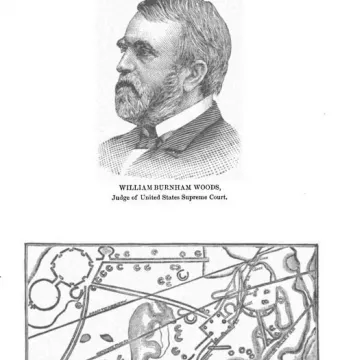
1891 © Howe, Henry, 1816-1893 · No restrictions

© Niagara66 · CC BY-SA 4.0

May 2024 © Blervis · CC BY 4.0
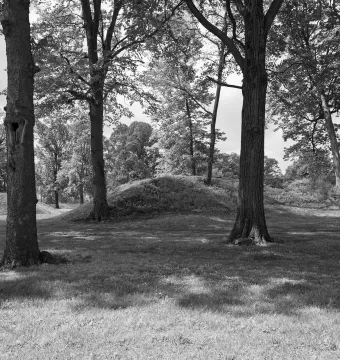
May 2026 © Public Lands Institute · CC0

© Nyttend · Public domain
Identification | |
| Title | Newark Earthworks |
| Alternative name | ouvrages de terre de Newark |
| Type | Earthworks complex |
| French name | Les terrassements de Newark |
Historical context | |
| Culture | Hopewell culture |
| Date built | Between 100 BCE and 400 CE |
| Construction period | Built over decades |
Creator | |
| Builders | Hopewell people |
Discovery and provenance | |
| Publication significance | First volume of the Smithsonian Institution's Contributions to Knowledge series and the Smithsonian Institution's first publication |
| Publication | Ancient Monuments of the Mississippi Valley |
| Documented by | Ephraim G. Squier and Edwin Hamilton Davis, surveyed from 1837 to 1847 |
Physical characteristics | |
| Wright Square | Nearly perfect square enclosure, originally about 20 acres with walls averaging 931 feet (284 m) in length |
| Octagon Earthworks | Complex in Newark, Ohio consisting of Observatory Mound, Observatory Circle, and the connected Octagon |
| Octagon dimensions | Eight walls of unspecified length and height |
| Connection | The Octagon is joined to Observatory Circle by parallel walls |
| Observatory Circle | 20-acre observatory circle |
| Octagon | 50-acre octagon |
| Great Circle significance | One of the largest circular earthworks in the Americas in terms of construction effort |
| Description | Contains the largest earthen enclosures in the world |
| Use | Ceremonial site, social gathering place, trade place, place of worship, and place to honor the dead |
| Significance in size | Single largest earthwork enclosure complex in the Ohio River Valley |
| Significance in size | Largest surviving Hopewell earthworks complex in North America |
| Great Circle | Circular earthwork in Heath, Ohio, with a deep moat enclosed by high walls; one of the largest circular earthworks in the Americas in terms of construction effort |
| Preserved components | Grand Circle Earthworks, Octagon Earthworks, and Wright Earthworks |
| Preserved area | Less than 10% of the entire site has been preserved since Euro-American colonization |
| Original extent | Extended over about an unspecified total area |
| Extent | Covers several square kilometers |
| Material | Earth |
| Great Circle center | Eagle Mound at the center of the Great Circle |
Iconography and meaning | |
| Octagon interpretation | A lunar observatory used to track the Moon's 18.6-year cycle |
| Observational alignment | Viewed from the observatory mound, the Moon rises within less than half a degree of the Octagon's exact center at the northernmost point of its 18.6-year cycle |
| Moonrise intention | Moonrise appears to have been intended in the design and construction by the indigenous builders |
Location and ownership | |
| World Heritage status | Designated a World Heritage Site in September 2023 |
| Location | Newark and Heath, Ohio, United States |
| World Heritage grouping | Designated together with the earthworks at Hopewell Culture National Historical Park and Fort Ancient |
| Region | Ohio River Valley |
| Management | The Octagon Earthworks and the Great Circle Earthworks are managed by the Ohio History Connection; the Moundbuilders Country Club maintains, secures, and provides restricted public access to the land |
| Designation | National Historic Landmark |
| State designation | Listed in 2006 as the official prehistoric monument of the State of Ohio |
| Part of | Hopewell Ceremonial Earthworks |
| World Heritage nomination | One of 14 sites proposed in January 2008 by the U.S. Department of the Interior for possible U.S. submission to the UNESCO World Heritage List |
History and restoration | |
| Eagle Mound name origin | Named by early settlers who believed it resembled an eagle in flight |
| Wright Square name origin | Named for Mrs. Frances Rees Wright |
| Wright Square remains | A fragment of the square enclosure remains, including a segment of wall and a segment of parallel wall leading toward what would have been the Cherry Valley Ellipse |
| Wright Square destruction causes | Development of Newark, construction related to the Ohio Canal, and farming |
| Wright Square condition | Much of the square enclosure and its associated mounds were destroyed during the nineteenth century |
| Ownership history | The Newark Board of Trade owned the property from 1908 until 1918 |
| Donation | The site was donated to the Ohio Historical Society in 1934 |
| Public use history | Used by the State of Ohio as a militia encampment from 1892 to 1908; leased to the Moundbuilders Country Club in 1910 for use as a golf course; managed by a trustee from 1918 to 1933; leased by the Ohio Historical Society to the country club in 1997 until 2078 |
| Historical significance | A landmark in American scientific research and the early development of archaeology as a scientific discipline |
| Scientific significance | The study of these prehistoric 'Mound Builders' was a trigger for scientific research in the United States and the early development of archaeology as a scientific discipline |
| Research conclusion | Prehistoric cultures in the region had advanced scientific understanding that was used as the basis for their complex construction |
| Research focus | Researchers analyzed the locations, alignments, dimensions, and distances between the earthworks |
| Research methods | Archaeogeodesy and archaeoastronomy |
| Archaeological excavation | Emerson Greenman excavated Eagle Mound in 1928 and determined it was not a burial mound; the underlying structure was a rectangular multi-post building with a central hearth and T-shaped screening fence, apparently ceremonially decommissioned before the mound was built |
| Destruction and preservation history | Less than 10% of the total site survives after destruction during Euro-American development, including construction of the Ohio Canal, streets and houses of Newark, land clearing, and agricultural cultivation |
| Site closure | The country club left the site on 1 January 2025 |
| Agreement | A deal was reached in August 2024 |
| Legal ruling | In 2022, the Ohio Supreme Court ruled that the historical society could use eminent domain to buy out the lease from Moundbuilders Country Club |
| Wright Square donation | Donated to the Ohio Historical Society in 1934 |