
Edith Dircksey Cowan Memorial
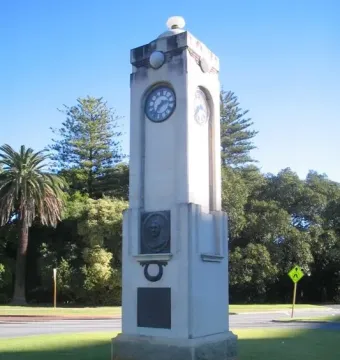
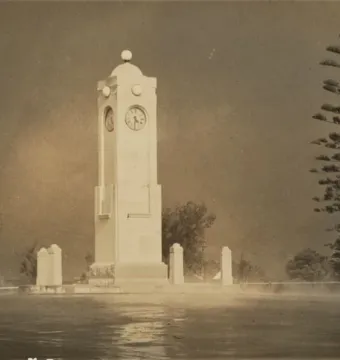
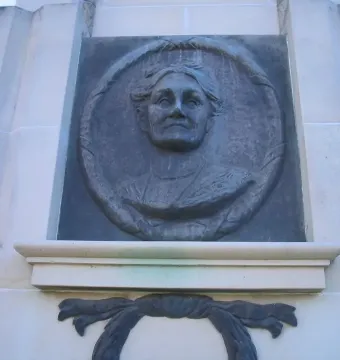
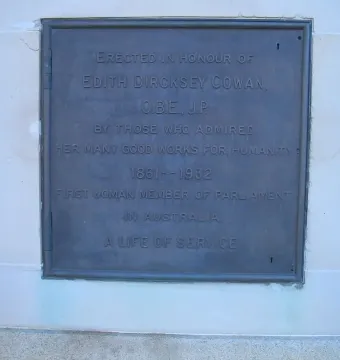
The Edith Dircksey Cowan Memorial, formerly known as the Edith Cowan Clock Memorial, stands at the entrance to Kings Park in Perth, Western Australia. It commemorates Edith Cowan (1861–1932), the first woman in Australia elected to parliament, in 1921. Cowan was a social reformer and an advocate for children’s and women’s rights, and her work made her widely known in Australia. The memorial is about 6 metres high and built from regional limestone in an Art Deco clock-tower style. It features a bronze plaque with Edith Cowan’s portrait, another plaque with text, and a clock on each side of the tower. It was unveiled by Lieutenant Governor James Mitchell on 9 June 1934.
© Moondyne · Public domain
© Unknown authorUnknown author · Public domain
May 2018 © JarrahTree · CC BY 2.5 au
© Moondyne · Public domain
© Moondyne · Public domain
Identification | |
| Title | Edith Dircksey Cowan Memorial |
| Former name | Edith Cowan Clock Memorial |
| Type | Memorial monument |
Historical context | |
| Purpose | Memorial to Edith Cowan |
| Honoree significance | First woman elected to a parliament in Australia, in 1921 |
| Honoree occupation | Social reformer, children's rights activist, and women's rights activist |
| Commemorated person | Edith Cowan (1861–1932) |
Creator | |
| Designers | Harold Boas and Henry Atwell |
| Designer roles | Harold Boas was a prominent Perth architect; Henry Atwell was city engineer |
| Sculptor of portrait | Margaret Johnson of Mount Hawthorn |
Discovery and provenance | |
| Design approval | Approved by the Edith Cowan Memorial Committee in February 1933 |
| Construction contractor | W. Ogilvy |
| Published design | A sketch of the design was published in The West Australian |
| Initial memorial proposals considered | Edith Cowan Ward at King Edward Memorial Hospital; a model baby health centre; an honour drive in Kings Park; a pathway in the Parliament House grounds; an archway at the entrance gates of Kings Park |
| Site approval | Approved by the Perth City Council in December 1932 |
| Original proposed location | Kings Park; a safety zone in the middle of Kings Park Circus was eventually selected |
| Planning committee | Edith Cowan Memorial Committee |
| Fundraising body | Edith Cowan Memorial Committee |
History and restoration | |
| Public controversy | Protests were lodged by the Kings Park Board, the Royal Institute of Architects, and the Town Planning Institute |
| Significance of refusal | The refusal of the proposed archway site was taken as implying that Edith Cowan was not considered a person of national significance |
| Interpretation | The debate has been viewed as representative of gender bias operating at the time |
| Historic significance | The memorial was the subject of public debate and protests, including objections that the site should be reserved for a memorial of national significance and arguments about whether a woman should be memorialised in such a form |
| Legal challenge | Town Planning Commissioner David Lomas Davidson sought an injunction against construction in the Supreme Court, but it was refused |
| Rededication date | 12 March 1996 |
| Later alterations to surroundings | After 1974 the traffic island was enlarged, the pylons were removed, and the platform was replaced by lawn |
| Rededication occasion | 75th anniversary of Cowan's election to parliament |
| Unveiling occasion | Second anniversary of Edith Cowan's death |
| Unveiled by | Lieutenant-Governor James Mitchell |
| Unveiling date | 9 June 1934 |
| Construction start date | May 1934 |
Physical characteristics | |
| Depicted person | Cowan |
| Features | Bronze plaque with Edith Cowan's full-face portrait, plaque with an inscription, and a working clock on each side of the tower |
| Bust design | A bust in relief with a wreath of gum leaves and nuts |
| Chosen form | Monument |
| Form | Clock tower |
| Height | About 6 meters; the fragment also notes that the exact measurement is not given |
| Location | Top of a hill on a traffic island at the junction of Kings Park Road, Malcolm Street and Fraser Avenue, immediately opposite the main entrance to Kings Park, Perth, Western Australia, Australia |
Materials | |
| Material | Regional limestone |
| Material | Donnybrook freestone |
Style | |
| Style | Interwar Art Deco |
Location and ownership | |
| Current location | Kings Park, Perth, Western Australia, Australia |
| Original location | Safety zone in the middle of Kings Park Circus, originally described as a raised circular platform surrounded by pylons |
| Current condition | Considered to be in good condition |
Significance | |
| Historical significance | First memorial erected in Australia for a female civilian |