
Font de Santa Eulàlia
Font de Santa Eulàlia is a sculptural monument located in Plaça del Pedró, in Barcelona’s El Raval district, within Ciutat Vella. Created in 1673, it is considered the oldest monument in the city. The original work was made by Benet Parés and Josep Darder. A few years later, the image of the saint was replaced by another by Llàtzer Tramulles and Lluís Bonifaç, which was destroyed in 1936. The current version, dating from 1951, is by Frederic Marès. The work is listed as a Local Cultural Asset (BCIL) in the Catalan Cultural Heritage Inventory under code 08019/523.
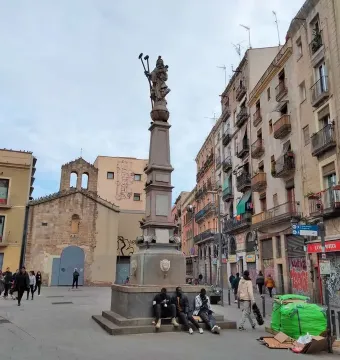
January 2024 © Enric · CC BY-SA 4.0
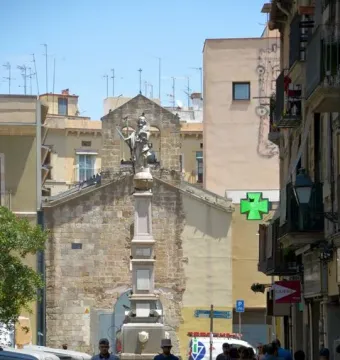
June 2023 © DimiTalen · CC0
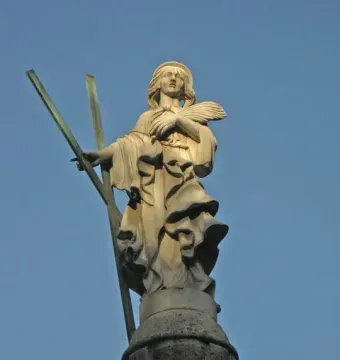
September 2011 © Enfo · CC BY-SA 3.0
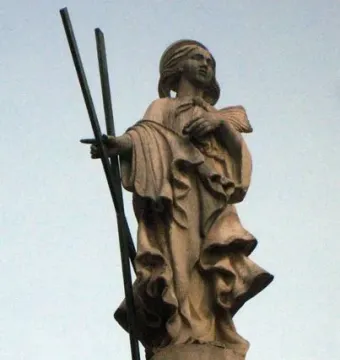
May 2013 © Enfo · CC BY-SA 3.0 es
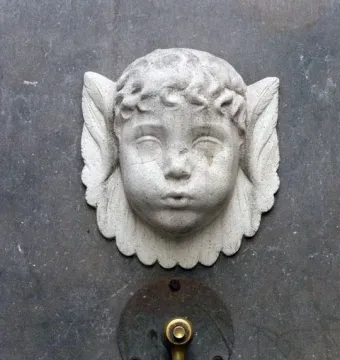
May 2013 © Enfo · CC BY-SA 3.0 es
Identification | |
| Title | Font de Santa Eulàlia |
| Subject | Saint Eulalia, patron saint of Barcelona |
| Alternative name | Santa Eulalia fountain |
| Type | Historic fountain; sculptural monument |
Historical context | |
| Construction date | 1673 |
| Commissioned by | The Council of One Hundred (Consell de Cent) |
| Commission year | 1670 |
| First stone laid | 14 September 1672 |
| Inauguration date | 29 November 1673 |
| Historical significance | Considered the oldest public monument in Barcelona still preserved in its original location |
| Legend associated with location | An ancient legend said Saint Eulalia was crucified naked at the site in the time of the prefect Dacian |
Creator | |
| Base maker | Miquel Colomer, with help from the mason Jaume Arnaudies and the silversmith Hilari Fornaguera |
| Protection grille maker | Josep Gamot |
| Current version artist | Frederic Marès |
| Definitive sculptor / builder | Benet Parés |
| Replacement statue artists | Llàtzer Tramulles and Lluís Bonifaç |
| Original model maker | Josep Darder |
| Original creators | Benet Parés and Josep Darder |
| Original sculptor of saint image | Josep Darder |
Discovery and provenance | |
| Original planned or earlier monument site | Plaça del Blat (now Plaça de l'Àngel) for the 1616 obelisk |
| Earlier monument on the same theme | A 1616 obelisk dedicated to Saint Eulalia by Rafael Plansó, topped by an angel by Felip Ros |
| Earlier monument fate | Demolished in 1823 because it obstructed traffic; the angel figure was placed in a niche on a building in the same square |
Physical characteristics | |
| Form | A pyramidal obelisk with several sections of varying diameter |
| Crowned by | An image of Saint Eulalia |
| Replacement statue description | A standing image of the saint with the attributes of her martyrdom: a palm and an X-shaped cross |
Materials | |
| Original crowning image maker | Josep Darder |
| First model material | Wood |
| Definitive material | White and black marble |
| Original crowning image material | Wood |
Location and ownership | |
| Location | Plaça del Pedró, Barcelona, in the El Raval neighborhood of the Ciutat Vella district |
| Country | Spain |
| Original monument location | Plaça del Blat (now Plaça de l'Àngel) for the earlier 1616 monument |
| Current position | Middle of Plaça del Pedró |
| Heritage designation | Listed as a Local Cultural Asset (BCIL) in the Catalan Cultural Heritage Inventory |
| Heritage inventory code | 08019/523 |
History and restoration | |
| Fate of the saint's head | Rescued by local residents during the war and later preserved in the Barcelona History Museum |
| Restoration by | Marta Polo |
| Restoration year | 1997 |
| Returned to original position | 1982, to the middle of Plaça del Pedró |
| New image after rebuilding | By Frederic Marès |
| Rebuilt | 1951 |
| Conversion into fountain | After the regime change, Governor-General Marqués de Campo Sagrado proposed turning the monument into a fountain; the adaptation was carried out by Josep Mas i Vila |
| What remained after destruction | Only the base remained, and it continued to function as a fountain |
| Destroyed | 19 July 1936, at the beginning of the Spanish Civil War |
| Plates added in 1826 | Four plaques on the sides of the base commemorating the martyrdom of the saint in 303, the laying of the first stone, the monument's inauguration, and its reconstruction date, plus another plaque on the plinth dedicated to Marqués de Campo Sagrado |
| Fountain inauguration date | 12 February 1826 |
| Attempted removal | In 1823 the Trienio Liberal city council intended to dismantle the monument, but popular opposition allowed only a small relocation to a corner of the square |
| Structural reinforcement | The obelisk supporting the statue had to be reinforced because it had been designed for the wooden image |
| Replacement statue completion year | 1687 |
Significance | |
| Status | Considered the oldest public monument in Barcelona |