
Tauzieher
Tauzieher is a limestone sculpture by Nikolaus Friedrich, erected in 1911 in Rheinauhafen, Cologne. It shows a muscular man hauling a heavy rope or hawser up to fasten it to a bollard, and stands 6.5 metres high. The work grew out of a male figure Friedrich exhibited in 1908 at the Cologne Artists’ Association show. Funded by public collection and city support, it was unveiled on 4 March 1911 as Cologne’s first free-standing public sculpture. In 1980, it was listed as a historical monument and later became the subject of Tatzu Nishi’s transformation Obdach (1997).
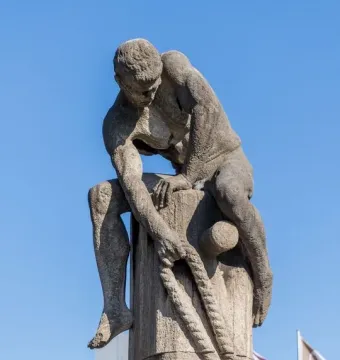
© Raimond Spekking · CC BY-SA 4.0
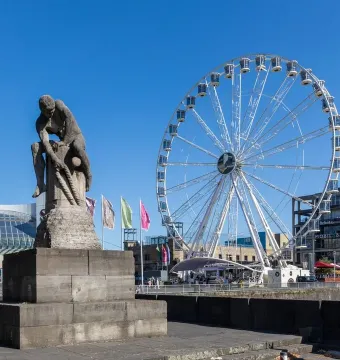
August 2026 © Raimond Spekking · CC BY-SA 4.0

May 2012 © Climey Amors · CC BY-SA 3.0
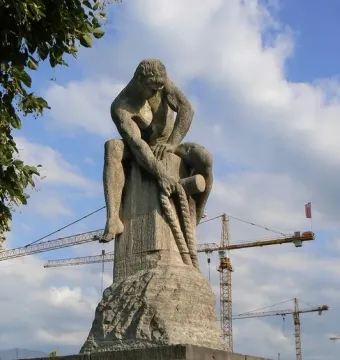
July 2007 © VollwertBIT · CC BY-SA 2.5
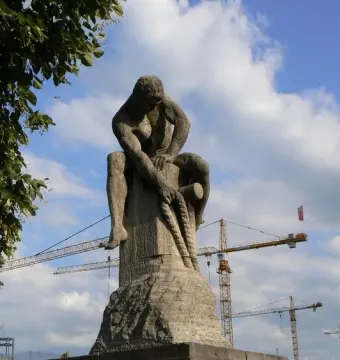
July 2007 © VollwertBIT · CC BY-SA 2.5
Identification | |
| Title | Tauzieher |
| Type | Freestanding sculpture in public space |
| Alternative title | Der Tauzieher |
Historical context | |
| Date created and installed | 1910–1911 |
Creator | |
| Artist | Nikolaus Friedrich |
| Artist nationality | German |
| Artist birthplace | Cologne |
| Artist residence at the time | Charlottenburg |
Discovery and provenance | |
| Installation site chosen | An open area at Holzmarkt in front of the new Cologne harbor, to the right of the swing bridge and at the foot of the Malakoff Tower |
| Scaffolding erection began | 21 September 1910 |
| City council approval date | 23 March 1910 |
| Unveiling date | 4 March 1911 |
| Funding | Raised by Cologne art lovers, with a municipal grant of 10,000 marks to cover the shortfall |
| Public response to original work | It received lively approval in art circles |
| Original size | About half the size of the later sculpture |
| Original exhibition | 1908 exhibition of the Association of Cologne Artists at the Cologne Flora |
| Commissioned enlargement | A greatly enlarged version was planned for a prominent place in Cologne |
Physical characteristics | |
| Height | About 6.5 metres |
| Base proportion | The base takes up a little more than half of the total height |
Materials | |
| Material | Limestone (Muschelkalk) |
| Other elements | Wooden bollard and rope/hawser |
Appearance | |
| Setting within the sculpture | The bollard emerges from unformed rock at its base |
| Stylistic comparison | Reminiscent of the Belvedere Torso in pose and modelling |
| Action depicted | Climbing onto a bollard and hauling up a rope to secure it |
| Pose details | Leaning forward, with his legs clamped around the bollard; right hand pulling the hawser and left hand gripping the bollard |
| Depicted figure | A nude, muscular, Herculean man |
Iconography and meaning | |
| Subject | A rope-puller making a heavy rope or hawser fast to a bollard |
| Symbolic meaning | Symbolizes the idea that anyone can earn prosperity through work |
Location and ownership | |
| Location | Rheinauhafen, Cologne, Germany |
History and restoration | |
| Heritage protection | Listed as monument no. 66 and protected as one of the first cultural monuments in Cologne on 1 July 1980, together with the nearby swing bridge and quay-wall railing |
| Later transformation | Subject of Tatzu Nishi's 1997 transformation Obdach |
Significance | |
| Historical significance | First freestanding sculpture in Cologne's public space |
Other | |
| Poem about the sculpture | An unknown author wrote a poem in September 1911 about the contradiction between the nude rope-puller and his symbolic message |