
Pfalzfeld Obelisk
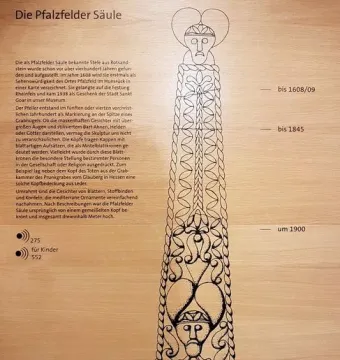
The Pfalzfeld obelisk is a Celtic carved sandstone monument from the La Tène culture, dated to the 4th or 5th century BC. Believed to have been a funerary monument from nearby burial grounds, it was not originally located in Pfalzfeld, though it was there by the early 17th century. The stone has been moved several times over the centuries and suffered damage through weathering and relocation. Historical drawings record its changing condition and height. In 1938, it was gifted to the Rheinisches Landesmuseum Bonn, where it remains today. The obelisk is also featured on the coat of arms of the municipality of Pfalzfeld.
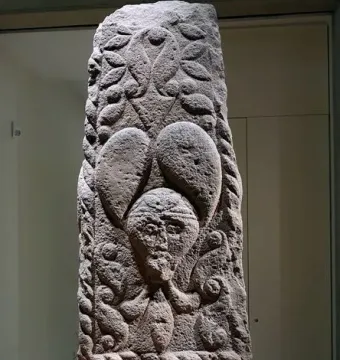
May 2018 © Kleon3 · CC BY-SA 4.0
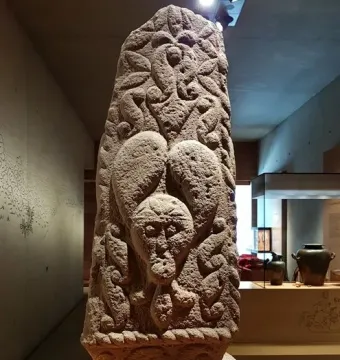
May 2018 © Kleon3 · CC BY-SA 4.0
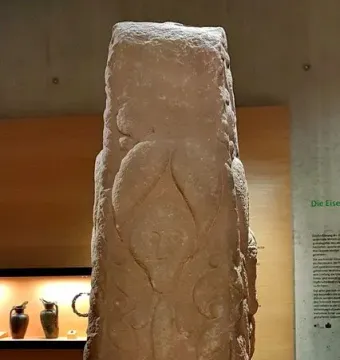
May 2018 © Kleon3 · CC BY-SA 4.0
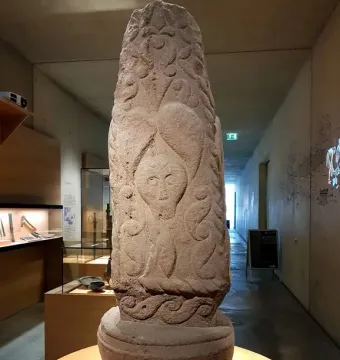
May 2018 © Kleon3 · CC BY-SA 4.0
May 2018 © Kleon3 · CC BY-SA 4.0
Identification | |
| Title | Pfalzfeld obelisk |
| German names | Pfalzfelder Säule; Flammensäule; Pfalzfelder Steinstele; Pfalzfelder Stele |
| Type | obelisk-shaped stele |
Historical context | |
| Period | Iron Age La Tène culture |
| Date | 4th or 5th century BC |
| Probable function | funerary monument |
| Probable original context | probably a cult column on a burial mound, or from one of the nearby burial grounds; exact original association can no longer be determined |
| Historical interpretation | 18th-century antiquarians apparently thought it was a Roman tombstone |
| Culture | Celtic |
Creator | |
| Discovery / first documentation | First drawn by Wilhelm Dilich on a 1608/09 map of the Rheinfels district |
Discovery and provenance | |
| Probable origin | possibly the Odenwald, if the Pfalzfeld heads and the fragmentary sandstone head from Heidelberg came from the same workshop |
| Workshop connection | a shared workshop with the Heidelberg sandstone head has been suggested, but no workshop-level investigation has yet been carried out |
| Comparative find | stylistically and materially similar to a fragmentary sandstone head from Heidelberg |
| Alternative origin hypothesis | possibly from one of the burial grounds near Pfalzfeld in the early Hunsrück-Eifel cultural area |
| Original location | unknown |
| Later movements | moved to St Goar in 1737; to Koblenz in 1805; to the border of St Goar and Pfalzfeld in 1807; to the cemetery of St Goar in 1845; to a room in Rheinfels Castle in 1932; gifted to the Rheinisches Landesmuseum Bonn in 1938 |
| Excavations | futile excavations were carried out in 1737 in search of the tomb |
| Rediscovery | about forty years later, found by the Hessian official Winkelmann during an inspection of the overgrown churchyard of Pfalzfeld |
| Former location | churchyard of Pfalzfeld |
| Find spot | Pfalzfeld (Hunsrück) |
Physical characteristics | |
| Shape | four-sided, rectangular, slender, and tapering, with an overturned dome-shaped base |
| Dimensions | broken tip diameter 55.8 cm; dome base diameter about 40 cm |
| Original height | probably about 3.5 m; one estimate gives up to 2.80 m from the base and 3.50 m overall |
| Surviving part | Only the lower part survives |
| Height | 1.48 m |
Materials | |
| Material | brown-violet quartz sandstone |
| Probable stone source | Saar-Nahe Basin |
Technique | |
| Carving | carved sandstone block |
Appearance | |
| Decoration | all four sides are decorated with a similar basic pattern, with slight differences in execution and orientation |
| Borders | rope-like, diagonally notched borders; rope moulding (seilstab) |
| Motifs | mask-like human heads with large eyes, moustache, nose, eyes without pupils, a narrow headband, and no visible mouth; triple-leaf/three-leaf designs beneath the heads; S-shaped swirls; downwards-facing palmettes |
| Headgear | Celtic leaf-crown of two asymmetrical teardrop-shaped leaves or two bladder-shaped parts, possibly mistletoe leaves |
| Forehead detail | triple leaf, eyebrows, horizontal band, and lotus motif |
| Interpretation of lower design | variously interpreted as beard, tasselled torc, or plinth supporting a severed head |
Iconography and meaning | |
| Mistletoe meaning | sacred mistletoe was believed to heal illness, remedy infertility, and strengthen life and growth |
| Stylistic connections | connections have been proposed to North Italian/Etruscan art; rope borders resemble those on contemporary Etruscan cippi; the work is stylistically close to the Glauberg statue(s), the Glauberg prince, and a Late La Tène stone head from Heidelberg; the mouthless-face feature is also compared with the Entremont head pillar |
| Alternative interpretation | possibly a phallic symbol; the dome base has been read as the glans |
| Symbolism | the head motif has been linked to Celtic ideas of the head as the center of being and to the cult of the severed head; the work has also been read as apotropaic and protective for a socially high-ranking deceased |
| Possible original crown | it may originally have been crowned with a human head, possibly resembling the Janus-faced Heidelberg head |
Location and ownership | |
| Current location | Rheinisches Landesmuseum Bonn |
| Current status | still held there |
| Displayed on | the coat of arms of the municipality of Pfalzfeld |
History and restoration | |
| Condition and damage | the stone appears to have suffered significant damage in the latter half of the 19th century from weathering and frequent relocation, including the loss of part of the base |
| Documentation history | drawn in 1608/09, again in 1739, and mentioned in a drawing from about 1845; the first drawing was described as astonishingly careful |
| Reconstruction and copies | a cast of the original column stands in the village center of Pfalzfeld on Backesplatz, and a hypothetical reconstruction in presumed original form was installed in 2008 at the Celtic experience and memorial site near the old railway station |
Significance | |
| Art historical significance | one of the most important examples of Early Celtic art |
| Stylistic features | braid, spiral, mask, and S-shaped curl motifs; an obelisk shape rare among known Celtic stone monuments |
| Interpretive notes | the design has been read as showing limited influence from Mediterranean developments, although Etruscan influence has been proposed |
| Related scholarship | Anne Ross argued for influence from Etruscan phallic tombstones; Ian Armit discussed the phallic interpretation in relation to fertility and renewal |