
Orpheus’ Well
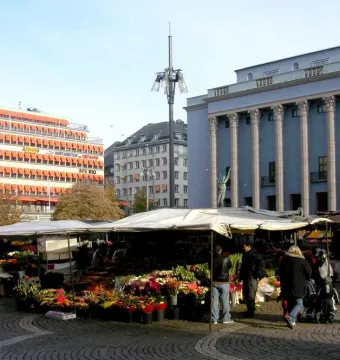
Orpheus’ Well, also known as Orpheusgruppen or Orfeusbrunnen, is a fountain with an elaborate sculptural group in Stockholm, Sweden. It is located in the northeastern part of Hötorget, by the steps of the Concert Hall. The work was designed by Swedish sculptor Carl Milles and completed in 1936. It was unveiled by the artist himself. The figures were cast by Herman Bergmans Konstgjuteri, as were many of Milles’ other works. At the center of the fountain stands Orpheus playing the lyre, rising above eight other figures moving to the rhythm of divine music.
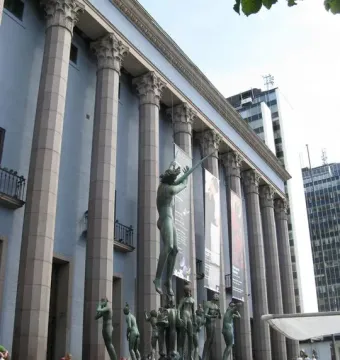
August 2010 © Yair Haklai · CC BY-SA 3.0
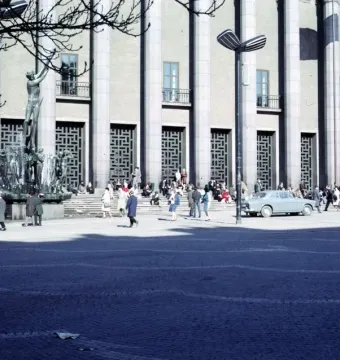
1965 © Andy Eick · CC BY 2.0
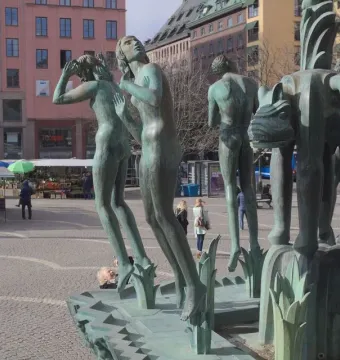
© One Trick Pony · CC BY-SA 2.0
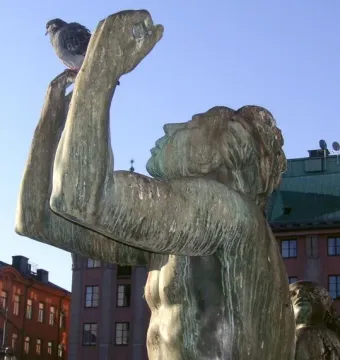
2008 © Holger.Ellgaard · CC BY-SA 3.0
October 2007 © Holger Ellgaard · CC BY-SA 3.0
Identification | |
| Title | Orfeusgruppen |
| Type | Fountain with an elaborate sculptural group |
| Source title language | Swedish |
| Alternative names | Orfeusbrunnen; Orfeus-Gruppe; Orpheus' well; "Musiken" ("Music") |
Historical context | |
| Pedestal description | The pedestal was mockingly said to resemble a bunch of bananas or an artichoke |
| Approval date | 1935 |
| Approval margin | One-vote majority; the decisive vote was cast accidentally for Milles |
| Initial design | A lone, extremely slender youth of colossal size standing on a pedestal |
| Development history | The sculpture had a long and problematic history and the final result differed significantly from the proposal submitted in 1925 |
| Competition year | 1925 |
Creator | |
| Designer / artist | Carl Milles |
| Designer nationality | Swedish |
| Architect of concert hall | Ivar Tengbom |
Discovery and provenance | |
| Competition result | Milles' proposal was chosen by the prize jury |
| Unveiling | Unveiled by the artist himself |
| Foundry | Herman Bergmans Konstgjuteri |
Physical characteristics | |
| Specific figure detail | One male figure raises his hands desperately toward the sky |
| Portrait feature | The desperate male figure has the facial features of Beethoven |
| Central figure | Orpheus playing the lyre |
| Composition | Orpheus rises above eight other figures moving in rhythm to divine music |
| Surrounding figures | Eight male and female figures |
Iconography and meaning | |
| Theme | Divine music |
| Depicted figure | Orpheus |
| Mythological context | Orpheus was the most famous singer in Greek mythology |
| Interpretation | Orpheus represents the art of music |
| Interpretation | The nine figures were interpreted as a sculptural counterpart to Beethoven's Symphony No. 9 |
| Beethoven symbolism | For Milles, Beethoven symbolized the great, suffering genius of the artist, which he himself wanted to be |
Location and ownership | |
| Current location | Northeastern part of Hötorget, by the stairs of the Konserthuset, Stockholm, Sweden |
| Intended location | The new Stockholm Concert Hall (Konserthuset), Stockholm, Sweden |
| Architectural integration | Milles worked carefully to adapt the Orpheus group architecturally to the concert hall behind it |
History and restoration | |
| Artist's reaction | Milles was very delighted by the Beethoven interpretation |
| Collaboration | Tengbom and Milles later had several joint projects |