
Kykladic Idol
Kykladic Idol is a marble sculpture from the Bronze Age Cycladic culture. The female idol, with folded arms, belongs to the early Spedos type and is dated to between the 27th and 24th centuries BCE (FK II). Its findspot is unknown. The figure was acquired by the Badisches Landesmuseum in Karlsruhe in 1975 after coming from an illegal excavation, and was returned to Greece on 6 June 2014 at the Archaeological National Museum in Athens. It is associated with inventory number Π29034 at the Archaeological National Museum in Athens, and was formerly in Karlsruhe under inventory number 75/49.
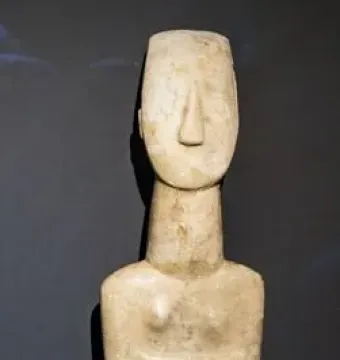
October 2024 © ArchaiOptix · CC BY-SA 4.0
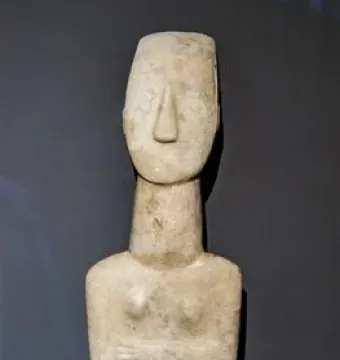
October 2024 © ArchaiOptix · CC BY-SA 4.0
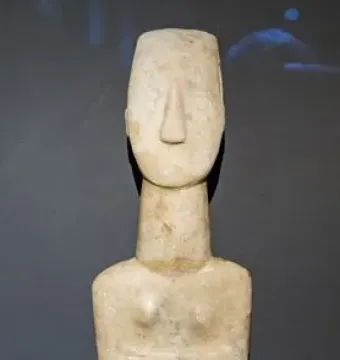
October 2024 © ArchaiOptix · CC BY-SA 4.0
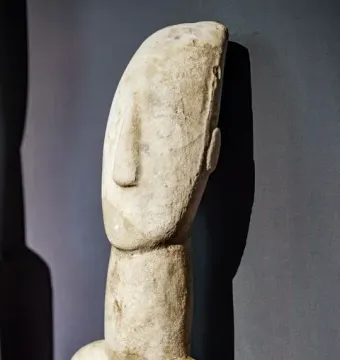
January 2025 © ArchaiOptix · CC BY-SA 4.0
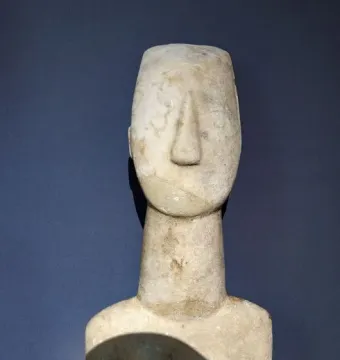
January 2025 © ArchaiOptix · CC BY-SA 4.0
Identification | |
| Title | Female Idol with Folded Arms |
| Alternative title | Kykladenidol |
| Object type | Cycladic idol |
| Alternative title | Idole féminine aux bras croisés |
Historical context | |
| Culture | Cycladic culture |
| Period | Bronze Age |
| Date | 27th to 24th century BCE (FK II) |
| Typology | Early Spedos type |
| Alternative typology attribution | Primitive Spedos-B type |
Creator | |
| Scholarly note | This method of assigning idols to individual makers is considered controversial |
| Attribution basis | Lower-set right ear, especially in comparison with the left ear |
| Attribution | Attributed by Pat Getz-Preziosi / Pat Getz-Gentle to the Woodner sculptor |
Discovery and provenance | |
| Acquisition price | 300,000 Swiss francs |
| Transferred with | Cycladic frying pan (NAMA Π20935) |
| Transferred by | Jürgen Walter and Harald Siebenmorgen |
| Returned to | National Archaeological Museum of Athens |
| Return date | 6 June 2014 |
| Purchase by museum | A few months after the loan |
| Purchase purpose | In anticipation of the 1976 exhibition Kunst der Kykladen |
| First received by museum | January 1975, initially as a loan |
| Last private owner | Nicolas Koutoulakis |
| Acquisition date | 1975 |
| Acquired by museum | Badisches Landesmuseum, Karlsruhe |
| Provenance context | Getz-Preziosi suggested the three idols attributed to the Woodner sculptor may originally have come from the Kavos deposit and were later dispersed by looters or through the art market |
| Proposed provenance | Kavos deposit on Keros, according to Pat Getz-Preziosi / Pat Getz-Gentle |
| Proposed provenance | Probably Amorgos, according to Jürgen Thimme |
| Reported provenance | Naxos, according to art dealer Nicolas Koutoulakis |
| Findspot | Unknown; proposed origins include Naxos, Amorgos, and the Kavos deposit on Keros |
| Provenance | Looted object; came from an illegal excavation and was illegally exported from Greece |
Physical characteristics | |
| Damage | Broken at the upper and lower neck and at the knees |
| Condition | Very well preserved, with only the left foot missing |
| Breasts | Small and high-set |
| Ears | Plastically modeled ears |
| Nose | Slanted, flat nose that broadens considerably downward |
| Head shape | Flat head projecting backward; oval face narrows slightly upward and ends almost angularly |
| Pubic triangle | Not incised or sculpted |
| Legs | Separated by a deep gap, with the material fully broken through only in the lower legs |
| Thigh marking | Incisions mark the boundary between the thighs and the lower abdomen |
| Forearms and hands | Fully three-dimensional with a small space between them |
| Arms position | Arms crossed over the chest, left forearm over the right |
| Modeling | Almost two-dimensional due to the very shallow profile |
| Proportions | Very slender; shoulder width to body length ratio about 20%, compared with a preferred ratio of about 25% in other idols |
| Maximum depth | 6 cm |
| Width | 17.8 cm |
| Height | 88.8 cm |
History and restoration | |
| Weathering | Weathering is more pronounced on the left side of the body; the original finely smoothed surface is preserved in places |
| Restoration | A broken-off part on the right side of the chin was restored after discovery |
Materials | |
| Material | Marble |
| Probable marble source | Probably Naxos |
Technique | |
| Original coloration | Originally painted |
| Pigment traces | Visible remains in the pubic region indicate blue paint |
| Ghost traces | A former paint layer left lightly raised traces of polychromy where it protected the surface from weathering |
| Ghost trace interpretation | These traces indicate formerly painted dark hair or a headdress, and the left eye and eyebrow appear in relief |
Appearance | |
| Rarity of ears | Plastically worked ears are very rare; only six large idols with ears are known |
| Chronological hypothesis | Getz-Preziosi considered the Karlsruhe idol to have been created in the middle of the three attributed works |
| Rarity of ear-height asymmetry | The difference in ear height occurs only in these three figures |
| Type of figure | Female idol with crossed arms |
| Comparative works | The Woodner specimen, now in the Harmon collection, and inventory no. 724 at the Museum of Cycladic Art in Athens |
| Relative ranking among attributed group | The three idols attributed to the Woodner sculptor rank 2nd, 5th, and 6th among known idols |
| Size significance | Very large; in 2014 it was the fifth largest completely preserved Cycladic idol |
| Figure depicted | Female nude figure |
Significance | |
| Function / meaning | Unknown |
| Burial context | Most known provenanced Cycladic idols come from graves, and some were ritually deposited in caches |
| Rarity in graves | Idols are rare and appear in only a fraction of graves |
| Burial association | No evidence from other grave goods that idols were given only to men, women, people of high status, or any other identifiable group |
Location and ownership | |
| Current location | National Archaeological Museum of Athens |
| Former location | Badisches Landesmuseum, Karlsruhe |
| Former inventory number | 75/49 |
| Current inventory number | Π29034 |
| Exhibition history | Shown in the 1976 exhibition Kunst der Kykladen and the 2011 exhibition Kykladen - Lebenswelten einer frühgriechischen Kultur; later integrated into the permanent exhibition of the Badisches Landesmuseum before transfer to Athens |
| Exhibition significance | A highlight of the 1976 exhibition because of its exceptional size; central work in the 2011 exhibition |
| Public response | The exhibitions prompted Greek objections concerning clandestine excavations, antiquities trafficking, and illicit trade in cultural property |