
Statue of Victor Schœlcher
The Statue of Victor Schœlcher is a bronze sculpted group by Louis-Ernest Barrias honoring Victor Schœlcher for his role in the second abolition of slavery in France. It was inaugurated the following year in Cayenne, in French Guiana, then a French colony and now an overseas department. The sculpture depicts Schœlcher accompanied by a newly freed enslaved man. Protected as a historic monument, it was later criticized for its paternalistic aesthetic and for obscuring the role of enslaved people in the abolition. It was first symbolically covered during the social movement of 2017, then vandalized and pulled down in 2020 amid debates over Covid-19 management, George Floyd’s killing, and efforts to decolonize public space.
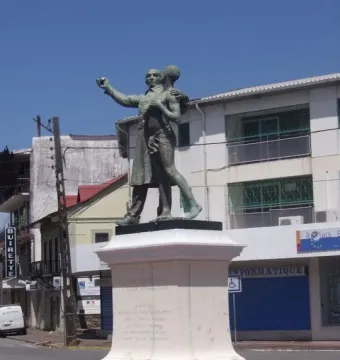
December 2011 © GuillaumeG · CC BY-SA 3.0
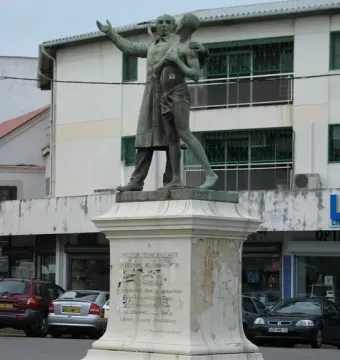
© Raybx973 · Public domain
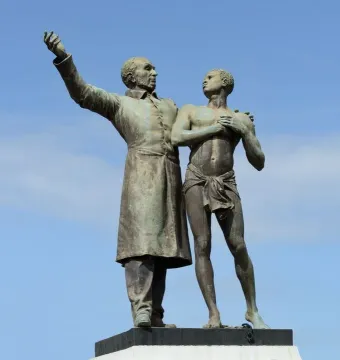
March 2013 © Cayambe · CC BY-SA 3.0
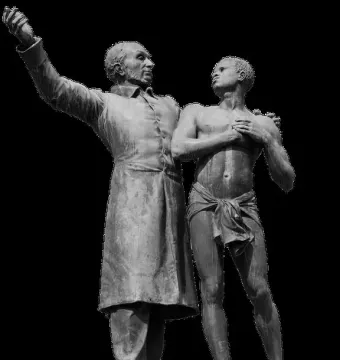
January 2025 © Cayambe · CC BY-SA 3.0
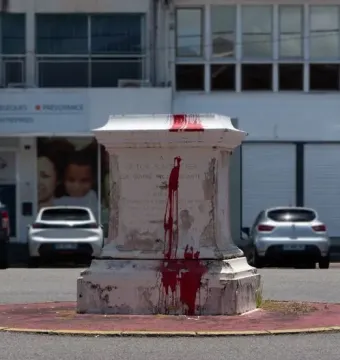
September 2022 © Don-vip · CC BY-SA 4.0
Identification | |
| Title | Statue of Victor Schœlcher |
| Type | Bronze statue |
Creator | |
| Artist | Louis-Ernest Barrias |
| Other artist mentioned | Anatole Marquet de Vasselot |
Historical context | |
| Date sculpted | 1896 |
| Date dedicated | 1897 |
| Inauguration place | Cayenne, French Guiana |
| Inauguration context | Then a colony of France |
| Historical context | Commissioned after Victor Schœlcher died in 1893 by a group formed in Paris and in the colonies in 1894 to raise a monument in his memory |
| First abolition context | Slavery was first abolished in 1794, reinstated in 1802 by Bonaparte, and definitively abolished in 1848 |
Discovery and provenance | |
| Commissioned to | Louis-Ernest Barrias |
| Casting | Bronze cast in 1895 from a plaster model |
| Original model | Plaster model; the original plaster is displayed at the municipal museum in Bourbon-Lancy, Saône-et-Loire, in the church of Saint-Nazaire |
Physical characteristics | |
| Attributes | Broken chains at the enslaved man's feet |
| Clothing | Schœlcher wears a frock coat; the enslaved man wears a simple loincloth (calimbé) |
| Depicted figures | Victor Schœlcher and a newly freed enslaved man |
| Pose and composition | The two figures stand side by side; Schœlcher extends his right arm toward the horizon and places his left arm around the enslaved man's shoulders |
| Number of figures | Two |
Materials | |
| Material | Bronze |
Appearance | |
| Depicted enslaved man | A young Black man |
| Expression and gesture | He holds his hands together on his heart and looks at Schœlcher with admiration and gratitude |
| Symbolic meaning | Schœlcher’s gesture is presented as guiding the freed man toward freedom and a better future; the broken chains symbolize regained freedom |
Iconography and meaning | |
| Commemorates | Victor Schœlcher's leading role in the abolition of slavery in 1848 |
| Purpose | To commemorate the memory of Victor Schœlcher, especially because he presided over the commission for the abolition of slavery |
| Subject matter | A monument to the abolition of slavery and Schœlcher's role in it |
| Reason for commemoration in Guyana | Although his links with Guyana were weak, the statue honors him for his role in abolition |
| Associated historical event | The decree abolishing slavery, which arrived in Guyana and was promulgated there by Governor André-Aimé Pariset |
| Quoted inscription source | The pedestal inscription is said to quote the conclusion of the report submitted by the commission for the abolition of slavery, chaired by Schœlcher, to Minister of the Navy and Colonies François Arago |
Location and ownership | |
| Current status | No longer visible in the square; only the pedestal remains there |
| Storage location | Stored in a warehouse of the city's technical services |
| Original location | Center of Place Victor-Schœlcher in Cayenne, French Guiana |
| Historical site context | The square was strategic because it long hosted the Hôtel de la Banque de Guyane and lay on the route between the Old Port of Cayenne and the city center |
| Square address | At the intersection of rue Louis-Blanc, rue du Docteur-Sainte-Rose, and rue des Peuples-autochtones (formerly rue Christophe-Colomb) |
| Former square name | Place Victor-Hugo |
History and restoration | |
| Heritage review | In 1998, its protection file was examined by the Regional Commission for Historical, Archaeological and Ethnological Heritage (Corephae) on the occasion of the bicentenary of the first abolition of slavery in 1794 |
| Street renaming | Christophe-Colomb Street was renamed Peuples-autochtones Street in 2021 to honor the Amerindian peoples of Guyana and because of the harms caused by Columbus's exploration of America |
| Later replacement | In 2022, a statue representing the peoples of Guyana was temporarily installed at the former location of Schœlcher's statue by the Movement for Decolonization and Social Emancipation (MDES) |
| Public use of site | The square was used for Bastille Day celebrations on 14 July and for the abolition of slavery on 10 June |
| Pre-removal significance | For a long time it was the only monument in Guyana dedicated to the memory of slavery |
| Heritage status | Classified as a historic monument in 1999; the statue and its pedestal were first listed by decree of 27 July 1999 and then classified by decree of 24 September 1999 |
| Post-removal storage | Stored in a city warehouse to protect the work and for the needs of the investigation |
| Damage in 2020 | Covered with red paint; a syringe was placed in Schœlcher's right hand; what appeared to be a torn heart was placed at the feet of the freed slave |
| Further vandalism | In 2018, black and red shirts were placed on the heads of the two figures: a black one on Schœlcher and a red one on the freed slave |
| Condition before removal | Vandalized before being toppled; earlier covered on the margins of the 2019 social movement and in 2017 covered with a hood |
| Removal context | Toppled in the night of 22 to 23 October 2020 amid contested COVID-19 management, reactions to George Floyd's murder, and a desire to decolonize public space |
| Removal date | 2020 |
Criticism | |
| Critical reception | Criticized for paternalism and for obscuring the role of free and enslaved Black people in the abolition movement |
| Art-historical interpretation | The statue is often reproached for presenting a particular representation of the abolition of slavery |
| Historical interpretation | Seen as linked to the French colonial civilizing mission and the expansion of the colonial context; the sculpture presents Schœlcher as the sole architect of abolition |
| Symbolic interpretation | The enslaved body is used to celebrate Schœlcher's philanthropy and, by extension, that of white people |
| Interpretive criticism | This aesthetic reinforces criticism aimed at abolitionist supporters who are accused of being paternalistic despite their abolitionism |
Other | |
| Art-historical note | Marcus Wood emphasized the youthful beauty and sensuality of the enslaved man in contrast to Schœlcher's virility, seeing an homoerotic charge |
| Reference in literature | Mentioned by Jean Hess in À l'Île du Diable and by Albert Londres in Au bagne; some authors think Frantz Fanon may have been referring to it in Peau noire, masques blancs, though it may instead be the Schœlcher statue by Vasselot in Fort-de-France |
| Measurements | Height, width, and depth are not specified in the fragment |